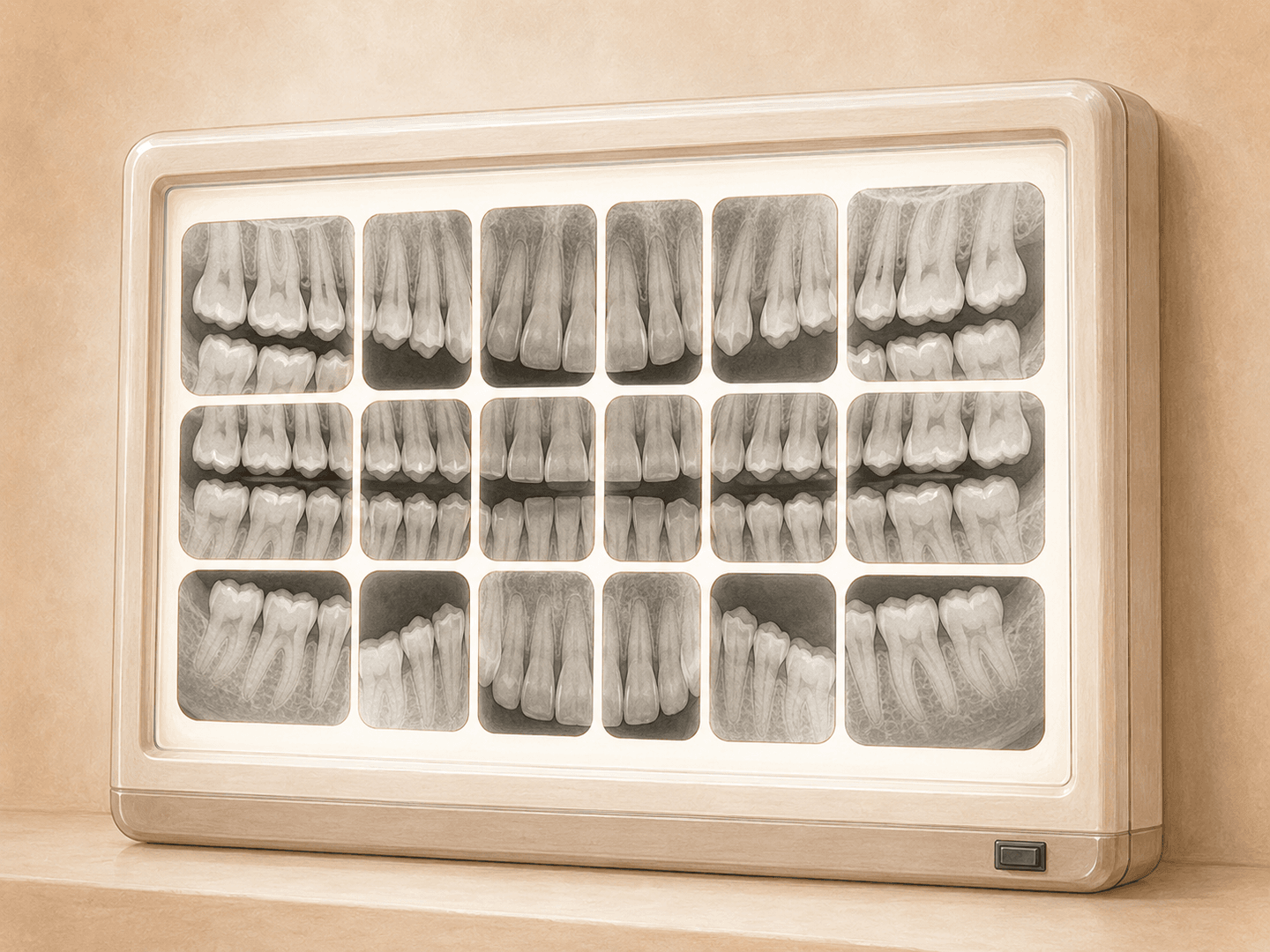
D0210 is the CDT code for a full-mouth X-ray series, or FMX, showing every tooth and the surrounding bone.
- When to use: The intraoral set shows the crowns, roots, and bone of every tooth, whatever the image count, often as a new patient's baseline.
- When not to use: A pano is D0330, standalone bitewings are D0270 to D0274, and a few selected periapicals are D0220 plus D0230.
- Billing note: Most plans pay one FMX every three to five years and count a pano against it, so check claim history for D0210 and D0330.
What D0210 covers
D0210 reports a comprehensive intraoral radiographic series. The “comprehensive series” generally means enough films to show every tooth and the surrounding bone, typically a combination of periapical images and bitewings. The exact film count is not specified by the code itself. Carriers expect a clinically reasonable set that documents the full dentition.
It does not cover:
- A single panoramic image. That’s D0330.
- Standalone bitewings. Those are D0270 (single), D0272 (two), D0273 (three), or D0274 (four).
- A single periapical. That’s D0220 (first image) and D0230 (each additional).
- 3D cone beam imaging. Those are D0364 through D0368, or the capture-only codes D0380 through D0384 when an outside practitioner reads the scan. The CBCT billing guide covers the family.
If the practice took a pano and a few periapicals, the correct code is generally D0330 plus the periapical codes, not D0210.
When to bill D0210
Bill D0210 when:
- A new patient presents and a full diagnostic set is clinically warranted.
- An established patient is past the carrier’s FMX frequency window and clinical conditions justify new imaging.
- The patient’s last FMX is too old to support current treatment planning.
Do not bill D0210 for:
- A panoramic-only image. Use D0330.
- A small set of periapicals taken to investigate a single area. Use the D0220/D0230 series.
- Routine recall bitewings on a patient with a recent FMX. Use D0274.
Top reasons D0210 gets denied
- Frequency. The most common issue. The patient had an FMX or a panoramic within the plan’s lookback window (often three to five years), and the new claim hits the cap.
- Pano counts against FMX. Many plans treat D0210 and D0330 as alternates. A recent D0330 blocks a new D0210.
- Bitewings counted toward the series. Some plans count recent D0274 toward the FMX, so a full series taken at the next recall denies.
- No transfer of records noted. A patient new to the practice with imaging from a prior provider can still hit the carrier’s frequency cap. The carrier reads its own claim history, not the chart.
- Image attachments missing. When the FMX is taken to support a downstream procedure (a crown, an endo, a surgical extraction), the carrier expects to see the films attached to the procedure claim.
Documentation that supports the claim
The claim needs:
- Date of service matching the date the films were taken.
- Confirmation the films were taken and stored (not just prescribed).
- Image attachments when the FMX supports a same-day or downstream procedure claim.
For the patient record, document:
- The clinical reason for the new series (new patient, expired imaging, specific diagnostic question).
- Findings reviewed on the films.
- Any treatment planning that depended on the imaging.
A blank chart entry that says “FMX taken” is thin. The chart should reflect that the films were read, not just exposed.
D0210 versus D0330
The two films answer different diagnostic questions. D0210 captures every tooth with full periapical detail of the roots and surrounding bone, plus interproximal coverage from the bitewings. D0330 captures the entire upper and lower arch in a single image, including the condyles and sinuses, at the cost of detail at any individual tooth.
Clinically:
- D0210 fits cases that need detailed assessment of individual teeth, root anatomy, periapical pathology, or restoration margins. New-patient diagnostic series and pre-prosthetic planning usually fall here.
- D0330 fits cases that need a broad survey of the jaw: mixed dentition in pediatric patients, third-molar evaluation, TMJ structures, or post-trauma screening. Surgical consults often start with a pano.
For billing, most plans treat D0210 and D0330 as alternates for frequency, not as additive procedures. A patient with a recent D0330 will typically hit the cap when D0210 is billed, and vice versa. A pano paired with a few periapicals on the same date is generally not D0210. Code D0330 plus the periapicals individually (D0220 for the first image and D0230 for each additional).
If the clinical case genuinely needs both a pano and a full series on the same date, expect the carrier to pay one and deny or downgrade the other. A narrative explaining the clinical reason for both helps but does not override the plan’s frequency design.
When individual films add up to a full series
What the images show decides the code, whatever the office calls the procedure. The ADA’s guide to the comprehensive series codes gives three examples. Twenty-two images on a full adult dentition that show every crown, root, periapical area, interproximal area, and the bone is D0210. Fifteen images on a patient with many missing teeth, covering the remaining teeth and every edentulous ridge, is also D0210. Ten periapicals on a full dentition that leave teeth or bone unimaged is not a full series. That set is billed as D0220 once plus D0230 with a quantity of 9.
A panoramic image is never part of a D0210, according to the same ADA guide, because the receptor sits outside the mouth and D0210 is an intraoral code. A pano plus bitewings is billed as D0330 and the bitewing code, even when the dentist uses the two together the way they would use a full series. Hawaii Dental Service’s 2023 procedure code guidelines say the same thing from the payer side: a pano, or a pano with periapicals or bitewings, should not be submitted as D0210.
Carriers then apply their own payment rule to individually coded films, and it catches offices that coded correctly.
- Delta Dental of North Carolina’s 2026 dentist handbook treats individually listed intraoral images taken by the same office on the same date as a full series when their combined fees equal or exceed the fee for D0210. The pano is left out of that sum. The allowance stops at the D0210 fee, and the excess is not billable to the patient.
- Delta Dental of New Jersey limits any combination of same-claim intraoral images to the full series fee, handles a pano submitted with supplemental images the same way, and asks for a narrative when a claim carries eight or more intraoral images or a pano with supplemental bitewings or periapicals.
- Hawaii Dental Service’s 2023 procedure code guidelines process any same-date combination of intraoral images and a pano as a full series when the combined fees reach the D0210 fee, with the plan’s frequency limits applied.
The frequency rule is the part that costs the patient. On plans that apply the full-series frequency to a converted set of films, a new patient’s four bitewings and a handful of periapicals can use up the benefit and block the FMX the dentist wanted to take next year. Delta Dental of North Carolina’s handbook handles vertical bitewings the same way: when D0277 costs as much as a full series, it counts as one for payment, benefit, and frequency.
Bitewings taken soon after a full series are a related problem. Delta Dental of North Carolina’s handbook does not let the same office bill the patient for bitewings within six months of a D0210, and denies them outright when a different office takes them.
Example case
A new patient transfers to the practice and brings no prior imaging. The dentist orders a full series at the first visit. The hygienist takes 14 periapicals and four bitewings. The dentist reviews the images, notes restorations on every quadrant, identifies a periapical lesion on tooth #19, and adds an endo consult to the treatment plan.
Billing steps:
- Verify the patient’s plan has not paid a D0210 or D0330 inside the frequency window.
- Code D0210 on the same claim as the comprehensive exam (D0150).
- Attach the films if the downstream endo claim will reference them, or note them in the patient record for later attachment.
- Watch for a denial on frequency. If the patient had a recent FMX at the prior practice that the new carrier is aware of, the claim will pend or deny even though the new practice has no images on file.
What to get right in your PMS
The menus and field names vary by system. The steps that matter are the same:
- Check the patient’s claim history before scheduling the FMX. The carrier reads its own data, not your chart. A recent D0210 or D0330 from a prior provider will deny the new claim.
- Attach the images to the procedure claim, not just the patient record. Many systems store images at the patient level by default. The clearinghouse needs them linked to the specific claim line.
- Confirm the procedure date matches the exposure date. Some practices generate the claim on a different day than the films were taken. The carrier uses the date of service on the claim.
- Don’t double-bill bitewings. The D0210 series typically includes them. A separate D0274 on the same date pays nothing and can flag the account.
- Use D0330 when only a pano was taken. Coding a panoramic-only visit as D0210 is a common upcode that draws audits.
FAQs
- What is the dental code for an FMX?
- D0210. The full-mouth series, often called an FMX, is a complete set of intraoral periapical and bitewing films that image every tooth and the surrounding bone. Most plans pay one D0210 every three to five years and treat a single panoramic film (D0330) as an alternate for frequency, so a recent pano can block a new FMX claim.
- How often will a plan pay for D0210?
- Most plans pay one D0210 every three to five years. The exact interval is plan-specific and counts from the date of the last D0210 or D0330, not just D0210. Verify the frequency before scheduling a new FMX, especially on transfer patients with imaging history from another office.
- What's the difference between D0210 and D0330?
- D0210 is a complete series of periapical and bitewing films taken at the chair. D0330 is a single panoramic image. They serve different diagnostic purposes but most plans treat them as alternates for frequency, so a recent D0330 will block a D0210 claim and vice versa.
- Can I bill D0210 with D0274 the same day?
- Usually no. The D0210 series typically already includes bitewings. Billing D0274 on top of D0210 generally pays nothing on the second line and may trigger an audit flag. If the practice took standalone bitewings instead of a full series, code D0274 by itself.
- How many periapicals make an FMX?
- There is no set number. The ADA removed the old 14 to 22 image language from the D0210 descriptor, and its guide on the comprehensive series codes says the dentist decides the type and number of images. The test is coverage: the set has to show the crowns and roots of every tooth, the periapical areas, the interproximal areas, and the bone, including edentulous areas. The ADA's own example of 10 periapicals on a full adult dentition does not qualify, so that set is billed as D0220 plus D0230 with a quantity of 9.
- What if the patient had an FMX at a prior practice?
- The carrier reads its own claim history, not the patient chart. A D0210 paid to another provider inside the frequency window will block a new D0210 even if the new practice never received the films. Ask the patient to request prior imaging from the previous office before scheduling a new series, and add a narrative if the clinical case justifies repeating the imaging.
Related codes
Need help billing this code?
We handle D0210 claims daily.
If your team is spending time on denials, narratives, or carrier follow-up for this code, our dental insurance verification service can take it off your plate. We submit the claims, post what comes back, and follow up on anything unpaid.
“Claims, posting, denials, all of it gets handled, and it costs far less than hiring another employee. My front desk got hours of their week back, and honestly I just don't think about billing anymore.”
CDT codes are maintained by the American Dental Association. This page is an editorial billing guide, not the official ADA code descriptor. Verify current coverage policies with each carrier before submitting claims.