D1510 is the CDT code for a fixed space maintainer on one side of one arch, holding space after a primary tooth is lost early.
- When to use: A fixed, one-sided appliance holds space for the permanent successor, and you report one unit for each quadrant treated.
- When not to use: A fixed appliance spanning both sides is D1516 upper or D1517 lower, a removable one is D1520, and a distal shoe is D1575.
- Billing note: Plans limit space maintainers by age and per-quadrant frequency, so chart the lost primary tooth and the unerupted successor, with a radiograph if required.
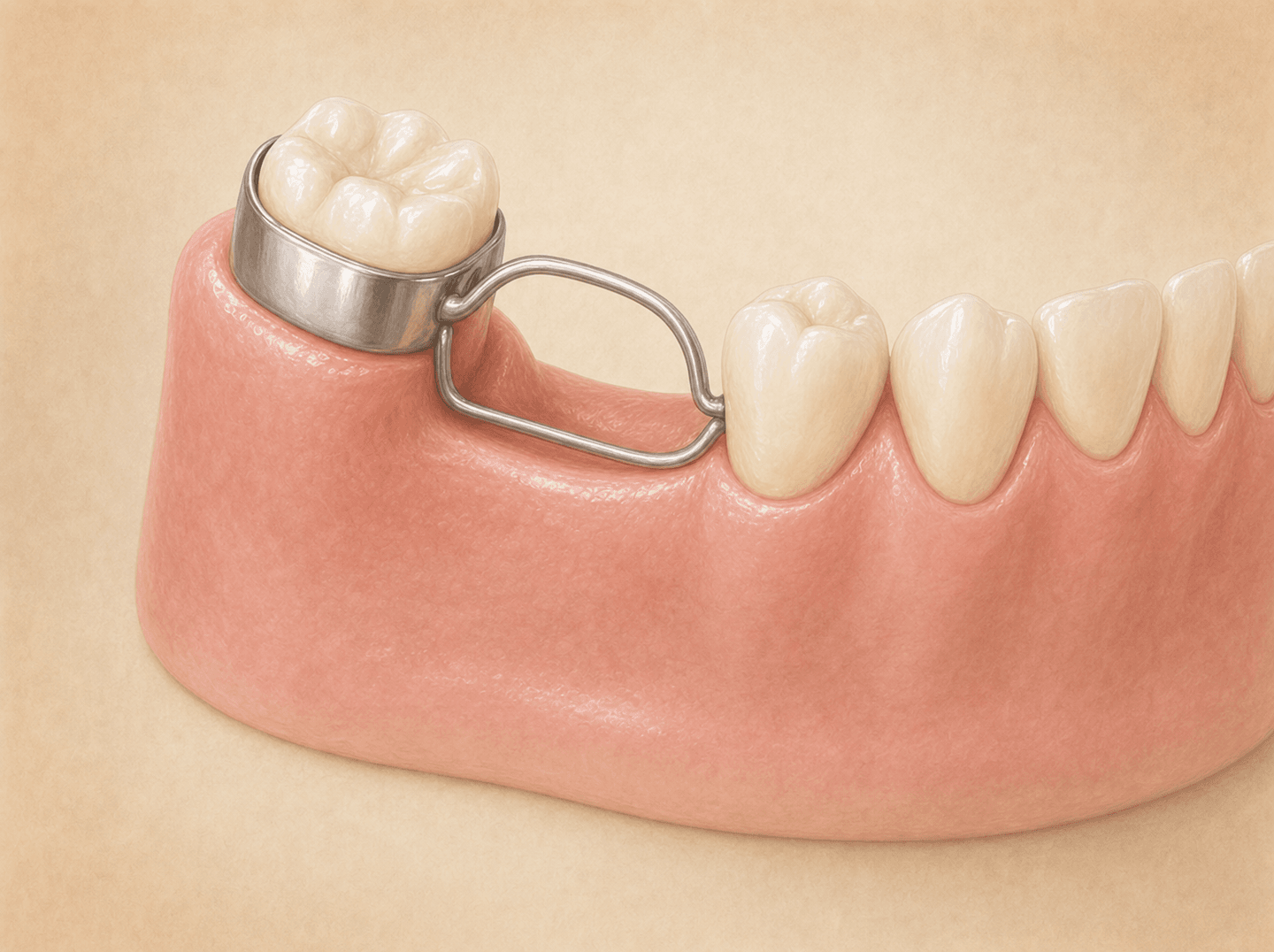
What D1510 reports
D1510 reports a fixed space maintainer placed on one side of one arch, scoped per quadrant. It is the cemented or bonded appliance a dentist places after a child loses a primary tooth early. The appliance, usually a band on an adjacent tooth with a wire loop crossing the gap, holds the space open so neighboring teeth do not drift in and crowd out the permanent tooth still coming.
It is a passive appliance. It holds space and does not move teeth, which keeps it in the preventive family rather than orthodontics.
The space-maintainer family: three axes
The space-maintainer codes form a grid, and picking the wrong member is a common error. Three axes separate them:
- Fixed vs. removable. Cemented or bonded in place, or an appliance the patient can take out.
- Unilateral vs. bilateral. One side of an arch, or a single appliance spanning both sides.
- Arch. Maxillary (upper) or mandibular (lower), which the code calls out only on the bilateral members.
The fixed branch, where D1510 lives:
- D1510 is fixed, unilateral, per quadrant. One side of one arch.
- D1516 is fixed, bilateral, maxillary. A single appliance holding space on both sides of the upper arch.
- D1517 is fixed, bilateral, mandibular. The same for the lower arch.
The removable branch mirrors it:
- D1520 is removable, unilateral, per quadrant.
- D1526 is removable, bilateral, maxillary.
- D1527 is removable, bilateral, mandibular.
Per quadrant: how to count the units
The revised descriptor scopes D1510 per quadrant. If a child loses primary teeth in more than one quadrant and the dentist places a separate fixed unilateral maintainer in each, report D1510 once per quadrant, each line with its own quadrant designation. Two quadrants treated means two units of D1510, not one line for the appointment.
A single D1510 for a two-quadrant case underbills the practice. Two lines without distinct quadrant designations invite a duplicate-procedure denial.
What D1510 is not
- A distal shoe. The guided-eruption appliance used when the second primary molar is lost before the first permanent molar erupts is D1575, the fixed unilateral distal-shoe code, also scoped per quadrant. The standard D1510 descriptor excludes the distal shoe.
- A re-cement or removal. Re-cementing or re-bonding a loose fixed unilateral maintainer is D1553, and removing one is D1556. Build both into the workflow so a later visit on the same appliance is not billed as another D1510.
- Orthodontic treatment. An appliance that moves teeth is orthodontics, a different category.
- A bilateral or removable maintainer. Those are D1516, D1517, and D1520 (see the family above).
When to bill D1510
Bill D1510 when a dentist cements or bonds a fixed, one-sided space maintainer in a quadrant after the early loss of a primary tooth, to keep the space open for the permanent successor. Typical situations:
- A primary molar is lost or extracted well before the permanent tooth is ready to erupt, and the adjacent teeth would otherwise drift into the gap.
- A child with mixed dentition needs arch length preserved in one quadrant until eruption.
Coverage reality: age, the lost tooth, and frequency
Space-maintainer coverage is common for children but gated by several plan-specific conditions.
Age and dentition. Most plans cover maintainers for the primary and mixed-dentition years and cap coverage by age. A maintainer for an older patient, or for a permanent-tooth space, often falls outside the benefit.
The lost tooth and timing. Plans typically want the maintainer tied to the early loss of a primary tooth with the permanent successor not yet ready to erupt. Some ask for the tooth number, the extraction date, or a radiograph showing the unerupted permanent tooth. A maintainer placed when the permanent tooth is about to come in may be denied as not necessary.
Per-quadrant frequency. Plans usually pay per quadrant and apply a frequency window so the same quadrant is not re-billed inside a set period. A replacement maintainer in the same quadrant can deny against that window.
Documentation that supports the claim
The chart note and claim for D1510 should capture:
- The quadrant. Each unit needs its quadrant designation.
- The lost tooth and timing. The primary tooth lost or extracted, the date, and that the permanent successor is not yet ready to erupt. This is the clinical justification carriers look for.
- The appliance type. That the maintainer is fixed and unilateral, so the code matches the appliance.
- A supporting radiograph where required. Many plans want a film showing the unerupted permanent tooth. Attach it to the claim, not just the record.
FAQs
- What does per quadrant mean on D1510?
- D1510 is reported once for each quadrant that gets an appliance. If a child loses primary teeth in two quadrants and the dentist places a separate fixed unilateral maintainer in each, that is two units of D1510, each with its own quadrant designation, not one line for the visit. Posting a single line for a two-quadrant case underbills the practice.
- What is the difference between D1510 and D1516 or D1517?
- Unilateral versus bilateral, plus arch. D1510 is a fixed unilateral maintainer, one side of one arch, reported per quadrant. D1516 is a single fixed appliance spanning both sides of the maxillary (upper) arch, and D1517 is the same for the mandibular (lower) arch. Pick by whether one side or both sides of the arch are being maintained.
- What is the difference between D1510 and D1520?
- Fixed versus removable. D1510 is a fixed (cemented or bonded) unilateral space maintainer, and D1520 is a removable unilateral space maintainer the patient can take out. Both are unilateral and reported per quadrant, so code by how the appliance is retained.
- Does insurance cover D1510, and what are the limits?
- Coverage is common for children but conditional, and the conditions are plan-specific. Most plans that cover space maintainers limit them to patients under a certain age, often the primary or mixed-dentition years, require that the lost tooth was a primary tooth whose permanent successor is not yet ready to erupt, and may exclude maintainers for a permanent-tooth space. Many also pay only once per quadrant and want the tooth number and extraction context. Verify the age limit, the primary-tooth requirement, and the per-quadrant frequency before treatment.
- Do I bill separately to re-cement or remove the space maintainer later?
- Yes, each has its own code. Re-cementing or re-bonding a loose fixed unilateral maintainer is D1553, and removing one is D1556, both per quadrant. Neither is another D1510. Whether the plan pays re-cement or removal as a separate benefit varies, so check before billing.
Related codes
- D1516
- D1517
- D1520
- D1526
- D1527
- D1553
- D1556
- D1575
Need help billing this code?
We handle D1510 claims daily.
If your team is spending time on denials, narratives, or carrier follow-up for this code, our dental insurance verification service can take it off your plate. We submit the claims, post what comes back, and follow up on anything unpaid.
“Claims, posting, denials, all of it gets handled, and it costs far less than hiring another employee. My front desk got hours of their week back, and honestly I just don't think about billing anymore.”
CDT codes are maintained by the American Dental Association. This page is an editorial billing guide, not the official ADA code descriptor. Verify current coverage policies with each carrier before submitting claims.