D3430 is the CDT code for a retrograde filling, the seal placed in the cut end of a root during endodontic surgery, billed per root.
- When to use: A root-end cavity is prepared and filled during an apicoectomy or similar surgery, with one line for each root that receives a filling.
- When not to use: The apicoectomy itself is D3410, D3421, D3425, or D3426, and two separate fillings in a single root go on D3999 with a narrative.
- Billing note: Some plans limit D3430 per tooth rather than per root, so check the frequency rule before a two-root molar surgery.
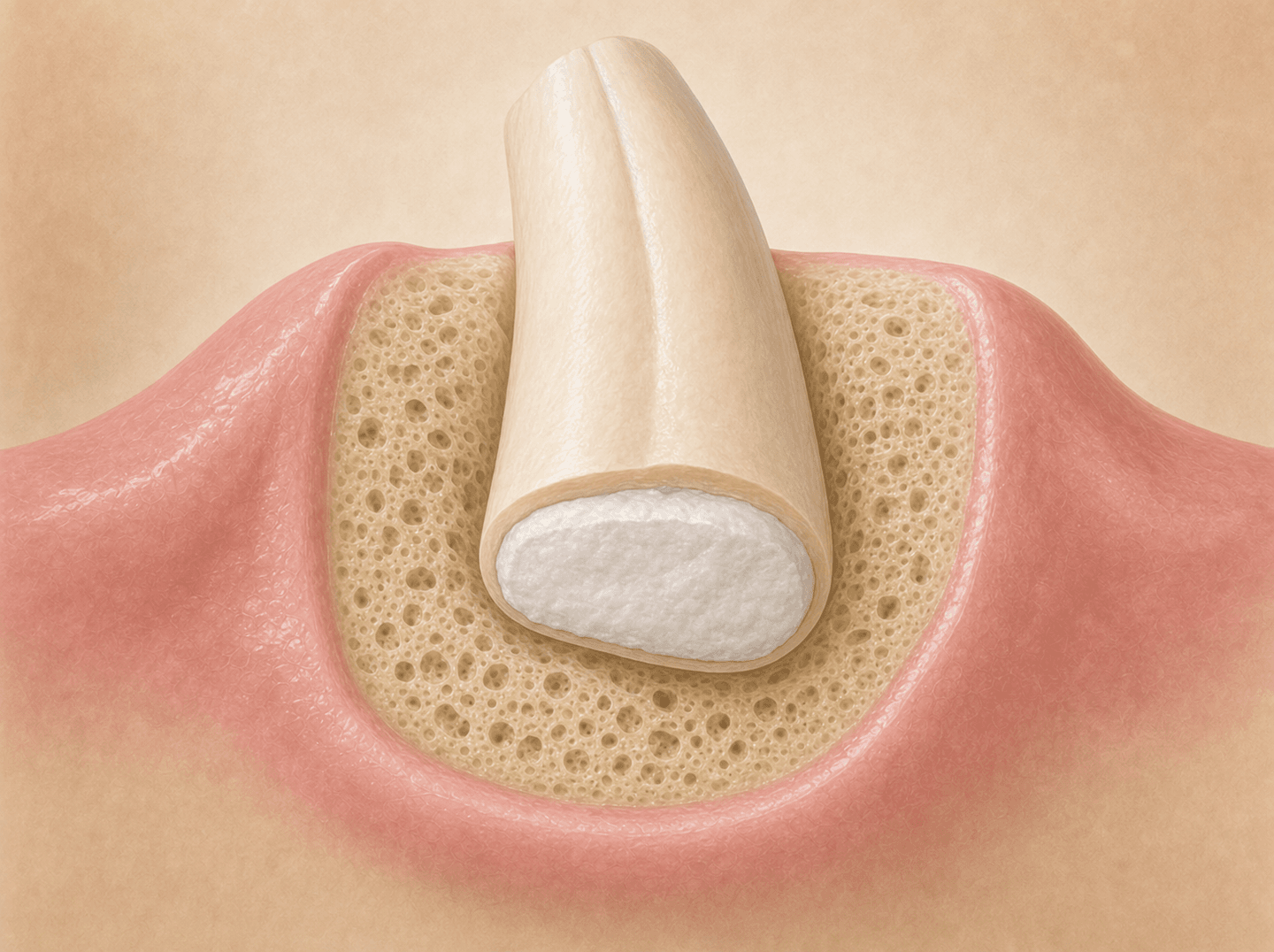
What D3430 reports
During periradicular surgery, the surgeon resects the root tip, prepares a small cavity in the cut root end, and packs it with a sealing material. That root-end filling is D3430. It seals the canal from the apical side when a seal from the crown side has failed or cannot be achieved.
The code’s unit is the root. One root, one D3430, regardless of whether the tooth is a single-rooted incisor or a three-rooted molar.
Per root, not per tooth
The AAE’s Endodontists’ Guide to CDT 2026 includes a molar surgery on tooth #3 coded as D3425, D3426, and D3430 twice, with a note that root-end fillings are coded per root. That is the counting rule to follow.
The error to watch for runs the other way. Some payer documents in circulation describe D3430 as per tooth, and offices that follow them bill one line on a two-root surgery. That under-reports the work, and nothing on the EOB will flag it.
Which surgeries it rides with
D3430 is placed during periradicular surgery, so it attaches to a surgical code on the same tooth and date:
- D3410, apicoectomy on an anterior tooth, billed once per tooth.
- D3421, apicoectomy on a premolar, first root.
- D3425, apicoectomy on a molar, first root.
- D3426, each additional root, typically on a premolar or molar.
- D3470, intentional reimplantation, where the tooth is removed, treated, and replaced in its socket.
Each of those descriptors leaves the retrograde filling out, which is why it is billed on its own line. On premolars and molars the apicoectomy lines count resected roots, and the D3430 lines count filled roots. They usually match, but not always: a root can be resected without a root-end filling.
Grafting and barriers at the same site are separate again: D3428 for a bone graft placed at the surgical site of that tooth and D3432 for a resorbable membrane, counted per site.
When one root needs two fillings
D3430 has no second unit for the same root. If two separate root-end fillings go into one root, as can happen when two canals exit a single mesial root, the descriptor routes the case to D3999 with a narrative explaining the anatomy. Expect the D3999 line to go to review.
Where the per-root rule meets plan limits
The code counts roots; a plan’s frequency table may not. PEHP’s 2026 CDT code guide limits D3430 to once per permanent tooth in a three-year period. Under that rule, the second root-end filling on a molar can deny on frequency even though it was billed correctly. Medi-Cal Dental marks D3430 global, meaning it is treated as part of another procedure and not paid separately.
UnitedHealthcare’s surgical endodontics policy (DCP010.15, effective May 2026) lists the situations where a retrograde filling is indicated. They include a canal blocked so it could not be filled nonsurgically, a failed apical seal that cannot be corrected without surgery, root perforations, and resorptive defects. The policy does not support it on a tooth with a poor overall prognosis. Write the narrative to those indications.
Worked example: lower first molar, two roots
Tooth #19 had root canal treatment and retreatment, and the periapical lesions persist on both roots. The endodontist resects the mesial and distal root tips and places a root-end filling in each.
The claim reads D3425 for the first root, D3426 for the second, and D3430 twice, all on #19 and the same date. The narrative covers the treatment history, why nonsurgical retreatment was not repeated, and the pre-op radiograph findings. Under a plan that counts D3430 per root, both fillings pay. Under a per-tooth frequency rule, one pays and the second comes back as a frequency denial, which the estimate should have anticipated.
Documentation that supports the claim
- Tooth number and which roots received a root-end filling.
- The pre-op radiograph showing the apical pathology on each treated root.
- The root canal and retreatment history, with the reason surgery was chosen over another nonsurgical attempt.
- A post-op radiograph showing the root-end fillings.
FAQs
- Is D3430 per root or per tooth?
- Per root. The CDT nomenclature for D3430 says per root, and the AAE's 2026 coding guide shows a two-root molar surgery billed with D3430 twice. Some payer documents and frequency tables treat it per tooth; those are plan rules, not the code's unit.
- Is the retrograde filling included in the apicoectomy?
- No. The descriptors for D3410, D3421, D3425, and D3426 each leave the root-end filling out of the surgical procedure. The root-end filling goes on its own D3430 line, on the same date and tooth as the apicoectomy.
- What if one root needs two retrograde fillings?
- Not as a second D3430. The D3430 descriptor sends more than one filling in a single root, for example where two canals exit one root, to D3999, unspecified endodontic procedure, with a description of what was done.
- Can D3430 be billed with intentional reimplantation?
- Yes, when a root-end filling is placed. The D3470 intentional reimplantation descriptor excludes retrograde filling material, the same way the apicoectomy codes do, so the filling is reported separately on D3430 per root.
- What is a retrofill?
- Retrofill is shorthand for a retrograde or root-end filling, and the code for it is D3430. After the root tip is resected, the surgeon prepares a small cavity in the cut end of the root and fills it to seal the canal from the apical side.
Related codes
Need help billing this code?
We handle D3430 claims daily.
If your team is spending time on denials, narratives, or carrier follow-up for this code, our outsourced dental insurance billing service can take it off your plate. We submit the claims, post what comes back, and follow up on anything unpaid. Already sitting on older claims that never paid? Our AR cleanup project works the backlog.
“Claims, posting, denials, all of it gets handled, and it costs far less than hiring another employee. My front desk got hours of their week back, and honestly I just don't think about billing anymore.”
CDT codes are maintained by the American Dental Association. This page is an editorial billing guide, not the official ADA code descriptor. Verify current coverage policies with each carrier before submitting claims.