D4273 is the CDT code for a connective tissue graft that uses the patient's own tissue, usually harvested from the palate, to cover an exposed root or thicken the gum at the first tooth or position treated.
The donor source is what carriers check first. Bill D4273 only when the graft tissue came from the patient, not from a processed allograft or xenograft, which is D4275. The other frequent mix-up is with the free soft tissue graft, D4277, and some plans still treat root-coverage grafting as cosmetic.
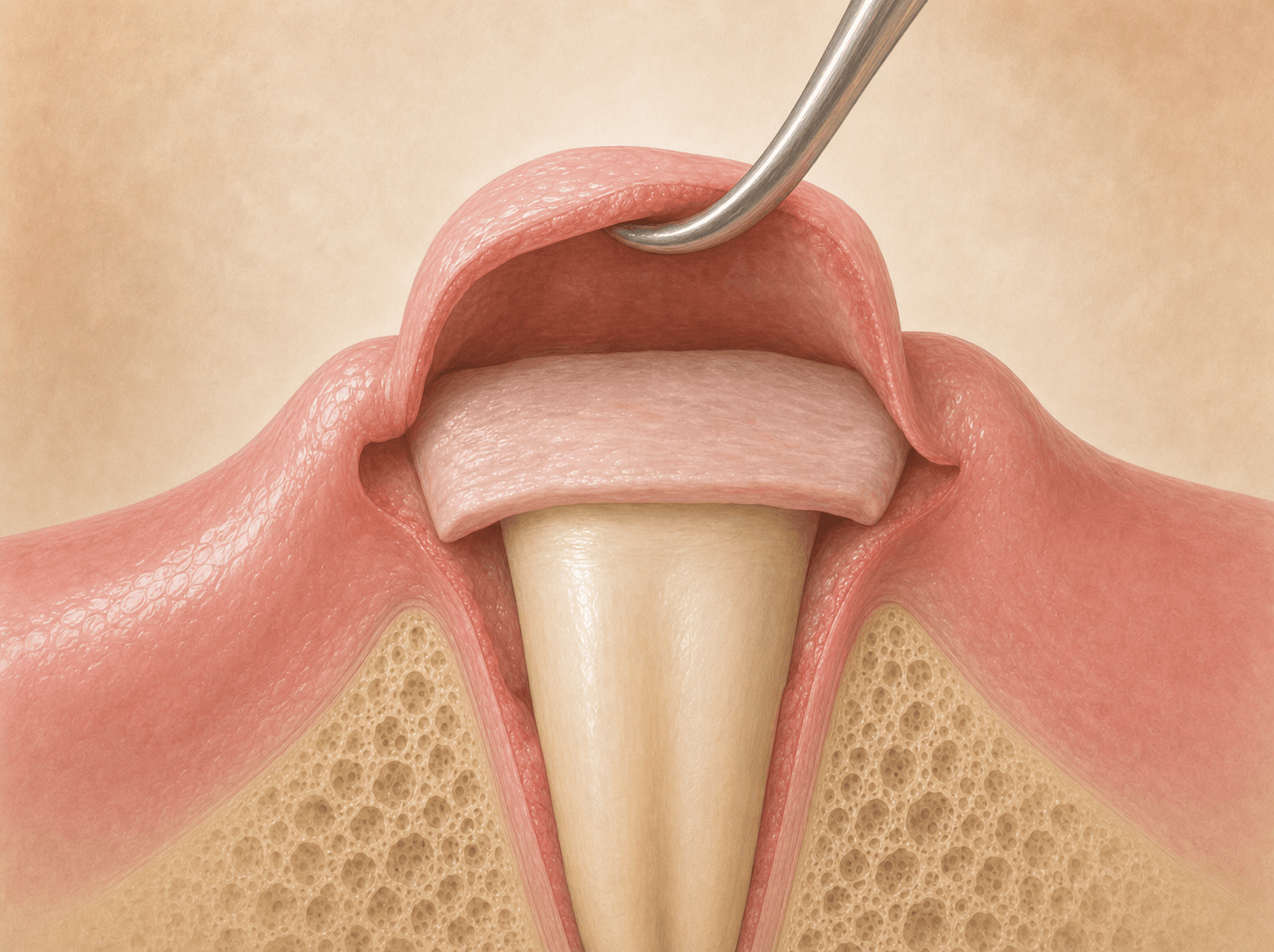
What D4273 covers
D4273 reports a connective tissue graft that uses the patient’s own tissue for the first tooth, implant, or edentulous position in the graft. The surgeon harvests a subepithelial layer of connective tissue, usually from the palate, and places it under a flap at the recipient site to cover an exposed root surface or add thickness to thin gum tissue. The fee covers both surgical sites, the donor site where the tissue is taken and the recipient site where it is placed, so the palatal harvest is not billed on its own.
It does not cover:
- Each additional contiguous position in the same graft. That is the add-on D4283, reported alongside D4273.
- The same graft using processed donor material instead of the patient’s own tissue. That is D4275 (non-autogenous), with D4285 as its add-on.
- A free soft tissue graft, an epithelialized graft placed on the surface to widen attached keratinized tissue. That is D4277, with D4278 as its add-on.
- A pedicle graft, where adjacent tissue is rotated or slid over while staying attached at its base. That is D4270.
- A combined connective tissue and double pedicle graft. That is D4276.
When to bill D4273
Bill D4273 when:
- Connective tissue harvested from the patient is grafted to cover a root or thicken tissue at the first position in the graft.
- The tissue is the patient’s own, not a processed allograft or xenograft.
- The operative note documents both the donor site and the recipient site.
Do not bill D4273 for:
- An additional contiguous position in the same graft. Use D4283.
- A graft that used donor material rather than the patient’s tissue. Use D4275.
- A free (epithelialized) soft tissue graft. Use D4277.
- A pedicle graft that stays attached at its base. Use D4270.
Autogenous versus non-autogenous
The line that separates D4273 from its nearest sibling is the source of the graft tissue, not the technique at the recipient site.
- D4273 is autogenous. The connective tissue is taken from the patient, almost always the palate. One surgical procedure, two sites, both included in the fee.
- D4275 is non-autogenous. The graft uses processed donor material, such as an acellular dermal matrix or a xenograft, so there is no palatal harvest. The recipient work can look identical, but the source is different.
Code what was actually placed. If the operative note or the material invoice shows a processed donor product and the claim says D4273, an audit will reprocess it, because the autogenous code asserts that tissue was harvested from the patient. This is the most common conceptual error on the connective tissue graft codes, and it survives a code-number check because both numbers are real. The fix is to read the note for the donor source before you pick the code.
A second axis sits one step out: connective tissue graft versus free soft tissue graft. D4273 places a subepithelial layer under a flap, the usual approach for root coverage. D4277 places an epithelialized graft on the surface, the usual approach for widening the band of attached keratinized tissue. Same region of the mouth, different procedure, different code.
Top reasons D4273 gets denied or downgraded
- Classified as cosmetic. Some plans treat root-coverage grafting as cosmetic unless a functional need is on record. Progressive recession, root sensitivity, an inadequate band of attached tissue, or a restorative reason usually moves it into a covered category, but the standard is plan-dependent.
- Wrong donor source coded. D4273 billed when a processed donor product was used. The correct code is D4275. Carriers that request the operative note or material invoice will reprocess the claim.
- Confused with the free soft tissue graft. D4273 billed for an epithelialized free gingival graft, or D4277 billed for a subepithelial connective tissue graft. The operative technique decides the code.
- Thin documentation of the defect. No recession measurement, no keratinized-tissue width, no perio charting or photos showing why the graft was needed. Many carriers deny mucogingival surgery without this.
- No pre-authorization. Many plans require pre-auth for soft tissue grafting. A claim submitted without it can be denied or pended even when the procedure would have qualified.
- Frequency or same-site repeat. A graft at a site treated within the carrier’s lookback window pends or denies without a narrative explaining the clinical reason for regrafting.
Documentation that supports the claim
The claim needs:
- The tooth, implant, or edentulous position treated, and whether it is the first position (D4273) or an additional contiguous one (D4283).
- The donor source, stated plainly as autogenous (patient’s own tissue) so the code and the note agree.
- Recession measurements and the width of attached or keratinized tissue at the site.
- Recent periodontal charting and radiographs.
- A functional reason for the graft when the plan screens for cosmetic exclusions: sensitivity, progressive recession, restorative need, or an inadequate tissue band.
- Intraoral photos of the recipient site when available.
For the operative record, document the harvest at the donor site and the graft at the recipient site as one procedure, since the D4273 fee covers both. If a pre-authorization was obtained, keep the approval reference with the claim.
Example case
A 44-year-old patient has recession on tooth #6 with root sensitivity and a thin band of attached tissue. The periodontist plans a connective tissue graft using tissue harvested from the palate. The plan covers mucogingival surgery when a functional need is documented and requires a pre-authorization.
Billing steps:
- Submit a pre-authorization with the perio charting, recession measurement, keratinized-tissue width, and the functional reason (sensitivity and progressive recession). Wait for the approval before scheduling.
- Perform the graft. Harvest connective tissue from the palate and place it under a flap at #6. Document both the donor site and the recipient site in the operative note.
- Bill D4273 for the first position. Do not add a separate line for the palatal harvest; the fee already covers the donor site.
- Attach the operative note, photos, and the pre-auth reference.
- Post the carrier’s payment against the approved amount. If the plan applied a cosmetic exclusion despite the documentation, pull the EOB, read the reason, and appeal with the functional-need record.
If a second contiguous position had been grafted in the same site, it would be one D4283 line added to the D4273, not a second D4273.
What to get right in your PMS
- Code the first position D4273 and each additional contiguous position D4283. The count is by position within the graft, not per quadrant.
- Confirm the donor source before you pick the code. Autogenous (patient’s tissue) is D4273; processed donor material is D4275. The note and any material invoice have to match.
- Do not unbundle the donor site. The palatal harvest is inside the D4273 fee, not a separate line.
- Check for a pre-auth requirement. Many plans require pre-authorization on soft tissue grafting, and skipping it is a predictable denial.
- Attach the defect documentation. Recession measurements, keratinized-tissue width, charting, and photos are what carry the claim past a cosmetic screen, and coverage stays plan-dependent.
FAQs
- What is the CDT code for a connective tissue graft?
- D4273 when the graft uses the patient's own tissue (autogenous), typically harvested from the palate, for the first tooth, implant, or edentulous position in the graft. D4283 is the add-on for each additional contiguous position in the same graft site. If processed donor material is used instead of the patient's tissue, the code is D4275 with D4285 as its add-on.
- What is the difference between D4273 and D4275?
- The donor source. D4273 is autogenous, meaning the connective tissue comes from the patient, usually the palate. D4275 is non-autogenous, meaning the graft uses processed donor material such as an acellular dermal matrix or a xenograft instead of harvesting from the patient. Both cover the first position in the graft. Code what was actually placed, because the operative note and any lab or material invoice have to match the code on an audit.
- What is the difference between D4273 and D4277?
- The graft type. D4273 is a connective tissue graft, a subepithelial layer tucked under a flap to cover a root or thicken tissue, and it is the usual choice for root coverage. D4277 is a free soft tissue graft, an epithelialized piece placed on the surface, usually to widen the band of attached keratinized tissue. Different procedures, different codes, so read the operative note before you pick one.
- How do I bill a connective tissue graft on more than one tooth?
- Bill D4273 for the first tooth, implant, or edentulous position in the graft, then D4283 for each additional contiguous position in the same graft site. The count is by position within the graft, not per quadrant. Two teeth grafted in one contiguous site are D4273 plus one D4283, not two D4273 lines.
- Why did the carrier deny D4273 as cosmetic?
- Some plans classify soft tissue grafting for root coverage as cosmetic unless a functional need is documented. On many plans the fix is documentation: progressive recession, root sensitivity, an inadequate band of attached tissue, or a restorative reason, backed by perio charting, recession measurements, and photos. Coverage is plan-dependent, so a pre-authorization before surgery is the cleanest way to know where a plan stands.
- Is the palatal donor site billed separately from D4273?
- No. The D4273 fee includes both the recipient site and the donor site surgery, so the palatal harvest is not a separate line. Billing a separate donor-site procedure alongside D4273 is a common unbundling error.
Related codes
Need help billing this code?
We handle D4273 claims daily.
If your team is spending time on denials, narratives, or carrier follow-up for this code, our outsourced dental insurance billing service can take it off your plate. We work inside your PMS and post payments the same week.
CDT codes are maintained by the American Dental Association. This page is an editorial billing guide, not the official ADA code descriptor. Verify current coverage policies with each carrier before submitting claims.