D9972 is the CDT code for in-office whitening applied to the outside surfaces of the teeth, reported once per arch.
- When to use: The dentist or hygienist applies and activates the bleaching agent chairside in one visit, and a full-mouth session bills as two units.
- When not to use: Take-home custom trays are D9975, one discolored tooth is D9973, and bleaching inside a root-canal-treated tooth is D9974.
- Billing note: Nearly every plan excludes bleaching as cosmetic, so collect the full fee at the visit and give the patient a superbill for FSA or HSA.
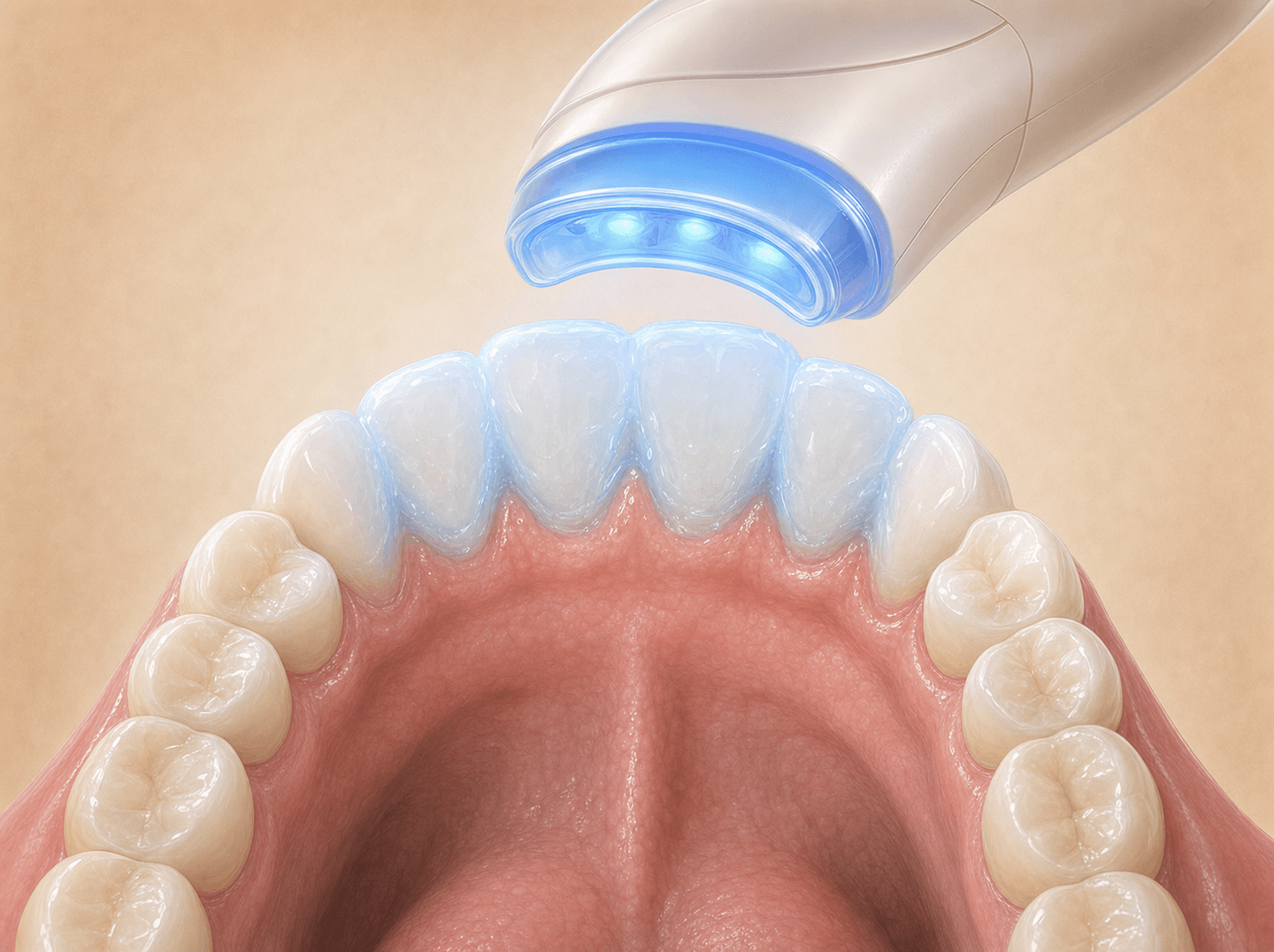
What D9972 covers
D9972 reports whitening applied to the outside surfaces of the teeth in the dental office, one arch per unit. The dentist or hygienist applies a professional-strength bleaching agent to the facial surfaces in a single visit. The agent is typically hydrogen peroxide or carbamide peroxide at higher concentrations than take-home products, often activated with a curing light or laser.
The code covers:
- In-office vital bleaching of an entire arch with professional-grade agents, whether light-activated or chemically activated. Zoom, Opalescence Boost, and similar chairside systems report under D9972.
- Full-mouth whitening as D9972 x2, or one arch (often the upper “smile zone”) as D9972 x1.
- Whitening before a restorative case so the dentist can shade-match crowns or veneers to the whitened teeth. Bill D9972 for the bleaching, and bill the restorative codes separately at their own appointments.
Combination systems such as KöR are split: the at-home custom-tray phase bills D9975, and only the single in-office boost visit bills D9972. Likewise, if take-home trays are dispensed at the same visit as in-office bleaching, both codes go on the claim.
It does not cover:
- Take-home bleaching with custom-fabricated trays. That’s D9975, also per arch.
- Bleaching a single discolored tooth (post-trauma, post-root-canal). That’s D9973, per tooth.
- Internal bleaching (walking bleach placed inside a non-vital tooth). That’s D9974.
- Over-the-counter whitening products dispensed without custom fabrication or in-office application.
- Cleaning or polishing. Prophylaxis is D1110/D1120, and “whitening” during a hygiene visit with no separate bleaching agent is not D9972.
The cosmetic exclusion
Most dental plans exclude bleaching as cosmetic, with language such as “Procedures for cosmetic purposes, including but not limited to bleaching, are not covered benefits.” In practice:
- Skip pre-authorization. The plan excludes the service category, so there is nothing to authorize.
- Skip the narrative on a routine cosmetic case. It will deny regardless. The narrow exceptions below are the only cases worth one.
- Present the cost on the treatment plan. Show D9972 x2 (if full-mouth) at your office fee, with a total, before the patient consents.
- Collect the full fee at the time of service. There is no insurance portion, so this is not a balance-bill situation.
Some offices don’t submit D9972 at all. Others submit knowing it will deny, because the denial EOB gives the patient documentation for FSA or HSA reimbursement. Either works, as long as the claim is posted to patient responsibility and never sits in insurance accounts receivable waiting on a payment that will not come.
D9972 vs. D9975 vs. D9973
The bleaching codes are numbered close together and easy to mix up.
| Code | Description | Billing unit | Typical scenario |
|---|---|---|---|
| D9972 | Outside-surface whitening done in the office | Per arch | Patient sits in the chair, bleaching agent applied and activated by staff |
| D9975 | Outside-surface whitening with custom trays | Per arch | Custom trays fabricated, bleaching kit dispensed for home use |
| D9973 | Outside-surface whitening of one tooth | Per tooth | Single discolored tooth (often post-trauma or post-root-canal) |
| D9974 | Whitening from inside one tooth | Per tooth | Walking bleach placed inside a non-vital tooth |
The most common mix-up is billing D9972 when the practice actually dispensed take-home trays (D9975). D9973 and D9974 are the bleaching codes that occasionally get insurance consideration, because a single tooth darkened by trauma or endodontic treatment may be classified as a functional or restorative issue rather than purely cosmetic.
Billing for FSA/HSA documentation
Whether a patient’s flexible spending account (FSA) or health savings account (HSA) reimburses whitening depends on their plan administrator. Your office can make it easier with a receipt or superbill that includes:
- CDT code D9972, described in plain terms as in-office whitening of the outside tooth surfaces, one arch.
- Number of arches treated (1 or 2).
- Date of service.
- Provider name and NPI.
- Office fee per arch and total charged.
If you submitted the claim and received a denial EOB, give the patient a copy. Some administrators require proof of denial before reimbursing a cosmetic dental procedure; others reimburse on the superbill alone.
When insurance might cover bleaching
Coverage is rare and limited to a narrow set of circumstances:
- Tetracycline staining documented as a medical condition. When the dentist frames bleaching as treatment for a developmental dental defect rather than cosmetic improvement, some plans have approved coverage. This takes a strong narrative, clinical photos, and sometimes a medical referral or prior authorization. Approval rates are very low.
- Single-tooth discoloration from trauma. A tooth that darkened after an injury may qualify under D9973 (per tooth), not D9972, on the argument that the discoloration is a consequence of trauma. Some carriers will consider this, especially if the tooth has had endodontic treatment.
- State mandate or plan-specific rider. A small number of plans include cosmetic riders or state-mandated coverage for certain procedures.
The burden of proof is on the practice. Submit with clinical photos, a detailed narrative, and any supporting medical records, and tell the patient denial is the most likely outcome.
Example case
A 32-year-old patient requests full-mouth in-office whitening before her wedding. She has an employer PPO dental plan and an HSA through her medical plan.
Billing steps:
- Verify the dental plan and confirm bleaching is excluded as cosmetic (it almost certainly is).
- Present D9972 x2 (upper and lower) at your office fee with the total, and confirm she understands her dental insurance will not cover it.
- Collect the full fee at the time of service.
- Perform the bleaching and chart the date, material used, and number of arches treated.
- Submit the claim. It will deny as cosmetic. Give her a copy of the denial EOB and a detailed superbill.
- Advise her to submit both to her HSA administrator for possible reimbursement.
What to get right in your PMS
- Bill per arch, not per visit. A single D9972 for full-mouth whitening undercharges the case and creates a mismatch with the chart if audited.
- Set a real fee on D9972. Practices that bundle whitening into a package price sometimes leave bleaching codes at $0, which leaves the patient without the line-item fees an FSA or HSA submission needs.
FAQs
- Does dental insurance cover D9972?
- Almost never. Nearly all dental plans classify bleaching as cosmetic and exclude it. Rare exceptions exist for tetracycline staining documented as a medical condition or for trauma-related discoloration, but treat D9972 as patient-pay by default.
- Do I bill D9972 once or twice for full-mouth whitening?
- Twice. D9972 is billed per arch, so a full-mouth session is D9972 x2, one for the upper arch and one for the lower. Put both line items on the treatment plan so the patient sees the total cost upfront.
- What is the difference between D9972 and D9975?
- Where the bleaching happens. D9972 is in-office bleaching performed by a dental professional in a single visit. D9975 is external bleaching with custom trays dispensed for at-home use. Both are billed per arch. A patient who gets in-office whitening on Monday and takes home custom trays on Tuesday has two separate codes and two separate charges.
- Should I submit D9972 to insurance even though it will deny?
- Either approach is fine as long as the patient understands the cost is theirs. Submitting produces a denial EOB the patient can use for FSA or HSA reimbursement. Not submitting saves a claim cycle on a guaranteed denial.
- Can patients use FSA or HSA to pay for in-office whitening?
- It depends on the administrator. Some allow teeth whitening as a qualified medical expense; others classify it as cosmetic and reject it. The patient should check with their plan administrator before treatment. Your office can help with a clear receipt showing the D9972 code, a description, and the date of service.
Related codes
Need help billing this code?
We handle D9972 claims daily.
If your team is spending time on denials, narratives, or carrier follow-up for this code, our outsourced dental insurance billing service can take it off your plate. We submit the claims, post what comes back, and follow up on anything unpaid.
“Claims, posting, denials, all of it gets handled, and it costs far less than hiring another employee. My front desk got hours of their week back, and honestly I just don't think about billing anymore.”
CDT codes are maintained by the American Dental Association. This page is an editorial billing guide, not the official ADA code descriptor. Verify current coverage policies with each carrier before submitting claims.