D2740 is the CDT code for a single crown made entirely of porcelain or ceramic, such as zirconia or e.max, on a natural tooth.
- When to use: A full-coverage ceramic crown with no metal substructure is permanently cemented on a natural tooth, whether lab-made or milled the same day.
- When not to use: A porcelain-fused-to-metal crown is D2750, D2751, or D2752 by metal, a ceramic bridge retainer is D6740, and a provisional crown is D2799.
- Billing note: Many plans pay D2740 at the D2751 base-metal PFM allowable on back teeth, so run a pre-estimate and explain the difference before treatment.
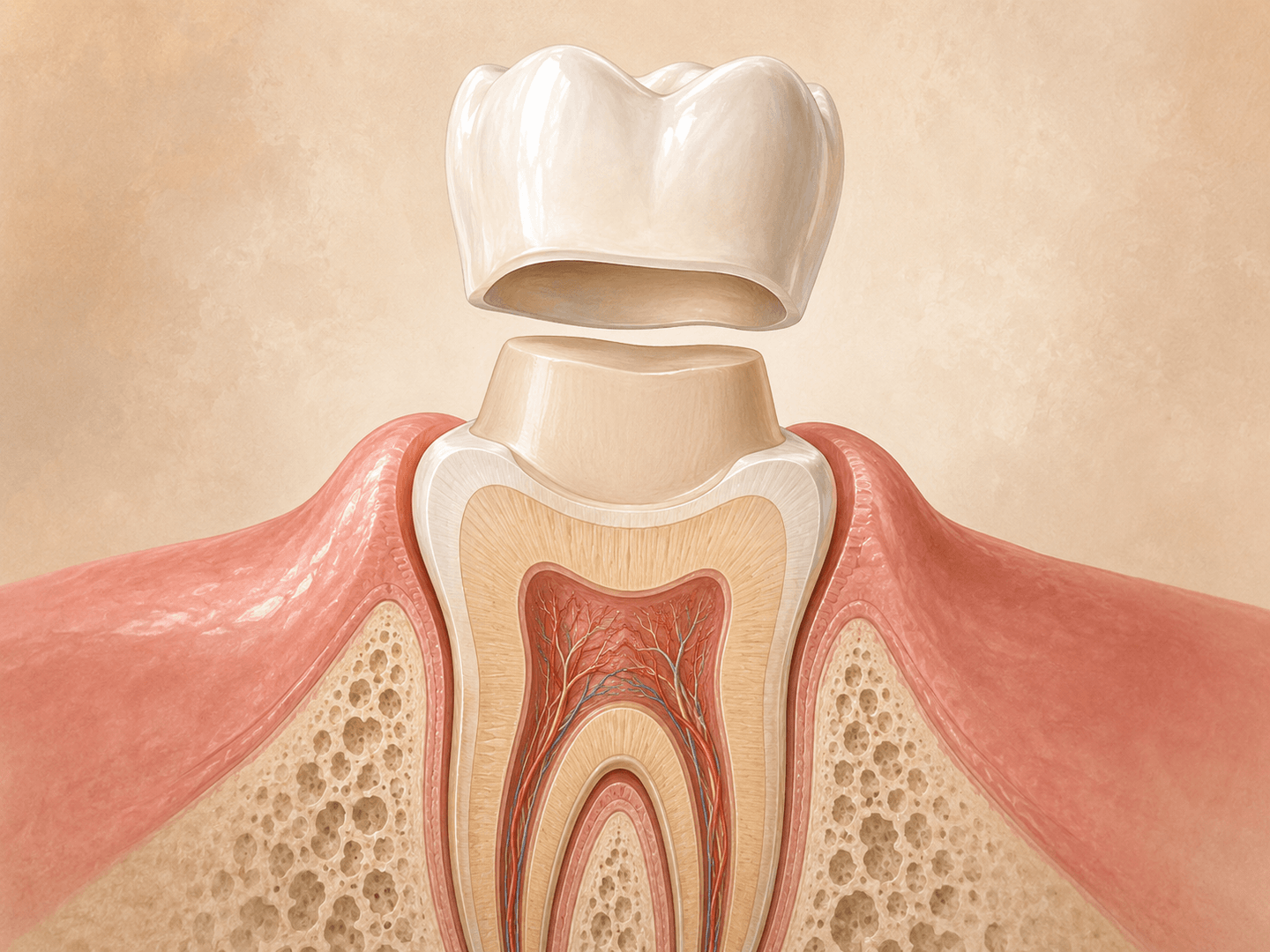
What D2740 covers
D2740 reports a single-unit, full-coverage crown made entirely of porcelain or ceramic material with no metal substructure, cemented on a natural tooth. This includes zirconia (full-contour or layered), lithium disilicate (e.g., IPS e.max), and feldspathic porcelain. The code applies to permanent teeth only.
It does not cover:
- Porcelain fused to metal (PFM) crowns. Use D2750, D2751, or D2752 depending on the metal.
- Porcelain or ceramic retainer crowns on a bridge. Use D6740. Mismatching D2740 for D6740 is one of the most common preventable denials on crown claims. D2740 does not signal that the crown supports a pontic as part of a larger prosthesis.
- Porcelain veneers (D2961/D2962).
- Provisional crowns (D2799).
- Implant-supported crowns (D6065 or D6066).
If the crown is a single unit on a natural tooth (or a core buildup on a natural tooth), and the entire restoration is ceramic, it’s D2740.
When to bill D2740
Bill D2740 when:
- A full-coverage ceramic crown is fabricated and permanently cemented on a prepared natural tooth.
- The crown replaces a failing existing restoration where the remaining tooth structure cannot support a direct restoration.
- The tooth has had root canal therapy and needs full-coverage protection.
- A fractured cusp or cracked tooth requires full-coverage restoration.
Do not bill D2740 for:
- Same-day milled crowns intended as long-term provisionals. Code the intent, not the material.
- Crowns seated on implant abutments. Use the D6060 series.
- Onlays that don’t cover all cusps. That’s the D2642/D2643/D2644 series (porcelain/ceramic onlay, two/three/four-or-more surfaces).
Top reasons D2740 gets denied or downgraded
Six issues account for most of the problems on this code:
- No pre-op radiograph on file. Most carriers want a pre-op X-ray showing the tooth’s condition. Submit one with the initial claim instead of waiting for the request.
- Frequency limit on a replacement crown. Plans typically allow one crown per tooth every 5 to 10 years. If the patient is inside the window, the claim will pend or deny without strong narrative and documentation of the clinical failure.
- Alternate-benefit downgrade. Many plans pay D2740 at the allowable for D2751 (base-metal PFM) on posterior teeth. This is a benefit limitation, not a denial. See the section below.
- Code mismatched to the case. D2740 submitted on what’s actually a bridge retainer (should be D6740), or on a same-day milled long-term provisional, or on an implant-supported crown. The carrier denies for code-procedure mismatch.
- Prior authorization not obtained. Some plans require predetermination on major restorative before treatment. If the plan requires it and you didn’t submit one, the claim denies for missing prior auth.
- Wrong tooth number. Sounds obvious, but transposed tooth numbers are a top reason for outright claim rejection. Worth double-checking before submission.
Alternate benefit downgrades
The most common billing issue with D2740 is not a denial. It’s a downgrade. Here’s how it works:
- You submit D2740 (all-ceramic crown) at your office fee.
- The carrier processes it but applies “alternate benefit” or “least expensive alternative treatment” (LEAT).
- They pay D2740 at the allowable for D2751 (base-metal PFM) or D2752 (noble-metal PFM).
- The unpaid difference is left open. Whether it becomes patient responsibility or a contractual write-off depends on your participating-provider agreement.
This is plan language, not a clinical decision. The carrier isn’t saying the ceramic crown was wrong. They’re saying the plan only pays for a PFM on that tooth.
What to do: Explain this to the patient before treatment. Run a pre-estimate if possible. Post the payment at the downgraded amount, then check the participating-provider agreement before billing the patient the difference. Some contracts allow it when the patient chose the upgrade and signed a financial agreement beforehand, others require it written off, and Medicaid prohibits balance-billing the member.
Documentation that supports the claim
The claim needs:
- Pre-operative radiograph showing the tooth’s condition (caries, fracture, failing restoration, or post-RCT status).
- Date of service matching the seating date, not the prep date (unless your state has a different convention).
- Correct tooth number. Double-check before submission.
- Narrative when the case has anything unusual (replacement crown, recent extraction history, minor patient, large structural loss).
For the patient record, document:
- Why a direct restoration isn’t viable (extent of structural loss).
- Material selected and shade.
- Occlusal contacts verified.
- Margins evaluated post-cementation.
- Whether the existing crown was removed (if replacement).
Replacement crowns
If this replaces an existing crown, most carriers need:
- The date the original crown was placed.
- The reason for replacement (fracture, recurrent decay, margin failure).
- A pre-op radiograph showing the failure.
Without these, the claim will pend or deny for “frequency limitation.”
Waiting periods
New patients with new insurance often hit waiting periods on major restorative. D2740 is typically classified as major. Common waiting periods:
- 6 months (most employer-sponsored plans).
- 12 months (some individual/marketplace plans).
- None (union plans, some government plans).
Verify before treatment. A claim submitted during the waiting period will deny, and you’ll owe the patient a refund if you collected based on estimated coverage.
Example case
A 38-year-old patient presents with a fractured upper left first molar (tooth #14). The tooth has a large failing composite restoration and completed root canal therapy from six months ago. The dentist preps and seats a full-zirconia crown.
Billing steps:
- Verify the patient’s plan has no remaining frequency limit on tooth #14 (no prior crown on file).
- Confirm the patient has cleared any major-restorative waiting period.
- Submit D2740 at office fee. Attach the pre-op radiograph and a one-line narrative noting the fracture and post-RCT status.
- Watch for an EOB showing alternate-benefit treatment. If the plan downgrades to the D2751 allowable, post the carrier’s payment and check the participating-provider agreement before posting the difference to the patient. Where the contract permits it and the patient signed the upgrade agreement, bill that difference along with the coinsurance. Where it requires a write-off, adjust it off.
- If the claim denies outright, pull the EOB, read the denial reason, and either correct and resubmit or appeal with additional documentation.
What to get right in your PMS
The exact menus and field names vary across Open Dental, Dentrix, Eaglesoft, Curve, and Carestream, and they shift between versions. The steps that matter are the same regardless of system:
- Code the procedure as D2740 on the correct tooth. Confirm tooth number twice before posting. A tooth-number mismatch is a common cause of outright rejection.
- Attach the pre-op radiograph to the claim itself, not just the patient record. Many systems store images at the patient level by default. The clearinghouse needs the image linked to the specific claim.
- Post the procedure on the seating date, not the prep date. This drives the date of service the carrier reads.
- Add a narrative to the claim before submission, not after. Adding a narrative after the carrier responds means a corrected-claim cycle that costs days.
- Confirm your fee comes from your office fee schedule, not the carrier’s allowable. Submitting at the allowable corrupts the secondary’s math on dual coverage and prevents recovery on alternate-benefit downgrades.
If your team is consistently missing one of these steps on D2740 claims, the fix is usually a checklist at the claim-creation step, not retraining on the PMS itself.
FAQs
- What's the difference between D2740 and D2750?
- D2740 is an all-ceramic or all-porcelain crown with no metal substructure. D2750 is porcelain fused to a high noble metal (PFM). The clinical difference is the substrate material. D2740 uses zirconia, lithium disilicate, or feldspathic porcelain. D2750 has a metal coping underneath the porcelain layer.
- Can I bill D2740 for a zirconia crown?
- Yes. Zirconia is a ceramic material. Full-contour zirconia crowns and layered zirconia crowns both report under D2740. Some carriers historically questioned this, but the ADA has confirmed zirconia belongs in the all-ceramic crown category this code covers.
- Why does the carrier keep downgrading D2740 to a PFM allowable?
- Many plans include an alternate benefit clause. If the tooth is a posterior molar and the plan considers a base-metal PFM (D2751) to be functionally adequate, they pay D2740 at the D2751 allowable. Whether the office can bill the patient the difference depends on the participating-provider agreement: some allow it on an upgrade the patient agreed to in writing, others require a write-off. This is not a denial. It's a benefit limitation written into the plan.
- Do I need a narrative for D2740?
- Often yes. Most carriers want a narrative when the crown is being placed within their frequency window of a prior crown on that tooth, when the patient is a minor, or when there's anything unusual on the clinical record. When in doubt, attach the narrative. It costs nothing and avoids a request for information.
- When should I use D6740 instead of D2740?
- Use D6740 when the porcelain or ceramic crown is a retainer crown supporting a bridge pontic. D2740 is for a single-unit crown on a natural tooth. Coding a bridge retainer as D2740 is one of the most common preventable denials on crown claims because the code doesn't signal that the crown is part of a larger prosthesis.
Related codes
Need help billing this code?
We handle D2740 claims daily.
If your team is spending time on denials, narratives, or carrier follow-up for this code, our outsourced dental insurance billing service can take it off your plate. We submit the claims, post what comes back, and follow up on anything unpaid.
“Claims, posting, denials, all of it gets handled, and it costs far less than hiring another employee. My front desk got hours of their week back, and honestly I just don't think about billing anymore.”
CDT codes are maintained by the American Dental Association. This page is an editorial billing guide, not the official ADA code descriptor. Verify current coverage policies with each carrier before submitting claims.