D2950 is the CDT code for a core buildup that rebuilds a broken-down tooth, with pins if needed, so it can hold a crown.
- When to use: A crown is planned and the tooth has too little structure left to hold it, often with more than half the clinical crown missing.
- When not to use: A cast post and core is D2952, a prefabricated post and core is D2954, and a large filling with no crown planned is a regular restoration.
- Billing note: Carriers often deny D2950 as not necessary without proof of structural loss, so send a pre-op x-ray, a photo, and a narrative naming what was missing.
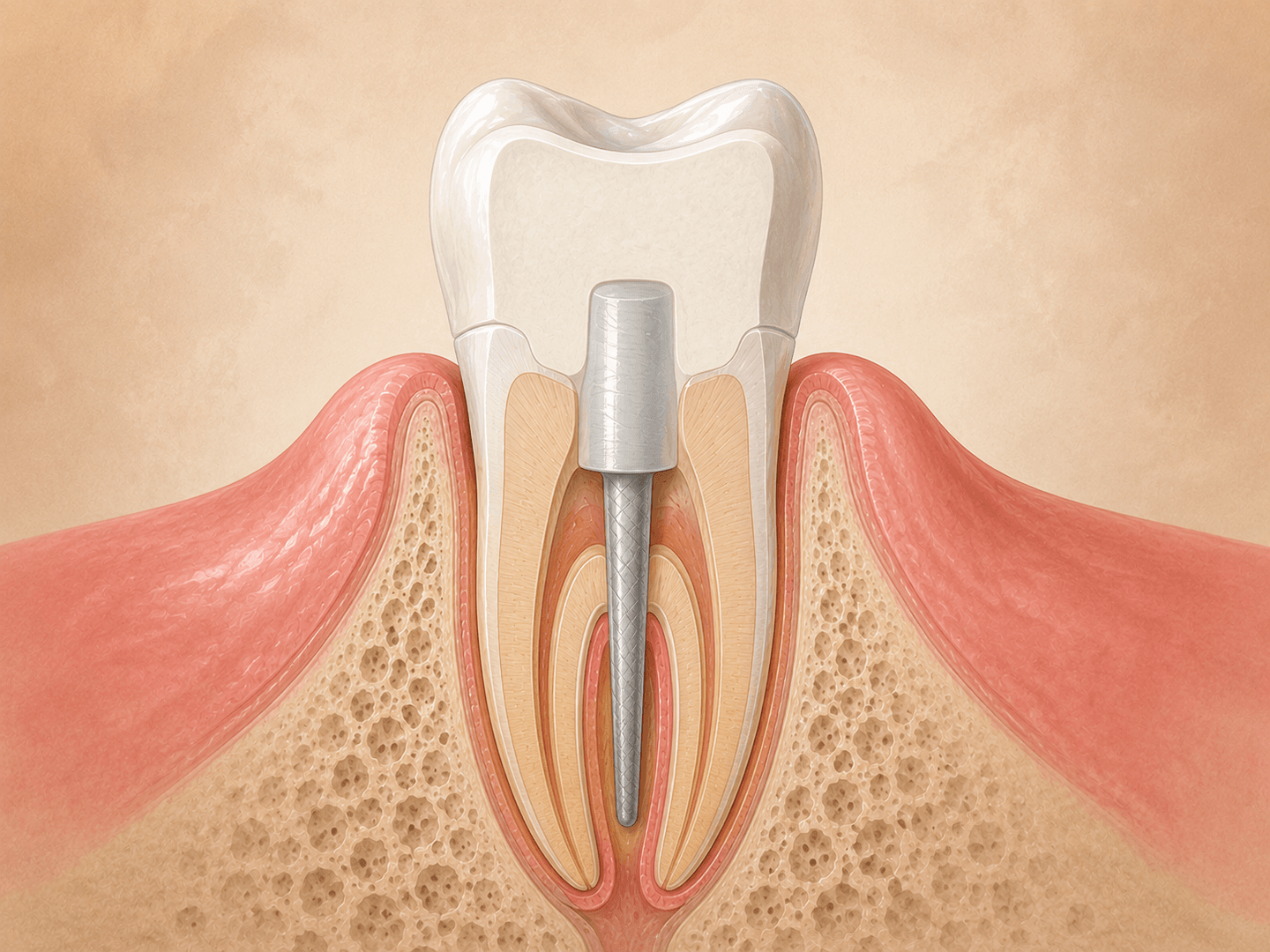
What D2950 covers
D2950 reports a core buildup placed on a natural tooth, including any pins required for retention. The buildup is the restorative material packed into the tooth to replace missing structure before a crown is prepared and cemented over it. It is an adjunctive procedure: it always goes with a crown or, occasionally, with a large direct restoration that’s being staged toward a crown later.
It does not cover:
- A direct restoration as the final restoration. That’s the D2140–D2394 series for amalgams and composites.
- A buildup with a cast post seated in a root canal. That’s D2952.
- A buildup with a prefab post seated in a root canal. That’s D2954.
- An additional indirectly fabricated (cast) post on the same tooth. That’s D2953, used with D2952.
- An additional prefabricated post on the same tooth. That’s D2957, used with D2954.
- A foundation restoration that is the final treatment, with no planned crown. That’s a regular restoration, not D2950.
The code assumes a planned crown. If no crown is planned, the buildup is generally just a large filling.
When to bill D2950
Bill D2950 when:
- A crown is planned and the tooth lacks sufficient structure to retain it without a buildup.
- More than half of the clinical crown is missing, fractured, or unsupported.
- A post-endo tooth needs structural reinforcement before crown preparation, and no post is being used.
- Pins are placed during the buildup to add retention.
Do not bill D2950 for:
- A small restoration that does not lead to a crown. Use the appropriate D2140–D2394 code.
- A buildup that includes a post seated in a root canal. Use D2952 (cast) or D2954 (prefab).
- A foundation under an inlay or onlay only. Carriers vary on this. Many bundle the buildup with the inlay/onlay benefit.
Top reasons D2950 gets denied or bundled
- “Not medically necessary.” The carrier judges the remaining tooth structure was adequate without a buildup. This is the most common denial and the hardest to overturn without strong documentation.
- Bundled with the crown. The plan considers the buildup inclusive to the crown benefit and refuses to pay it separately. Check the participating-provider agreement before billing the patient the buildup fee, since many contracts treat a bundled procedure as a write-off.
- Documentation missing. No pre-op radiograph, no clinical photo, no narrative describing the extent of structural loss. The carrier denies without enough information to judge necessity.
- Code mismatch. D2950 was billed when a post was actually placed. The carrier denies because the procedure should have been D2952 or D2954.
- Submitted without the crown claim. The carrier holds the buildup until it sees the crown on the same tooth. Some plans bundle them at adjudication, which can look like a denial.
What counts as “necessary”
The standard most carriers apply is straightforward in principle and contested in practice:
- More than half of the clinical crown is missing or unsupported.
- The remaining structure cannot retain a crown by itself.
- A post-endo tooth needs structural reinforcement.
The standard does not say “the tooth had decay” or “the prior filling was old.” It is about retention. A crown prep on a tooth with two thick cusps and a moderate filling generally does not need a buildup, and a carrier reviewing the claim will say so.
The chart and the radiograph need to show the case that meets the standard. A photo of the prepped tooth before the buildup material was placed is the strongest single piece of documentation. Most practices that lose appeals on D2950 lose them because no photo exists.
Documentation that supports the claim
The claim needs:
- Pre-op radiograph showing the tooth’s condition before the buildup.
- A clinical narrative describing the extent of structural loss.
- Ideally, a clinical photo of the prepped tooth before the buildup material was placed.
For the patient record, document:
- Estimated percentage of clinical crown remaining (or describe what was missing).
- Reason a direct restoration would not have been adequate.
- Whether pins were placed, and how many.
- Material used (composite, glass ionomer, amalgam buildup).
The phrase that does the most work in the narrative is the one that names what was missing: “Mesial cusp fractured to the gingival margin and lingual wall undermined by recurrent decay, leaving less than 30% of the clinical crown intact.” That sentence prevents most “not necessary” denials. A fill-in version is in our core buildup narrative template.
D2950 versus D2952 and D2954
The three codes share the same place in the workflow but describe different procedures:
- D2950 is a buildup with pins if needed. No post in the root canal.
- D2952 is a cast post and core. The post is custom-cast (typically in a lab) and the core is integral.
- D2954 is a prefab post and core. The post is a manufactured component seated in the canal, with the core built up around it.
If a post is placed in a root canal as part of the restoration, D2950 is wrong. Carriers cross-check this when the same tooth has recent endo on file.
Example case
A 51-year-old established patient has tooth #19 with a large failing amalgam, recurrent decay around the mesial margin, and a fractured distolingual cusp. After caries removal, less than 40% of the clinical crown remains. The dentist places a composite buildup with two pins to support the prep, then prepares for a porcelain crown.
Billing steps:
- Take a pre-op radiograph and a clinical photo before placing the buildup.
- Code D2950 with a clear narrative naming the structural loss and the pins.
- Submit on the same claim as D2740, with both films and the photo attached.
- Watch for an EOB. The buildup may pay, may bundle with the crown, or may deny for “not necessary.”
- If the denial cites necessity, appeal with the photo and narrative. If the denial cites bundling, post the carrier’s payment and check the participating-provider agreement before billing the patient the buildup fee or writing it off.
What to get right in your PMS
- Take and store a photo before placing the buildup. Without it, appeals on “not necessary” denials are very hard to win.
- Submit the buildup and crown on the same claim when possible. Splitting them across claims invites pending and reconciliation work.
- Attach the pre-op X-ray and the photo to the claim itself, not just the patient record. The carrier reads what’s on the claim.
- Use D2952 or D2954 when a post is placed. Coding D2950 with a post is a common error and a clean reason for the carrier to deny.
- Write the narrative at the time of treatment, not the time of submission. Narratives written days later from memory tend to be vague.
FAQs
- When is D2950 considered medically necessary?
- Most carriers consider a buildup necessary when more than half of the clinical crown is missing or unsupported, when there is insufficient tooth structure for a crown to be retained without it, or when a post-endo tooth needs structural reinforcement before crown preparation. Documentation should describe the extent of structural loss, not just state that a buildup was placed.
- Is D2950 the same as a post and core?
- No. D2950 is a core buildup placed in or on a natural tooth, with pins if needed. A post and core uses a prefabricated or cast post seated in a treated root canal. D2952 is a cast post and core, D2954 is a prefab post and core. If a post is part of the restoration, the correct code is D2952 or D2954, not D2950.
- Why does the carrier keep bundling D2950 into the crown payment?
- Some plans treat the buildup as part of the crown procedure and refuse to pay it as a separate benefit. The denial reads as 'inclusive to' or 'bundled with' the crown. This is plan language, not a clinical decision. Whether the patient can be billed the buildup fee depends on the participating-provider agreement, since many contracts bar billing the patient for a procedure the plan bundles.
- Do I need to attach a photo or X-ray to a D2950 claim?
- Yes, for most carriers. A pre-op radiograph showing the extent of decay or fracture, and a clinical photo or detailed narrative describing what was left of the tooth before the buildup, are the two pieces of evidence most likely to prevent a 'not necessary' denial.
- Can I bill D2950 if the patient doesn't end up getting the crown?
- Technically the code reports a buildup, not a buildup-plus-crown. If the buildup is placed and the crown is delayed (financial reasons, scheduling), the D2950 claim is valid. Carriers may pend it pending the crown claim and reconcile when the crown is submitted, especially if the plan bundles the two.
Related codes
Need help billing this code?
We handle D2950 claims daily.
If your team is spending time on denials, narratives, or carrier follow-up for this code, our outsourced dental insurance billing service can take it off your plate. We submit the claims, post what comes back, and follow up on anything unpaid.
“Claims, posting, denials, all of it gets handled, and it costs far less than hiring another employee. My front desk got hours of their week back, and honestly I just don't think about billing anymore.”
CDT codes are maintained by the American Dental Association. This page is an editorial billing guide, not the official ADA code descriptor. Verify current coverage policies with each carrier before submitting claims.