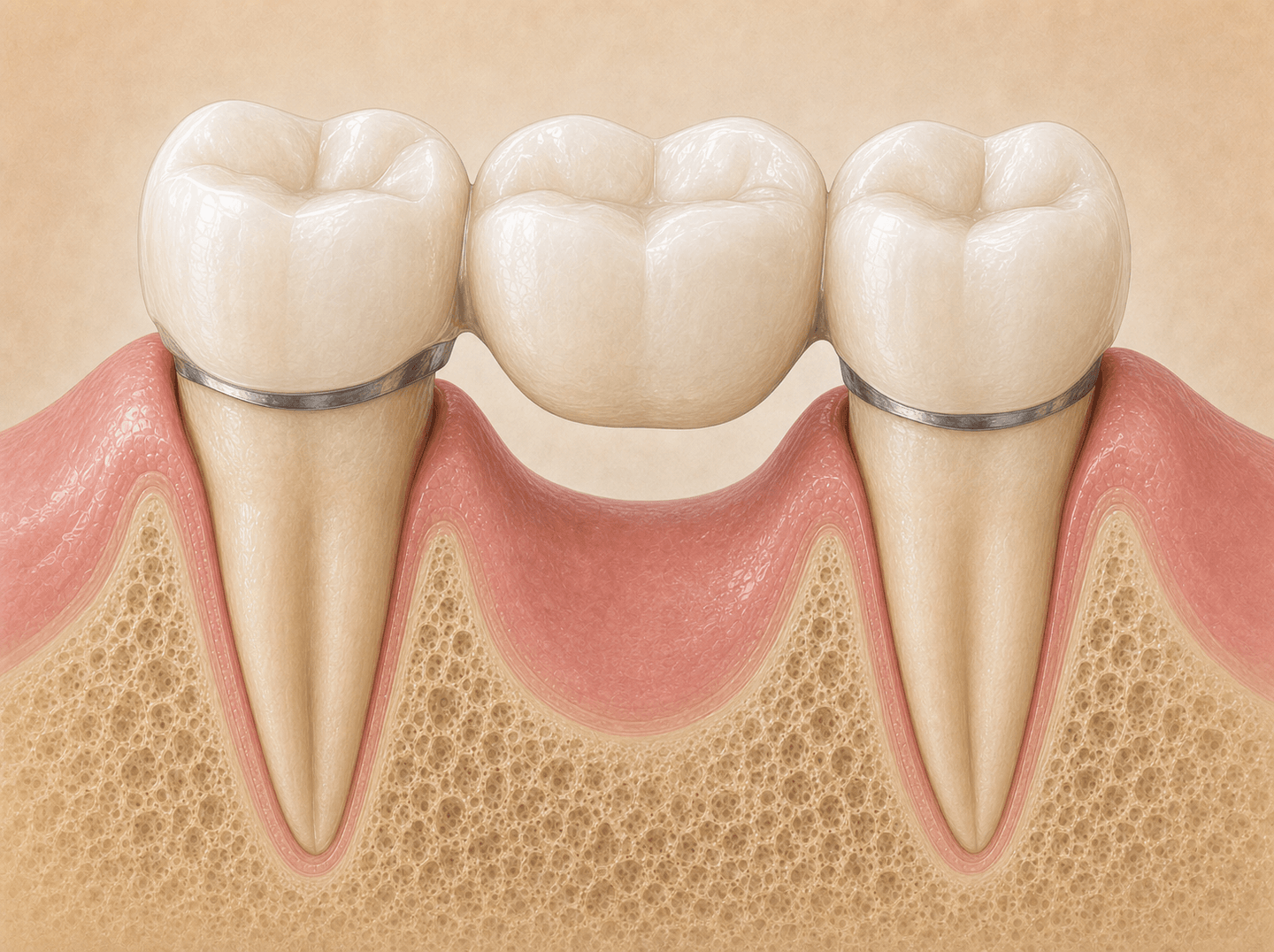
D6240 is the CDT code for a porcelain-fused-to-metal pontic — the replacement tooth in the span of a fixed bridge, built on a high noble metal substructure.
The code never bills alone. It pairs with retainer crown codes (D6750 on each abutment) and pays as part of the bridge unit. When it gets held up, the cause is almost always one of three things — the missing-tooth clause that often excludes the pontic, an abutment-pontic count mismatch on multi-unit bridges, or confusion between the noble metal designations (D6240, D6241, D6242).
On this page
- What D6240 covers
- When to bill D6240
- What separates D6240 from D6241 and D6242
- The missing-tooth clause as the dominant billing pattern
- Top reasons D6240 gets denied or downgraded
- The bridge claim as a unit: pontic plus retainer crowns
- Documentation that supports the claim
- Example case
- What to get right in your PMS
- FAQs
What D6240 covers
D6240 reports a porcelain-fused-to-metal pontic in a fixed bridge: the suspended replacement tooth between two abutments, fabricated from porcelain bonded to a high noble metal substructure (gold-platinum or similar high-content noble alloy). The code includes the laboratory fabrication of the pontic, its connection to the retainer crowns on each abutment, the try-in and adjustment, and the cementation as part of the bridge.
It does not cover:
- Pontics on a predominantly base metal substructure. Use D6241.
- Pontics on a noble metal substructure. Use D6242.
- Full-cast metal pontics (no porcelain). Use D6210 (high noble), D6211 (predominantly base), D6212 (noble).
- All-ceramic pontics. Use D6245.
- Resin or acrylic-faced metal pontics. Use the appropriate D6250 series.
- The retainer crowns on the abutment teeth. Use D6750 (high noble), D6751 (predominantly base), D6752 (noble) for PFM retainers.
- Implant-supported bridges. Use the D6065–D6079 series.
- Maryland bridges or resin-bonded prostheses. Use D6545–D6549.
The code is one of several pontic codes; the choice between them comes down to the metal substructure of the pontic.
When to bill D6240
Bill D6240 when:
- A fixed bridge has been fabricated with one or more pontics on high noble metal substructure with porcelain facing.
- The bridge has been cemented and the patient released from the delivery appointment.
- Each pontic in the bridge is billed as a separate D6240 (or appropriate variant).
Do not bill D6240 for:
- The retainer crowns on the abutment teeth. Those use D6750/D6751/D6752.
- Pontics fabricated on a different metal substructure. Match the code to the actual alloy.
- Single crowns on natural teeth or implants. Bridge codes only apply when the units are connected as a fixed prosthesis.
What separates D6240 from D6241 and D6242
The metal substructure designation drives the code:
- D6240: Porcelain fused to high noble metal. The metal is at least 60% noble metal content, with at least 40% gold. Typically a gold-platinum or gold-palladium alloy. Higher cost, better marginal accuracy, and lower allergy potential than base metal alloys.
- D6241: Porcelain fused to predominantly base metal. Less than 25% noble metal content. Typically a nickel-chromium or cobalt-chromium alloy. Lower cost. Some patients have nickel sensitivity, which can be a clinical consideration.
- D6242: Porcelain fused to noble metal. At least 25% noble metal content but less than 60%. A middle option between D6240 and D6241.
The lab work order should specify which alloy was used. The chart should match. Carriers occasionally audit metal-bridge claims and the metal designation has to be defensible if questioned.
The missing-tooth clause as the dominant billing pattern
The missing-tooth clause is the most consequential coverage rule on bridges. The clause excludes prosthetic replacement of teeth that were missing before the patient’s current coverage started. The pontic replaces the missing tooth, so the exclusion typically applies directly to the pontic.
How the math works on a typical bridge case:
- The patient lost tooth #19 five years before the current coverage started.
- The dentist treatment-plans a three-unit bridge: D6750 on #18, D6240 pontic for #19, D6750 on #20.
- The carrier processes the claim. The retainer crowns on #18 and #20 are covered as restorations on existing teeth (subject to the plan’s crown coverage). The pontic for #19 is excluded by the missing-tooth clause.
- The patient owes the full cost of the pontic plus standard coinsurance on the retainer crowns.
The implication is that even on a “covered” bridge case, the pontic can be entirely out-of-pocket. A pre-treatment estimate flags this before the patient commits to treatment.
Top reasons D6240 gets denied or downgraded
Five issues account for most problems on this code:
- Missing-tooth clause exclusion on the pontic. The most common scenario. The retainer crowns may pay; the pontic doesn’t. Patient owes the pontic in full.
- Frequency limit hit. A prior bridge or partial denture covering the same tooth position within the plan’s frequency window. Appeal with documentation of the prior prosthesis failure.
- Bridge span considered excessive. Some plans limit coverage on long-span bridges (5+ units) or require documentation that the case is appropriate. A narrative explaining the clinical case and the alternatives considered helps.
- Wrong metal designation. D6240 billed but the lab actually used predominantly base metal (should be D6241). The carrier’s audit may reconcile against the lab invoice. Match the code to the actual alloy.
- Documentation of pre-existing missing tooth absent. Some carriers require a panoramic radiograph or chart documentation showing the missing tooth position and the proposed bridge. A pre-op pano usually clears the request.
The bridge claim as a unit: pontic plus retainer crowns
D6240 never bills alone. A complete bridge claim includes:
- One D6240 (or appropriate pontic code) for each pontic in the bridge.
- One D6750 (or appropriate retainer crown code) for each abutment tooth.
For a standard three-unit bridge:
- D6750 on the mesial abutment.
- D6240 in the middle (pontic).
- D6750 on the distal abutment.
Three codes, one date of service, one bridge.
For a four-unit bridge with two pontics:
- D6750 on the mesial abutment.
- D6240 for the first pontic.
- D6240 for the second pontic.
- D6750 on the distal abutment.
Four codes, one date of service.
The carrier processes each code separately for coverage and patient responsibility, but the bridge functions as a single prosthesis. The chart should document the bridge as a unit (the bridge design, the lab work order, the cementation) and the claim should list all units.
Documentation that supports the claim
The claim needs:
- Date of service (the bridge cementation date).
- Tooth numbers for each pontic and each abutment.
- Metal designation matching the actual alloy.
- Panoramic radiograph or pre-op periapical for some carriers.
For the patient record, document:
- The bridge design (number of units, pontic positions, abutment teeth).
- Lab work order including alloy specification.
- Try-in date and fit verification.
- Cementation material and date.
- Occlusion checked and adjusted.
- Date the missing tooth was lost (relevant for missing-tooth clause documentation).
If the patient is a bridge-replacement case, document the date and clinical reason for replacement of the prior bridge.
Example case
A 51-year-old patient presents with a missing tooth #19, lost three years ago after a fracture. The teeth on either side (#18 and #20) are sound and well-restored. The patient wants a fixed bridge instead of an implant. The plan’s missing-tooth clause excludes replacement of teeth lost before current coverage; the patient lost #19 before the current policy started.
Treatment sequence:
- Visit 1: diagnostic impressions, periodontal evaluation, treatment plan.
- Visit 2: abutment preparations on #18 and #20, impressions, temporary bridge cementation.
- Visit 3 (two weeks later): final bridge try-in, occlusion verification, cementation.
Billing steps:
- Verify benefits. Confirm bridge coverage rules and the missing-tooth clause language.
- Run a pre-treatment estimate. Quote the patient the expected out-of-pocket including the full pontic cost (excluded by missing-tooth clause) plus coinsurance on the retainer crowns.
- Submit on the bridge delivery date:
- D6750 with tooth number 18.
- D6240 with tooth number 19.
- D6750 with tooth number 20.
- Specify high noble metal on the claim and in the chart.
If the patient’s plan doesn’t apply the missing-tooth clause on this case (some plans don’t), the EOB pays at the full bridge allowable. The pre-treatment estimate should have set the expectation either way.
What to get right in your PMS
The specifics vary across Open Dental, Dentrix, Eaglesoft, Curve, and Carestream. The steps that matter:
- Bill all units on the same date of service. The bridge is a single prosthesis delivered at one cementation visit.
- Use the correct pontic code per unit. D6240 for high noble PFM. D6241 for predominantly base metal PFM. D6242 for noble metal PFM. Match the code to the actual alloy.
- Pair pontic codes with the matching retainer crown codes. D6240 pairs with D6750 (both high noble PFM). The lab work order should specify the same alloy for both.
- Run pre-treatment estimates on bridge cases. The missing-tooth clause makes patient-responsibility prediction critical.
- Document the date the missing tooth was lost. Pull it from the patient’s records, prior carrier records, or the patient interview. This date drives the missing-tooth clause calculation.
If your office sees recurring patient-responsibility surprises on bridge cases, the cause is usually that the missing-tooth clause wasn’t explained at treatment planning. A pre-treatment estimate that lists each code’s expected payment, including the explicit “$0 covered” line for an excluded pontic, prevents the conversation after delivery.
FAQs
- What's the difference between D6240, D6241, and D6242?
- All three are PFM pontics, distinguished by the metal substructure. D6240 is porcelain fused to high noble metal (typically gold-platinum alloy). D6241 is porcelain fused to predominantly base metal. D6242 is porcelain fused to noble metal. The metal designation affects the office fee and sometimes the plan's allowable. The lab should specify which alloy was used and the chart should record it.
- Does D6240 bill alone?
- No. D6240 is the pontic only. A complete bridge claim includes the pontic plus retainer crowns on each abutment (D6750 for PFM retainer crown on high noble metal, D6751 for predominantly base metal, D6752 for noble metal). A three-unit bridge with one pontic and two abutments bills three codes on the same date: two retainer crowns plus the pontic.
- What's the missing-tooth clause and how does it affect D6240?
- The missing-tooth clause excludes coverage for prosthetic replacement of teeth that were missing before the patient's current coverage started. On bridges this typically means the pontic (which replaces the missing tooth) isn't covered, while the retainer crowns on the adjacent teeth may be covered as separate restorations. The patient owes the full pontic cost plus any uncovered retainer crown portion.
- Why was D6240 denied for frequency when the patient never had a bridge before?
- Bridge frequency typically counts at the tooth replacement level, not the bridge level. If the patient had a partial denture or prior bridge covering the same tooth position within the frequency window (usually 5 years), the new bridge claim hits the limit. The denial usually clears on appeal if the prior prosthesis is documented as failed or replaced for clinical reason.
- Can a bridge span more than three units?
- Yes. A four-unit bridge with two pontics bills as four retainer crowns and two pontics, all on the same date. Long-span bridges (5+ units) carry higher technical and biological risk; some carriers limit coverage on long spans or require documentation that an implant alternative was considered.
Related codes
Need help billing this code?
We handle D6240 claims daily.
If your team is spending time on denials, narratives, or carrier follow-up for this code, our outsourced dental insurance billing service can take it off your plate. We work inside your PMS and post payments the same week.
CDT codes are maintained by the American Dental Association. This page is an editorial billing guide, not the official ADA code descriptor. Verify current coverage policies with each carrier before submitting claims.