D6750 is the CDT code for a porcelain-fused-to-high-noble-metal retainer crown that anchors one end of a fixed bridge and supports a pontic — not a single-unit crown (that's D2750).
This is not a single-unit crown. The code signals that the crown is part of a bridge, supporting a pontic that replaces a missing tooth. The number-one billing error on D6750 is coding it as D2750 (single crown), which triggers a denial for code-procedure mismatch.
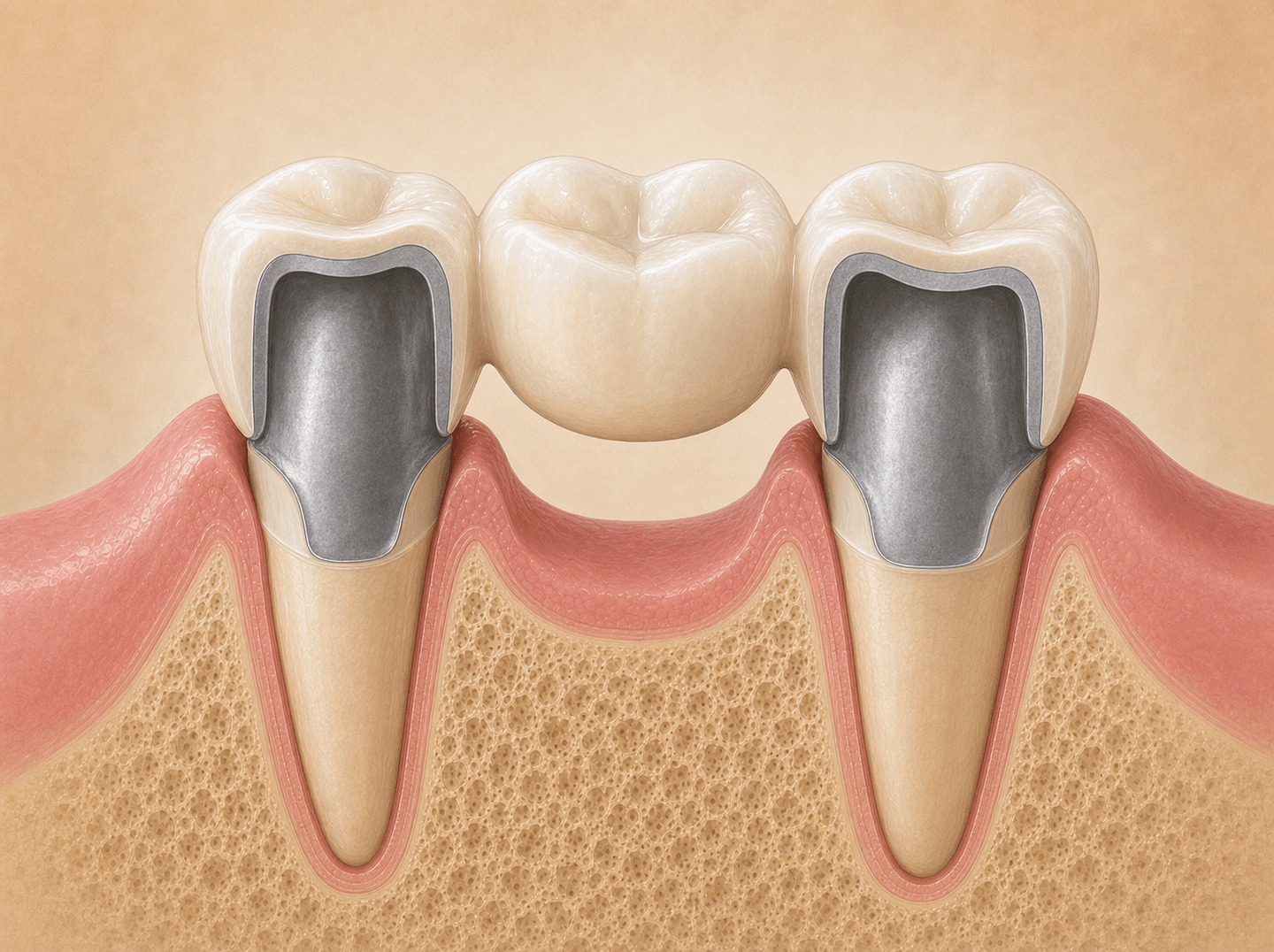
What D6750 covers
D6750 reports a retainer crown made of porcelain fused to high noble metal that serves as an abutment in a fixed bridge. The high noble metal substructure must contain at least 60% noble metal with at least 40% gold. Porcelain is layered over the metal coping for the visible surface. The code covers the fabrication, try-in, adjustment, and cementation of the retainer crown as part of the bridge delivery.
The key distinction: D6750 is not a standalone crown. It is part of a fixed partial denture (bridge). The crown is connected to a pontic that replaces a missing tooth, and the retainer crown bears the load for that pontic.
It does not cover:
- Single-unit PFM crowns on natural teeth. Use D2750.
- PFM retainer crowns on predominantly base metal. Use D6751.
- PFM retainer crowns on noble metal. Use D6752.
- All-ceramic retainer crowns. Use D6740.
- Full-cast metal retainer crowns (no porcelain). Use D6790 (high noble), D6791 (predominantly base), D6792 (noble). D6780/D6781/D6782 are the 3/4 (partial-coverage) cast retainer crowns, not the full-cast option.
- Implant-supported bridge retainers. Use the implant-supported fixed partial denture retainer codes; D6750 is a retainer crown on a natural tooth, and D6065 is a single implant-supported crown, not a bridge retainer.
- Maryland bridge or resin-bonded retainers. Use D6545 or D6548.
If the crown is cemented on a natural tooth, connected to a pontic, and made of porcelain fused to high noble metal, it’s D6750.
When to bill D6750
Bill D6750 when:
- A fixed bridge has been fabricated and the retainer crown on the abutment tooth uses porcelain fused to high noble metal.
- The bridge has been permanently cemented and the patient released from the delivery appointment.
- Each abutment in the bridge gets its own D6750 (or appropriate retainer code if the metals differ).
Do not bill D6750 for:
- Single-unit crowns that don’t support a pontic. That’s D2750.
- The pontic itself. Pontics use the D6240 series.
- Temporary bridges or provisional restorations before the final bridge is seated.
How bridge billing works: D6750 plus pontic plus retainer
D6750 is always part of a multi-unit claim. The bridge bills as a set of codes on a single date of service.
For a standard three-unit bridge:
- D6750 on the mesial abutment tooth.
- D6240 (PFM pontic, high noble) in the pontic position.
- D6750 on the distal abutment tooth.
Three codes, three tooth numbers, one date of service.
For a four-unit bridge with two pontics:
- D6750 on the mesial abutment.
- D6240 for the first pontic.
- D6240 for the second pontic.
- D6750 on the distal abutment.
The retainer and pontic codes should match on metal classification. If the lab fabricated the entire bridge in high noble metal, the retainers are D6750 and the pontics are D6240. If one abutment uses an all-ceramic retainer while the other uses PFM, the codes split (D6740 on the ceramic side, D6750 on the PFM side). The lab work order is the source of truth.
D6750 versus D2750: the retainer versus single-crown trap
This is the most common preventable error on bridge claims. D2750 and D6750 describe the same physical restoration (PFM crown on high noble metal), but they report different procedures:
- D2750 reports a single-unit crown on a natural tooth. No bridge. No pontic.
- D6750 reports a retainer crown that supports a bridge pontic.
When a practice codes a bridge retainer as D2750, the carrier sees a single crown. The claim doesn’t match the clinical procedure (a bridge), and the carrier denies for code-procedure mismatch. Sometimes the carrier processes the D2750 and denies the pontic because the pontic has no matching retainer code to link to. Either way, the claim gets kicked back.
The fix is straightforward: if the crown supports a pontic, it’s a retainer crown. Use D6750, D6751, D6752, or D6740 depending on the material. Never D2750.
This error often starts in the PMS. If the treatment plan was entered as a single crown and later changed to a bridge, the code may not have been updated. Check the procedure codes on the claim before submission, not after the denial arrives.
Top reasons D6750 gets denied
Six issues account for most problems on this code:
- Code-procedure mismatch (D2750 instead of D6750). The retainer was coded as a single crown. Carrier denies because the procedure doesn’t match the bridge being claimed.
- Missing-tooth clause. The pontic tooth was missing before coverage started. The carrier excludes the pontic and sometimes the retainers. See the next section.
- Pre-authorization not obtained. Most plans require a pre-treatment estimate on bridges. Without it, the claim denies for missing prior auth.
- Waiting period on major prosthodontics. New plans often impose a 12-month waiting period on major prosth. A bridge submitted during the waiting period denies outright.
- Frequency limit on replacement bridges. Plans typically allow one bridge per area every 5 to 10 years. If the patient had a prior bridge or partial in the same tooth positions within the window, the claim hits the frequency limit.
- Wrong metal classification. D6750 billed but the lab used predominantly base metal (D6751) or noble metal (D6752). If the carrier audits and the lab invoice doesn’t match the code, the claim gets adjusted or denied.
The missing-tooth clause
The missing-tooth clause is the single biggest coverage issue on bridge cases. The clause excludes prosthetic replacement of teeth that were missing before the patient’s current plan started.
How it plays out:
- Patient lost tooth #30 four years before their current coverage began.
- Dentist treatment-plans a three-unit bridge: D6750 on #29, D6240 on #30, D6750 on #31.
- Carrier processes the claim. The pontic for #30 is excluded by the missing-tooth clause. The retainer crowns on #29 and #31 may or may not be covered depending on the plan’s language. Some plans exclude the entire bridge. Others cover the retainers as restorations on the abutment teeth but exclude only the pontic.
- The patient owes the full pontic cost plus coinsurance on whatever the plan covers.
The missing-tooth clause varies widely. Some plans apply it only to the pontic. Some apply it to the entire prosthesis. A few plans don’t have it at all. The benefit booklet is the source of truth.
A pre-treatment estimate that includes the carrier’s explicit response on each code (D6750, D6240, D6750) prevents the surprise at delivery. Run it before the prep appointment, not after.
Documentation that supports the claim
The claim needs:
- Date of service matching the bridge cementation date, not the prep date.
- Tooth numbers for each retainer and each pontic position.
- Metal classification matching the actual alloy used by the lab. The lab work order is the reference.
- Pre-operative radiograph (panoramic or periapicals) showing the missing tooth site and the abutment teeth.
- Narrative when the case involves a replacement bridge, a long span, or any clinical complexity the carrier might question.
For the patient record, document:
- The bridge design (number of units, pontic positions, abutment teeth).
- Lab work order including alloy specification and noble metal content.
- Try-in date and fit verification.
- Cementation material and date.
- Occlusion checked and adjusted.
- Date the missing tooth was lost (drives missing-tooth clause determination).
- If this replaces a prior bridge: the date the original was placed and the clinical reason for replacement.
Example case
A 55-year-old patient is missing tooth #19, extracted two years after the current plan started. The teeth on either side (#18 and #20) are structurally sound. The dentist treatment-plans a three-unit PFM bridge on high noble metal.
Billing steps:
- Verify benefits. Confirm bridge coverage, the missing-tooth clause status (tooth #19 was lost during coverage, so the clause should not apply), waiting period status, and frequency limits.
- Submit a pre-treatment estimate: D6750 on #18, D6240 on #19, D6750 on #20.
- Wait for the carrier’s response. Quote the patient the expected out-of-pocket from the carrier’s numbers.
- After bridge delivery and cementation, submit the claim on the seating date:
- D6750 with tooth number 18.
- D6240 with tooth number 19.
- D6750 with tooth number 20.
- Attach the pre-op radiograph and the lab work order confirming high noble metal.
- If the EOB shows a downgrade (carrier paying at the D6751 allowable instead of D6750), post the carrier’s payment and bill the patient the difference between your office fee and the downgraded allowable minus the patient’s coinsurance.
What to get right in your PMS
The specifics vary across Open Dental, Dentrix, Eaglesoft, Curve, and Carestream. The steps that matter:
- Code retainer crowns as D6750, not D2750. If the treatment plan started as a single crown and changed to a bridge, update the code. This is the most common billing error on bridge retainers.
- Bill all bridge units on the same date of service. The bridge is a single prosthesis delivered at one cementation visit. Splitting the codes across dates creates processing issues.
- Match metal codes across the bridge. D6750 pairs with D6240 (both high noble). If the lab used a different alloy, update every code in the bridge to match.
- Attach the pre-op radiograph to the claim, not just the patient record. The clearinghouse needs the image linked to the specific claim.
- Run the pre-treatment estimate before the prep appointment. The missing-tooth clause and waiting-period status need to be resolved before the patient is in the chair, not after the bridge is cemented.
If your office sees recurring denials on bridge claims for code-procedure mismatch, the root cause is usually the treatment-plan-to-claim handoff. A checklist at claim creation that confirms “retainer codes, not single-crown codes” prevents the cycle.
FAQs
- What's the difference between D6750 and D2750?
- D2750 is a single-unit PFM crown cemented on a natural tooth. D6750 is a PFM retainer crown that anchors one end of a fixed bridge. Both are porcelain fused to high noble metal, but D6750 signals that the crown is connected to a pontic as part of a bridge. Billing a bridge retainer as D2750 is a common denial because the code doesn't match the procedure.
- What's the difference between D6750, D6751, and D6752?
- All three are PFM retainer crowns for bridges. D6750 is high noble metal (at least 60% noble metal, at least 40% gold). D6751 is predominantly base metal (less than 25% noble metal). D6752 is noble metal (at least 25% noble, but under 60%). The lab slip specifies which alloy was used. Code the one that matches the actual metal.
- Does D6750 bill alone?
- No. D6750 is one unit in a bridge claim. A three-unit bridge typically bills as D6750 (retainer on the first abutment), D6240 (pontic), and D6750 (retainer on the second abutment), all on the same date of service. Each unit in the bridge gets its own code and tooth number.
- Why was D6750 denied when the retainer crown is fine clinically?
- The most common reason is the missing-tooth clause. The carrier excluded the pontic because the tooth was lost before coverage started, and in some cases that exclusion extends to the entire bridge. Other common causes are frequency limits on replacement bridges, missing pre-authorization, and waiting periods on major prosthodontics.
- Does D6750 need pre-authorization?
- Usually yes. Most plans classify bridges as major prosthodontics and require a pre-treatment estimate or prior authorization before delivery. Some carriers will deny outright if pre-auth wasn't obtained. Check the plan's requirements before the prep appointment.
Related codes
Need help billing this code?
We handle D6750 claims daily.
If your team is spending time on denials, narratives, or carrier follow-up for this code, our outsourced dental insurance billing service can take it off your plate. We work inside your PMS and post payments the same week.
CDT codes are maintained by the American Dental Association. This page is an editorial billing guide, not the official ADA code descriptor. Verify current coverage policies with each carrier before submitting claims.