D7140 is the CDT code for removing an erupted tooth or exposed root with forceps or an elevator, with no flap, bone removal, or sectioning.
- When to use: The erupted tooth came out intact with an elevator, forceps, or both, and using an elevator alone does not make the case surgical.
- When not to use: Any flap, bone removal, or sectioning makes it D7210, impactions are D7220 through D7241, and a primary coronal remnant is D7111.
- Billing note: A missing pre-op radiograph is the most common pend or denial, so attach the film to the claim, not just the chart.
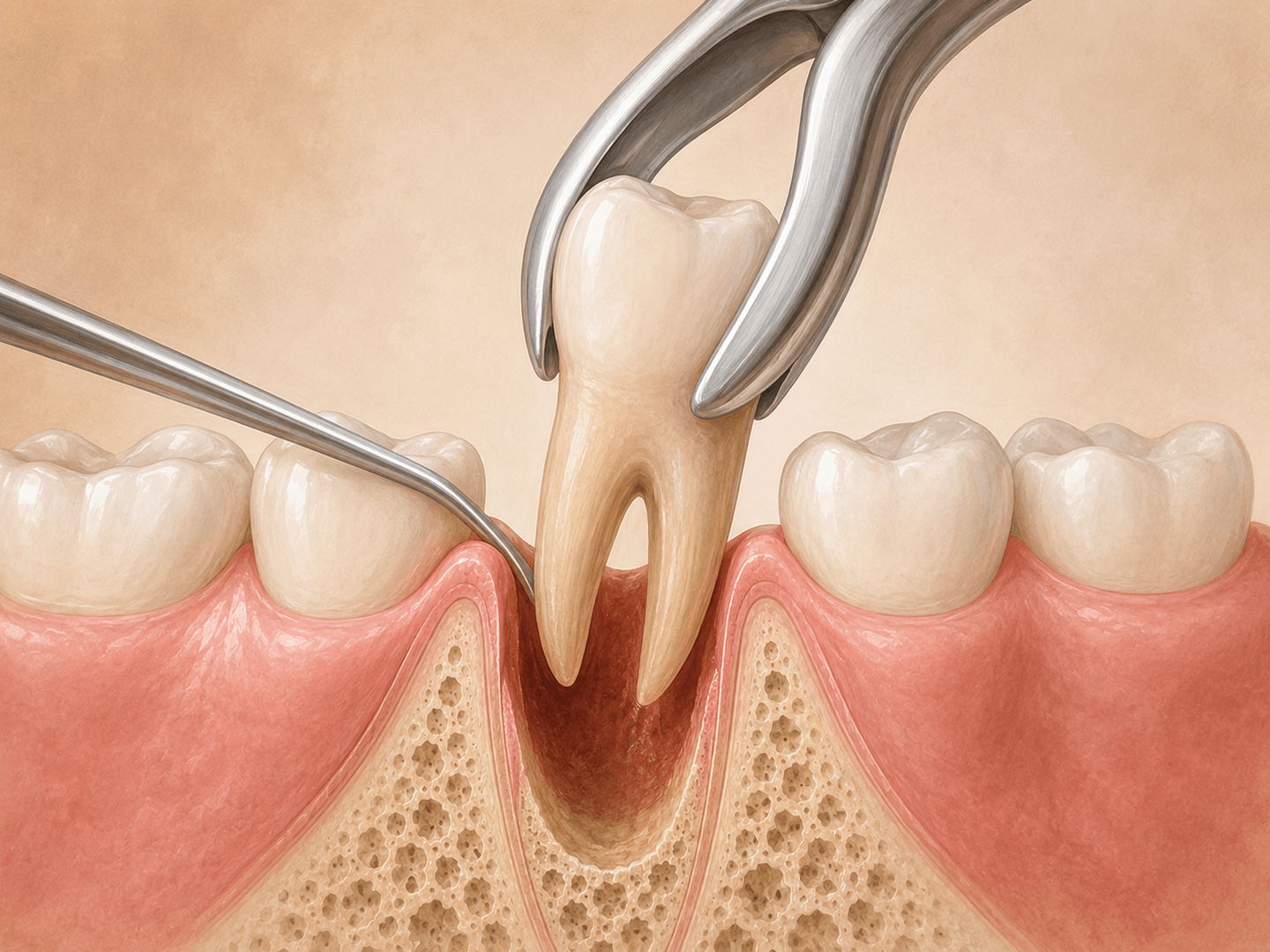
What D7140 covers
D7140 is the simplest extraction code in the CDT set. It reports a tooth that was already erupted into the mouth, or a root that was already exposed, delivered intact with an elevator, forceps, or both. No flap is elevated, no bone is removed, and the tooth is not sectioned. Using a dental elevator does not push the case to D7210.
It does not cover:
- Extractions requiring flap elevation, bone removal, or tooth sectioning. Use D7210.
- Residual roots without crown structure that are not clinically erupted. Use D7250 (root tip removal, cutting procedure). For coronal remnants of a primary tooth, use D7111.
- Impacted teeth, partial or complete. Use D7220, D7230, D7240, or D7241.
- Surgical removal of asymptomatic third molars or pre-eruption removal. Different codes apply.
D7140 versus D7210
The line between the two codes is technique, not the patient or the tooth:
- D7140 is elevator and/or forceps delivery of an erupted tooth, intact.
- D7210 is an extraction that required at least one of: flap elevation, bone removal, or sectioning.
The same tooth might be D7140 on one patient and D7210 on another, depending on the bone, the tooth’s anatomy, and what the surgery actually required. If the operative note describes any of the surgical steps, the case is D7210.
Some practices code every extraction as D7140 because the fee differential makes upgrading seem not worth it. That works until a carrier audit finds operative notes describing surgical technique on D7140 claims. The reverse error, billing D7210 for a simple extraction, invites a downgrade because the note doesn’t support the surgical code.
Top reasons D7140 gets denied
- No pre-op radiograph attached. The most common pend or denial. The carrier wants to see the tooth’s condition before paying. A film stored in the patient record but not attached to the claim is invisible to the carrier.
- Tooth number mismatch. The tooth on the claim doesn’t match the radiograph or the chart. Transposition is the most common cause of clean denials on extraction claims.
- Should have been D7210. The operative note describes flap elevation or bone removal. The carrier may upgrade and pay the difference, deny pending a corrected claim, or, least often, accept it as billed.
- Should have been a different extraction code. Residual roots billed as D7140 may need correction to D7250.
- Medical-eligibility cases. A trauma extraction billed to dental when medical coverage should have applied. This is less a denial than a reimbursement-pathway error, so check for a medical pathway before defaulting to dental.
Documentation that supports the claim
The claim needs:
- A pre-op radiograph showing the tooth’s condition.
- A tooth number that matches the films.
- A date of service that matches the surgery date.
- A brief operative note in the chart.
For the patient record, document:
- The clinical reason for the extraction (caries, fracture, periodontal, orthodontic, pre-prosthetic).
- The technique used (elevator and/or forceps, no flap, no bone removal, no sectioning).
- Post-op instructions provided.
- Any complications.
Write the operative note at the time of treatment, not at the end of the day, so it keeps the specifics carriers look for. A note that says “extraction of #14 by elevation and forceps, intact delivery, no flap, no bone removal” supports D7140 unambiguously. A note that says “extraction #14, sutures placed” suggests a flap was elevated and may invite an audit reclassification to D7210.
Example case
A 28-year-old patient has an unrestorable lower molar (#18) with a vertical fracture extending below the gumline on the distal. The tooth is fully erupted with no impaction. The dentist delivers it intact with an elevator and forceps, with no flap and no bone removal. The socket is curetted and irrigated, and gauze is placed for hemostasis. No sutures.
Billing steps:
- Take a pre-op radiograph showing the fracture and the tooth’s general condition.
- Code D7140 with the radiograph attached.
- Confirm the operative note records elevator and/or forceps technique, intact delivery, no flap, and no bone removal.
- If the claim pends for additional information, respond with the radiograph and operative note. Carriers occasionally lose the original attachment.
FAQs
- What's the difference between D7140 and D7210?
- Technique. D7140 is a simple extraction by elevator and/or forceps with no flap, no bone removal, and no sectioning; using an elevator does not make it surgical. If the extraction needed a flap, bone removal, or sectioning, the code is D7210.
- Do I need a pre-op X-ray for D7140?
- Yes, for most carriers. The film documents the tooth's condition and confirms the diagnosis, and without it the carrier may pend or deny. Attach it to the initial claim rather than waiting for a request.
- Can D7140 be billed under medical insurance?
- Sometimes. Extractions related to trauma, certain medical conditions (preparing for cancer treatment, organ transplant clearance, cardiac valve surgery clearance), or work-related injuries may have medical coverage. Most routine D7140 cases stay under the dental benefit.
- Can I bill D7140 multiple times on the same date for different teeth?
- Yes. D7140 is per tooth, not per visit, so each extraction is its own claim line with its own tooth number, and the carrier processes each line separately. Some plans cap the number of extractions paid per day, but that is a benefit cap, not a code restriction.
- Does D7140 include the routine post-op visit?
- For most plans, yes. The D7140 fee is treated as global and covers the routine post-op check within a short window, so a separate exam code on that visit usually denies as inclusive. If the patient returns with a complication that needs management beyond routine follow-up, D9930 (treatment of complications) may apply depending on what was done.
Related codes
Need help billing this code?
We handle D7140 claims daily.
If your team is spending time on denials, narratives, or carrier follow-up for this code, our outsourced dental insurance billing service can take it off your plate. We submit the claims, post what comes back, and follow up on anything unpaid. Already sitting on older claims that never paid? Our AR cleanup project works the backlog.
“Claims, posting, denials, all of it gets handled, and it costs far less than hiring another employee. My front desk got hours of their week back, and honestly I just don't think about billing anymore.”
CDT codes are maintained by the American Dental Association. This page is an editorial billing guide, not the official ADA code descriptor. Verify current coverage policies with each carrier before submitting claims.