D7210 is the CDT code for removing an erupted tooth that needed a flap, bone removal, or sectioning to come out.
- When to use: Any erupted tooth that needed surgical steps to remove, even one you expected to be simple.
- When not to use: A forceps-only extraction is D7140, and impacted teeth are D7220, D7230, or D7240.
- Billing note: Carriers downgrade to D7140 when the note says 'difficult' without naming the flap, bone removal, or sectioning.
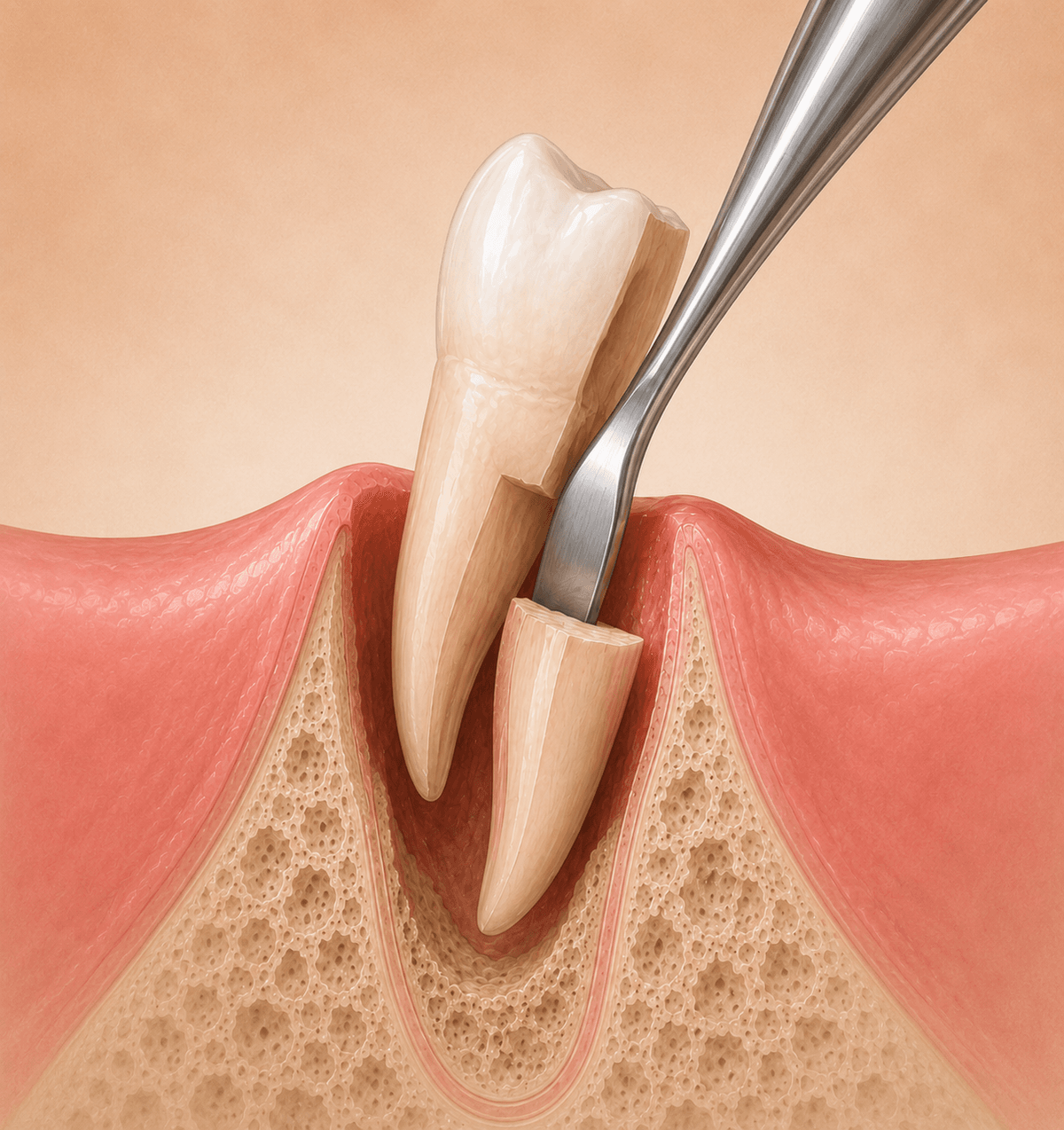
What D7210 covers
D7210 reports the surgical extraction of an erupted tooth that requires at least one of three surgical interventions: flap elevation, removal of bone, or sectioning of the tooth. The tooth is clinically erupted into the oral cavity but cannot be delivered intact with forceps alone.
It does not cover:
- A forceps-only extraction with no surgical intervention. Use D7140.
- Removal of residual/retained tooth roots that requires a cutting procedure (soft-tissue flap and/or bone removal). Use D7250. A residual or exposed root that can be removed by elevation/forceps without cutting is D7140.
- Impacted teeth at any level (soft tissue, partial bony, complete bony). Use D7220, D7230, D7240, or D7241.
- Removal of coronal remnants on a deciduous (primary) tooth. Use D7111.
The defining feature is technique: surgical intervention to deliver an erupted tooth. The tooth itself is visible above the bone, but the surgery is required to free it.
When to bill D7210
Bill D7210 when:
- The tooth is fully erupted but cannot be delivered with forceps alone.
- A flap is elevated to access the tooth or root.
- Bone is removed (using a bur, chisel, or similar) to expose more of the tooth or create a delivery path.
- The tooth is sectioned (cut with a handpiece) so individual pieces can be removed.
- A combination of the above is needed.
Do not bill D7210 for:
- Routine forceps extractions. Use D7140.
- Impacted teeth. Use the impaction codes.
- Residual/retained tooth roots requiring a cutting procedure. Use D7250.
- Surgical procedures that aren’t extractions. Use the appropriate periodontal or oral surgery code.
Top reasons D7210 gets downgraded to D7140
The most common adverse outcome on D7210 is not denial. It is downgrade. Five issues account for most of them:
- Narrative doesn’t name the surgical steps. A note that says “extraction of #19, sutures placed” doesn’t tell the carrier that a flap was elevated and bone was removed. The carrier defaults to D7140. Our dental narratives guide has a fill-in surgical extraction template that names each step.
- Operative note describes “complicated” or “difficult” without specifics. Adjectives don’t justify surgical coding. The note should name the technique.
- No pre-op radiograph. Without the films, the carrier can’t see the indication for surgical intervention.
- Routine-looking case on a single-rooted tooth. Carriers scrutinize D7210 claims on bicuspids and incisors more heavily than on molars because the surgical case is harder to justify on simpler anatomy. The narrative needs to be specific.
- Operative note appears to describe a forceps technique. The note says “elevated and delivered with forceps,” with no mention of bone removal or sectioning. The carrier reads this as D7140 regardless of how the claim was billed.
Writing a narrative that prevents downgrade
The narrative that holds up under carrier review names the surgical steps explicitly. Three elements together do most of the work:
- What was done. Flap elevated, bone removed, tooth sectioned. Use the operative term, not a generic word like “surgical.”
- Why it was done. Curvature of the roots, ankylosis, divergent roots, proximity to a critical structure, fracture during delivery requiring sectioning.
- What was used. Number 15 blade for the flap, surgical handpiece for bone removal or sectioning, periotome, elevators.
A narrative that reads “Number 15 blade elevation of mucoperiosteal flap. Surgical handpiece used to section #19 into mesial and distal halves due to widely divergent roots. Each half delivered separately with elevators and forceps. Socket curetted, flap repositioned, 4-0 chromic sutures placed” gives the carrier specific evidence that the surgical code is correct.
A narrative that reads “Surgical extraction of #19, sutures placed” leaves the carrier reading between the lines and usually downgrading.
Documentation that supports the claim
The claim needs:
- Pre-op radiograph showing the tooth and the surgical indication.
- A specific operative narrative naming the surgical steps performed.
- Tooth number matching films and chart.
- Date of service matching the surgical date.
For the patient record, document:
- The clinical reason for surgical intervention (root curvature, ankylosis, divergence, fracture, periodontal involvement, etc.).
- The surgical technique used, step by step.
- Instruments used.
- Suture material and count if sutures were placed.
- Post-op instructions and prescriptions.
The chart and the narrative are the same document conceptually. The narrative on the claim should match the chart note. If they diverge, the carrier may treat the inconsistency as a red flag.
D7210 versus D7140
The line between the two codes is purely technical:
- D7140: forceps-only delivery of an intact, erupted tooth. No flap, no bone removal, no sectioning.
- D7210: surgical delivery of an erupted tooth using flap elevation, bone removal, or sectioning.
The same tooth could be either code depending on what the surgery actually required. A lower second molar in dense bone with curved roots may require sectioning. The same tooth in a different patient might come out with forceps alone.
The code follows the procedure, not the prediction. If the operative note describes surgical technique, the code is D7210 even if the case was expected to be simple.
D7210 versus the impaction codes
A common over-coding error: billing D7210 on a wisdom tooth that’s actually impacted.
- D7220: soft tissue impaction (tooth covered by soft tissue only).
- D7230: partial bony impaction (tooth partially covered by bone).
- D7240: complete bony impaction (tooth completely covered by bone).
- D7241: complete bony impaction with unusual surgical complications.
If the wisdom tooth is impacted at any level, the impaction code is correct, not D7210. The fee differential and the documentation requirements differ.
Example case
A 32-year-old patient presents with tooth #30, a fully erupted lower right first molar, with a vertical fracture extending below the bone on the distal root. The dentist elevates a buccal mucoperiosteal flap, removes a small amount of buccal bone with a surgical handpiece to expose the distal root, sections the tooth between the mesial and distal roots, and delivers each root separately with periotomes and elevators. The socket is curetted and irrigated, the flap is repositioned, and 4-0 chromic sutures are placed.
Billing steps:
- Take a pre-op radiograph showing the fracture and root anatomy.
- Code D7210.
- Write the narrative with the specific surgical steps (flap elevation, bone removal, sectioning, root delivery, suture placement).
- Attach the radiograph and submit.
- If the claim downgrades to D7140 despite the narrative, appeal with the operative note from the chart, the photograph if one was taken, and the radiograph.
What to get right in your PMS
- Write the operative note before the claim is submitted, not after. Notes written days later are less specific and harder to defend.
- The narrative on the claim should match the chart note word-for-word where possible. Inconsistencies look like fabrication.
- Attach the pre-op radiograph to the claim itself. Films stored only at the patient level are not visible to the carrier.
- Use the impaction codes for impacted wisdom teeth. D7210 on an impaction is over-coding and invites audit.
- Track downgrade patterns by carrier. If one carrier consistently downgrades despite strong narratives, escalate the pattern. If multiple carriers downgrade, the operative notes probably need to be more specific.
FAQs
- What makes an extraction qualify as D7210 instead of D7140?
- At least one of three surgical steps: flap elevation (lifting the gum tissue away from the bone), bone removal (using a bur or other instrument to remove bone to access the tooth), or sectioning (cutting the tooth into pieces for removal). If none of those occurred, the extraction is D7140.
- Why did the carrier downgrade my D7210 to D7140?
- Almost always because the narrative or operative note didn't justify the surgical steps. The carrier defaults to the simpler code when the documentation is ambiguous. Strong notes that explicitly name the surgical technique are the most reliable defense.
- Do I need a pre-op X-ray for D7210?
- Yes for nearly every carrier. The film shows root anatomy, surrounding bone, and the diagnostic indication for surgical intervention. Submit it with the initial claim. Without it, the claim pends or downgrades.
- Is D7210 the same as removing a wisdom tooth?
- Not necessarily. Third molar extractions are coded by the level of impaction. A fully erupted wisdom tooth that needs flap elevation or bone removal can be D7210. A soft-tissue impaction is D7220, partial bony is D7230, complete bony is D7240. Use the level-specific code that matches the impaction status.
Related codes
Need help billing this code?
We handle D7210 claims daily.
If your team is spending time on denials, narratives, or carrier follow-up for this code, our outsourced dental insurance billing service can take it off your plate. We submit the claims, post what comes back, and follow up on anything unpaid. Already sitting on older claims that never paid? Our AR cleanup project works the backlog.
“Claims, posting, denials, all of it gets handled, and it costs far less than hiring another employee. My front desk got hours of their week back, and honestly I just don't think about billing anymore.”
CDT codes are maintained by the American Dental Association. This page is an editorial billing guide, not the official ADA code descriptor. Verify current coverage policies with each carrier before submitting claims.