D9222 is the CDT code for the first 15 minutes of deep sedation or general anesthesia, where purposeful response is reduced or absent.
- When to use: The anesthesia record documents deep sedation or general anesthesia with no advanced airway, and any portion of the first 15 minutes bills as one full unit.
- When not to use: Later 15-minute units are D9223, general anesthesia with an advanced airway is D9224 and D9225, and IV moderate sedation is D9239.
- Billing note: Many plans pay only with documented medical necessity, so send a narrative tying the anesthesia to the procedure or patient condition, with start and stop times.
What D9222 covers
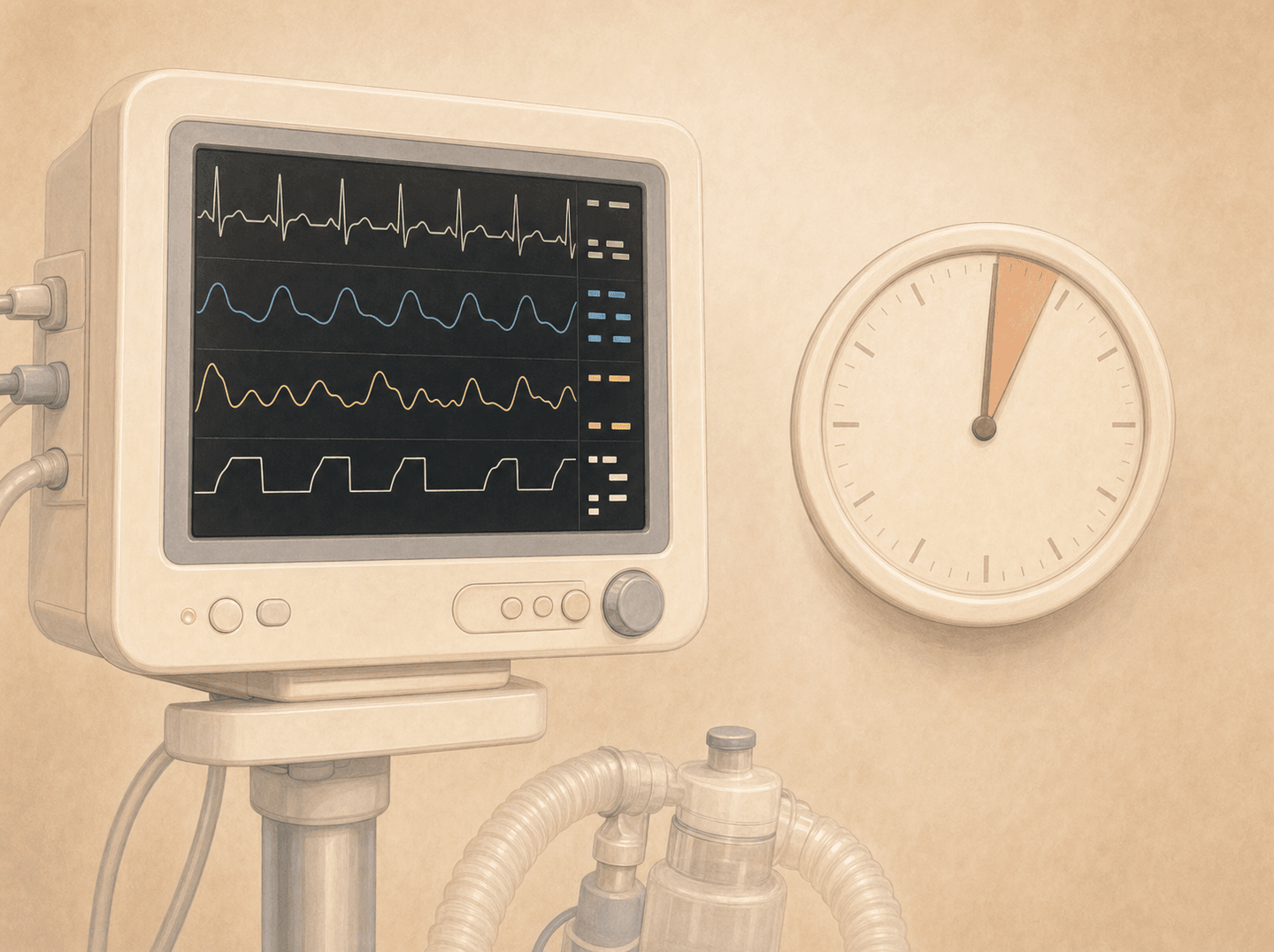
D9222 reports the first 15-minute increment of deep sedation or general anesthesia. Both take the patient to a state where purposeful response to stimulation is reduced or absent, a deeper plane than moderate sedation. The code is billed by elapsed time, not by procedure, and the first 15-minute block, or any portion of it, is one unit.
Every 15-minute block after that, or any portion of one, is a unit of D9223. D9222 opens the case and D9223 extends it.
The distinguishing axis: depth, then airway, then increment
Depth of sedation. Deep sedation and general anesthesia (D9222/D9223) reduce or remove purposeful response. Moderate sedation (D9239/D9243) keeps the patient responsive to verbal commands and maintaining their own airway. The anesthesia record describes the plane reached, and the code has to agree with it.
Airway, new for 2026. Deep sedation or general anesthesia without an advanced airway device is D9222 and D9223. General anesthesia that requires an advanced airway is D9224 and D9225. An advanced airway means a supraglottic or subglottic device, such as a laryngeal mask airway, a laryngeal tube, or an endotracheal tube. Both conditions must hold for the new pair: the patient reaches general anesthesia and the airway is in use. Increments before the airway went in, and deep sedation managed with something short of an advanced airway, stay on D9222 and D9223.
First increment versus add-on. D9222 is the first 15 minutes; D9223 is each subsequent 15 minutes. Every time-based sedation pair uses the same split.
What changed for 2026
D9222 and D9223 were revised. The descriptors now state the increment is 15 minutes or any portion of one, and that the code applies with or without nitrous oxide given alongside. The procedure is unchanged.
D9224 and D9225 were added for general anesthesia that requires an advanced airway, with the same first-15-minutes and each-subsequent-15-minutes structure. Before 2026 there was no separate code for this case. Add both to the PMS code list and label them as the advanced-airway pair, so the biller picks by what the chart says about the airway rather than by habit.
How the time units stack
The clock generally starts when the provider initiates the anesthesia and monitoring protocol and stays in continuous attendance, not merely when the first drug goes in. It stops when the patient is stable enough to be monitored by trained staff without that continuous attendance.
Worked example for a 40-minute case:
- First 15 minutes: D9222, one unit.
- Minutes 16 through 30: D9223, one unit.
- Minutes 31 through 40: D9223, one unit (any portion of a 15-minute block counts as a full unit).
A 40-minute case is D9222 plus two units of D9223. Claims fall apart when the times are missing and the carrier has nothing to adjudicate the units against. Always report D9222 before D9223: an add-on with no first unit is an orphan and gets rejected.
When to bill D9222
Bill D9222 when the provider administers deep sedation or general anesthesia without an advanced airway, and the anesthesia record shows the start time and the depth reached.
Do not bill D9222 for:
- Each additional 15-minute increment. Those are units of D9223.
- General anesthesia with an advanced airway. Use D9224 and D9225.
- IV moderate (conscious) sedation. Use D9239 for the first increment and D9243 for each additional one.
- Nitrous oxide as the only agent. Use D9230.
Coverage reality and medical cross-coding
Coverage is plan-dependent. Many dental plans pay deep sedation or general anesthesia only when it is medically necessary, commonly tied to a surgical procedure, the patient’s age, or a documented condition. A case requested for anxiety alone on a routine procedure is frequently denied as not necessary. Some plans require prior authorization, and some cap the total anesthesia time or units they pay, which reaches the D9223 units more than the first unit.
Many cases also have a path to medical insurance, particularly in hospital or surgical-center settings, for patients with a qualifying medical condition, or where a payer’s medical-necessity criteria are met. Medical billing uses its own code set and prior-authorization rules, so a medical case is not simply the CDT code sent to a medical payer.
Before the appointment, verify the anesthesia benefit, confirm whether prior authorization is required, and decide whether the case belongs on dental or medical. Put the patient’s out-of-pocket number in writing based on what the specific plan says.
Documentation that supports the claim
Deep sedation and general anesthesia claims get reviewed, so the anesthesia record carries the weight. It generally needs:
- Start time, when the provider initiated the anesthesia and monitoring protocol and began continuous attendance, and stop time, when that attendance ended. Record both at the time of treatment; reconstructed times are the first thing an anesthesia audit challenges.
- The depth of sedation reached, so the deep/general code is defensible against the moderate codes.
- The airway technique, including whether an advanced airway was placed.
- The drugs given, doses, and route.
- Vital signs monitored throughout the case.
- The procedure performed and the medical-necessity reason for the anesthesia.
The medical-necessity narrative does the most work on the claim. A line tying the anesthesia to the procedure or a documented patient condition prevents the common “not necessary” denial: “Deep sedation indicated for surgical extraction of impacted third molars in a patient unable to tolerate treatment otherwise, total anesthesia time 40 minutes.”
FAQs
- Is D9222 a current CDT code for 2026?
- Yes. D9222 is active in CDT 2026 and still reports the first 15-minute increment of deep sedation or general anesthesia. The 2026 revision states the increment is 15 minutes or any portion of one, and that the code applies with or without nitrous oxide given alongside. Two related 2026 changes: D9224 and D9225 were added for general anesthesia that requires an advanced airway, and D9248 (non-IV conscious sedation) was deleted.
- What is the difference between D9222 and D9223?
- D9222 is the first 15-minute increment of deep sedation or general anesthesia, and D9223 is each subsequent 15-minute increment. Any portion of a block counts as a full unit. D9222 opens the case and D9223 extends it, so a 40-minute case is D9222 plus two units of D9223. D9223 cannot stand alone on a claim without D9222.
- What is the difference between D9222 and D9224?
- The airway; the depth is the same. D9222 and D9223 report deep sedation or general anesthesia without an advanced airway device. D9224 and D9225, new for 2026, report general anesthesia that requires an advanced airway, such as a laryngeal mask airway or endotracheal tube. The patient must reach general anesthesia and the airway must be in use; increments before the airway went in stay on D9222 and D9223. The chart has to document the airway technique.
- What is the difference between D9222 and D9239?
- The level of sedation. D9239 (with its add-on D9243) is IV moderate, or conscious, sedation, where the patient responds to verbal commands and keeps a patent airway without help. D9222 (with D9223) is deep sedation or general anesthesia, where purposeful response is reduced or absent. A carrier can catch a mismatch from the anesthesia record, so match the code to the documented depth, then the increment to the documented time.
- Do I bill nitrous oxide separately with D9222 in 2026?
- No. Under the 2026 CDT changes, nitrous oxide used with other sedation or anesthesia drugs is part of the anesthesia service, and D9222 now reads with or without nitrous. D9230 is reported only when nitrous is the single agent, so adding it to a deep sedation case is no longer correct.
- Will insurance pay for deep sedation or general anesthesia?
- It is plan-dependent. Many dental plans pay only when it is medically necessary, often tied to a surgical procedure, the patient's age, or a documented condition such as a disability that makes treatment otherwise impossible. Some cases cross-code to medical insurance, which has its own rules and often its own prior authorization. Verify the anesthesia benefit, and whether the case belongs on medical, before quoting the patient.
Related codes
Need help billing this code?
We handle D9222 claims daily.
If your team is spending time on denials, narratives, or carrier follow-up for this code, our outsourced dental insurance billing service can take it off your plate. We submit the claims, post what comes back, and follow up on anything unpaid.
“Claims, posting, denials, all of it gets handled, and it costs far less than hiring another employee. My front desk got hours of their week back, and honestly I just don't think about billing anymore.”
CDT codes are maintained by the American Dental Association. This page is an editorial billing guide, not the official ADA code descriptor. Verify current coverage policies with each carrier before submitting claims.