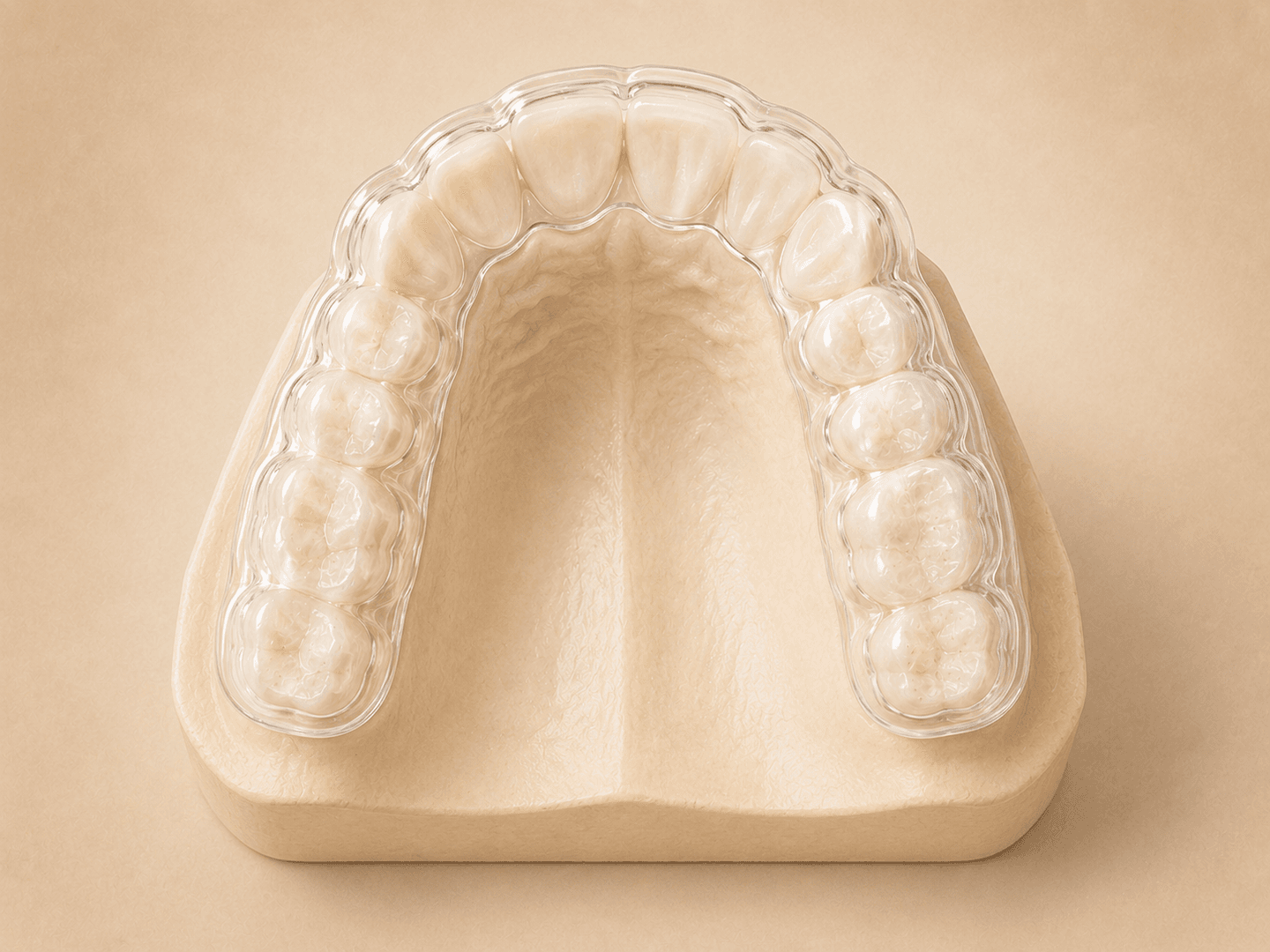
D9944 is the CDT code for a custom hard night guard that covers the full upper or lower arch to protect teeth from grinding.
- When to use: A hard night guard covering a full arch, including hard guards with a soft liner.
- When not to use: A full-arch guard that is soft throughout is D9945, and a hard guard covering part of the arch is D9946.
- Billing note: Many plans exclude night guards as cosmetic, so get a predetermination before fabrication.
On this page
- What D9944 covers
- The hard-and-soft laminate guard is a D9944
- When to bill D9944
- Coverage patterns by carrier
- Top reasons D9944 gets denied
- The documentation that gets D9944 paid
- Medical insurance crossover
- Documentation that supports the claim
- Pre-treatment communication with the patient
- Example case
- What to get right in your PMS
- FAQs
What D9944 covers
D9944 reports a custom-fabricated hard occlusal guard that covers the full upper or lower arch. The appliance is typically processed acrylic, taken from an impression or digital scan, and intended for nighttime wear to protect teeth and restorations from bruxism, clenching, and parafunctional grinding forces. The code includes the impression, the lab work, and the fit-and-deliver appointment.
It does not cover:
- An occlusal guard that is soft (thermoplastic or EVA) all the way through. Use D9945. A hard guard with a soft liner is not that appliance; see below.
- A hard occlusal guard covering only part of the arch (e.g., an anterior bite plane). Use D9946.
- An athletic mouthguard. Use D9941. The clinical purpose is different and most plans handle these very differently.
- A sleep apnea appliance. Use D9947 or appropriate medical CPT.
- A TMJ splint specifically designed as part of a TMD treatment plan with adjustable components. Several specialty codes apply depending on appliance design.
- An over-the-counter boil-and-bite night guard. D9944 is specifically a custom-fabricated dental appliance.
The clinical purpose of D9944 is protective and therapeutic. The appliance prevents tooth wear from grinding and reduces force on temporomandibular joints during sleep. This is different from athletic protection (D9941) and different from active TMD treatment with adjustable splints.
D9944 also stops at the appliance itself. Later visits on a guard the patient already has each report on their own code: D9942 for a repair or reline, D9943 for an adjustment, and, new in CDT 2026, D9936 for cleaning and inspecting an existing guard, counted per appliance. D9936 covers the cleaning and the check on its own and does not take in an adjustment, so a visit that also relieves a sore spot is D9943.
Report D9936 when that is the work, but do not plan around it as revenue. Early carrier treatment of it is mostly non-covered or bundled. Utah’s PEHP 2026 guide marks it not covered and treats it as included in what the plan already paid for the guard. Delta Dental Insurance Company’s 2026 code summary says it is not a benefit of most of its plans and leaves the fee to the patient, and where a plan does cover it, allows it once every 12 months and bars billing it alongside D9942. UnitedHealthcare added it to the applicable-codes list of its occlusal guard policy effective January 1, 2026, which registers the code without promising payment on it. Verify the specific plan before you quote the visit.
The hard-and-soft laminate guard is a D9944
The appliance most often miscoded off this page is the dual laminate, sometimes ordered as a hard/soft guard: a soft inner liner seated against the teeth under a hard outer shell. It feels soft in the hand, so it gets billed as D9945, and that is backwards.
The ADA has published guidance on guards built with both hard and soft components, and it puts them on the hard codes. The reasoning is that the working part of a guard is the occlusal surface, so the material meeting that surface decides hard versus soft. A soft liner makes the guard more comfortable to wear without changing how it is fabricated, what it does therapeutically, or how the patient uses it. A laminate guard covering the full arch is D9944. A laminate guard covering part of the arch is D9946. D9945 is for an appliance that is soft throughout.
The lab slip is where this goes wrong, because it usually names the material the patient feels. Read it for what meets the biting surface, not for the word soft.
When to bill D9944
Bill D9944 when:
- The patient presents with bruxism, clenching, or grinding symptoms, or with wear patterns consistent with parafunctional habit.
- The dentist takes an impression or digital scan for a hard acrylic occlusal guard.
- The appliance is fabricated (in-office or at the lab) and delivered to the patient.
- The appliance covers the full arch.
Do not bill D9944 for:
- Guards that are soft throughout. Use D9945 even if the patient calls it a night guard. The material matters, and a soft liner under a hard occlusal surface is still D9944.
- Partial-arch appliances. Use D9946.
- Anti-snoring or sleep apnea appliances. Use D9947.
- TMD-specific splints with adjustable bite components.
- Athletic mouthguards.
Coverage patterns by carrier
D9944 coverage varies more across carriers than almost any other restorative-adjacent code. The patterns:
- Plans that cover D9944 as a basic benefit. A small percentage of employer-sponsored PPOs treat occlusal guards as preventive or basic restorative. They pay 50 to 80% of the allowable with no special documentation required.
- Plans that cover D9944 only with bruxism documentation. A larger group requires a narrative noting the bruxism complaint or wear pattern. With the narrative, the claim pays. Without it, the claim denies.
- Plans that cover D9944 under a major benefit category with a separate annual maximum. Some plans treat occlusal guards as major restorative, applying the same deductible and coinsurance structure as crowns. The plan pays the allowable but the patient’s share is larger.
- Plans that exclude D9944 entirely. A significant percentage of plans exclude occlusal guards as cosmetic, non-essential, or as appliances for parafunctional habit. The exclusion is usually not appealable. The patient owes the full office fee.
- Plans that exclude D9944 but cover under TMJ benefit. Some plans exclude occlusal guards under dental but cover them under a separate TMJ benefit with its own annual maximum (often $500 to $1,500 lifetime). This requires a TMD diagnosis on the claim.
The implication: predetermination before fabrication is the single most useful step on this code. The plan-level variation is too wide to assume coverage from general benefit knowledge.
Top reasons D9944 gets denied
Five issues account for most denials:
- Plan excludes occlusal guards entirely. The EOB reads as “service not a covered benefit” or “appliances for parafunctional habit excluded.” Not appealable. Patient owes full fee. This is the most common single denial reason.
- No narrative or diagnosis on the claim. The plan covers D9944 with documentation but the claim was submitted without a bruxism narrative or TMD symptom note. The carrier denies for “missing medical necessity” or “documentation required.” Add the narrative and resubmit.
- Frequency limit exceeded. The patient had a guard placed inside the plan’s replacement window, and those windows run long. Centene’s occlusal guard policy publishes one guard per member per 36 months; Utah’s PEHP allows one per arch across seven years. The claim denies for frequency. Narrative documenting why the previous guard is no longer functional (worn through, dentition changed, fit failure) can sometimes overturn this. When it does not, the replacement is usually patient-pay, though whether the balance can actually be billed turns on the participating-provider agreement and Medicaid prohibits it outright. Inside a window that long, a repair or reline on D9942 is sometimes the only guard line the plan will still consider.
- Wrong code used for a soft appliance. D9944 was billed when the actual appliance is soft thermoplastic throughout. Use D9945. Some carriers will catch this and reprocess at the D9945 allowable. Others will deny outright. Submit the correct code from the start.
- TMJ-exclusion plan with TMJ-coded claim. The plan excludes anything under a TMJ benefit, and the claim was submitted with a TMD diagnosis code. The plan denies the claim and the patient may also have an exclusion on TMD-related dental treatment. Check the exclusions language before submitting under a TMD code.
The documentation that gets D9944 paid
For plans that cover D9944 with documentation, the narrative needs three pieces:
- The complaint. Why the appliance is being placed. “Patient reports nighttime grinding and morning jaw soreness” is a typical phrasing.
- The clinical findings. What you see in the mouth. Wear facets on canines, attrition on molar cusps, abfraction at the cervical, fractured restoration with no obvious traumatic cause.
- The treatment objective. What the appliance is meant to do. “Custom hard occlusal guard fabricated to protect dentition from continued parafunctional wear.”
Three sentences. Specific to the patient. Not a generic template applied to every D9944 claim, which carriers can detect over a batch.
For the patient record, document additionally:
- Wear pattern findings with tooth-specific notes.
- Any TMD symptoms (jaw clicking, popping, limited opening, muscle tenderness on palpation).
- Material selected (hard processed acrylic vs heat-cured vs other).
- Impression date and delivery date.
- Patient instructions for cleaning, storage, wear schedule, and follow-up.
Medical insurance crossover
Occlusal guards sometimes pay under medical insurance when the appliance is being placed as part of TMD treatment. The factors:
- Diagnosis matters. A documented TMD diagnosis from a dentist (or physician) is usually required for medical coverage. Bruxism alone is not always sufficient.
- CPT code, not CDT code. Medical claims don’t carry the dental CDT code. There’s no single “occlusal guard” CPT, and the right code is plan-specific. Crossover for an occlusal-guard/TMD orthotic generally relies on the unlisted maxillofacial prosthetic procedure code (CPT 21089) submitted by report, or whatever occlusal-orthotic/TMJ-appliance code the medical plan designates (some plans direct a DME/appliance code such as E0486). Verify the specific plan’s covered code and required documentation rather than assuming one CPT. Do not use CPT 21085. Its actual descriptor is “impression and custom preparation; oral surgical splint,” a surgical code for reconstructive oral surgery, and applying it to a removable night guard or TMD orthotic is a documented high-audit-risk error.
- ICD-10 diagnosis required. Use billable, laterality-specific codes: M26.621 (right TMJ), M26.622 (left TMJ), M26.623 (bilateral TMJ), or M26.629 (unspecified side) for TMJ arthralgia. G47.63 (sleep-related bruxism) and M26.69 (other specified disorders of TMJ) are also valid. Don’t submit M26.62 alone; it’s a non-billable header code that rejects without laterality specificity.
- Letter of medical necessity often needed. A short LOMN from the dentist explaining the diagnosis, the treatment plan, and the role of the appliance can clear pre-authorization on many medical plans.
Most general dental offices don’t run medical-crossover billing on occlusal guards because the volume isn’t high enough to justify the workflow. Practices with significant TMD volume often build the medical-billing workflow because the medical allowables on TMJ appliances are sometimes higher than dental allowables, especially under PPO contracts.
If your office doesn’t do medical crossover, the practical answer to a patient asking about medical coverage is “Your medical plan may cover this under a TMJ benefit. Call them directly to ask, and if they need documentation from us, we can provide it.” Patients who pursue medical reimbursement and succeed will sometimes ask the office for a superbill in addition to the dental claim.
Documentation that supports the claim
The claim needs:
- Date of service (typically the delivery date, not the impression date).
- Tooth coverage indicator (upper or lower arch).
- Narrative noting bruxism, clinical wear, or TMD symptoms (for plans that require documentation).
For the patient record, document everything outlined above. Carriers that audit chart notes on occlusal guards look for specificity. A “patient grinds, guard placed” note will not pass audit on a plan that paid the claim. A wear-pattern map and symptom inventory will.
Pre-treatment communication with the patient
Because D9944 coverage is so variable, the patient conversation needs to happen before the impression:
- Verify benefits and ask specifically about occlusal guard coverage.
- If the plan covers D9944, get the allowable and the patient’s coinsurance estimate.
- If the plan excludes D9944 or requires a separate TMJ benefit, present the full office fee as patient responsibility.
- Get a signed financial agreement reflecting the verified coverage.
- If predetermination is being run, hold the impression until the pre-d response comes back.
The conversation needs to be specific about the plan’s actual response, not a generic “we’ll check with your insurance.” Patients who hear “your insurance might cover this” and then receive a bill for the full fee are the ones who file complaints.
Example case
A 44-year-old patient presents at her recall visit. The hygienist notes wear facets on the canines and the patient confirms her partner has commented on grinding noise at night. The dentist examines, finds attrition on the molar cusps and a fractured composite on tooth #19 with no obvious traumatic cause. A hard occlusal guard is recommended.
Billing steps:
- Verify the patient’s dental benefits and ask specifically whether D9944 is covered and under what conditions. The eligibility rep confirms coverage at 50% of allowable with bruxism narrative required.
- Submit a predetermination with the bruxism narrative and clinical findings. The carrier returns a pre-d response confirming coverage at the stated allowable.
- Schedule the impression appointment and have the patient sign the financial agreement showing the estimated patient portion.
- Take the impression. Send to the lab.
- On the delivery appointment, fit the guard, instruct the patient on wear and care, and submit the claim with the narrative.
- The carrier pays at the predetermined allowable. The patient owes the coinsurance portion. No surprises.
What to get right in your PMS
The specifics vary across Open Dental, Dentrix, Eaglesoft, Curve, and Carestream. The steps that matter:
- Code by material and arch coverage. D9944 is hard and full arch. D9945 is soft and full arch. D9946 is hard and partial arch. A guard with a soft liner and a hard occlusal surface counts as hard, so it posts to D9944 or D9946. Check the lab order before posting.
- Post on the delivery date. The impression date matters clinically but the claim’s date of service is the day the appliance is delivered to the patient.
- Attach the narrative to the claim, not the patient record. Many systems store narratives at the patient level by default. The clearinghouse needs the narrative linked to the specific claim.
- Verify the patient is past any waiting period. Some plans treat D9944 as major restorative with a 6-month waiting period on new policies.
- Adjust the ledger correctly after the EOB. A denial as non-covered means no contractual write-off. A downgrade or coverage at less than expected means the difference is patient responsibility. A predetermined claim that pays as expected just needs the coinsurance posted.
If your office sees a high rate of D9944 patient-billing complaints, the cause is almost always pre-treatment communication. Predeterminations on this code prevent more complaints than any other workflow change you can make.
FAQs
- What is the dental code for a night guard?
- D9944 for a hard full-arch occlusal guard, D9945 for a full-arch guard that is soft throughout, and D9946 for a partial-arch hard guard. A guard with a soft liner under a hard occlusal surface is a hard appliance, so it is D9944 or D9946, not D9945. The hard appliance (D9944) is the most commonly billed of the three for adult bruxism. Coverage varies widely. Many plans exclude occlusal guards entirely as cosmetic, so predetermine before fabricating.
- What's the difference between D9944 and D9945?
- Both are full-arch occlusal guards. D9944 is hard acrylic. D9945 is soft (typically thermoplastic or EVA) all the way through. A dual-laminate guard, soft liner under a hard outer shell, is not a D9945: the ADA has published guidance that a guard with both hard and soft components reports as a hard appliance, because the material meeting the occlusal surface is what defines it. That makes a laminate full-arch guard a D9944 and a laminate partial-arch guard a D9946. The clinical choice between hard and fully soft depends on the patient's grinding severity, comfort tolerance, and the dentist's preference. Many carriers pay D9944 but exclude D9945, or vice versa. Check the plan before fabricating.
- Why did Aetna deny D9944 as not covered?
- Many plans exclude occlusal guards categorically as cosmetic or as appliances for parafunctional habit. A smaller number of plans cover them only when there's a documented bruxism diagnosis or TMD complaint in the chart. The denial is usually plan language, not a coding error. Predetermination before fabrication is the only way to know.
- Can I bill an occlusal guard to medical insurance under a TMJ diagnosis?
- Sometimes. If the appliance is being placed as part of TMD treatment with a documented TMJ diagnosis from a dentist or physician, some medical plans cover it under a DME or appliance benefit. The crossover billing involves a medical CPT code, an ICD-10 diagnosis code, and often a letter of medical necessity. Most general dental offices bill dental only because the medical setup isn't worth the volume.
- How often will a plan pay D9944?
- Ask for the interval by code, because the published windows are wider apart than the frequency figure offices tend to quote from memory. Centene's occlusal guard policy allows one guard per member per 36 months. Utah's PEHP allows one per arch in a seven-year period. A small number of plans allow one per arch per lifetime, which usually means the patient can get a replacement only after a clinical justification (appliance worn through, no longer fitting, dentition changed).
- Do I need to attach a narrative or diagnosis to the D9944 claim?
- Often yes. Carriers that cover occlusal guards usually require some indication of medical necessity. A one-line narrative noting the bruxism complaint, the clinical wear pattern observed, and any TMD symptoms is usually enough. Without it, the claim may pend or deny.
Related codes
Need help billing this code?
We handle D9944 claims daily.
If your team is spending time on denials, narratives, or carrier follow-up for this code, our outsourced dental insurance billing service can take it off your plate. We submit the claims, post what comes back, and follow up on anything unpaid.
“Claims, posting, denials, all of it gets handled, and it costs far less than hiring another employee. My front desk got hours of their week back, and honestly I just don't think about billing anymore.”
CDT codes are maintained by the American Dental Association. This page is an editorial billing guide, not the official ADA code descriptor. Verify current coverage policies with each carrier before submitting claims.