D9945 is the CDT code for a custom soft night guard that covers the full upper or lower arch, typically thermoplastic or EVA.
- When to use: The guard is soft all the way through and covers the full arch, often for mild grinders or patients who cannot tolerate hard acrylic.
- When not to use: A hard full-arch guard, including one with a soft liner, is D9944, and a hard partial-arch guard is D9946.
- Billing note: Some plans pay D9944 but exclude D9945 as inadequate, so ask about D9945 by code and get a signed financial agreement before fabrication.
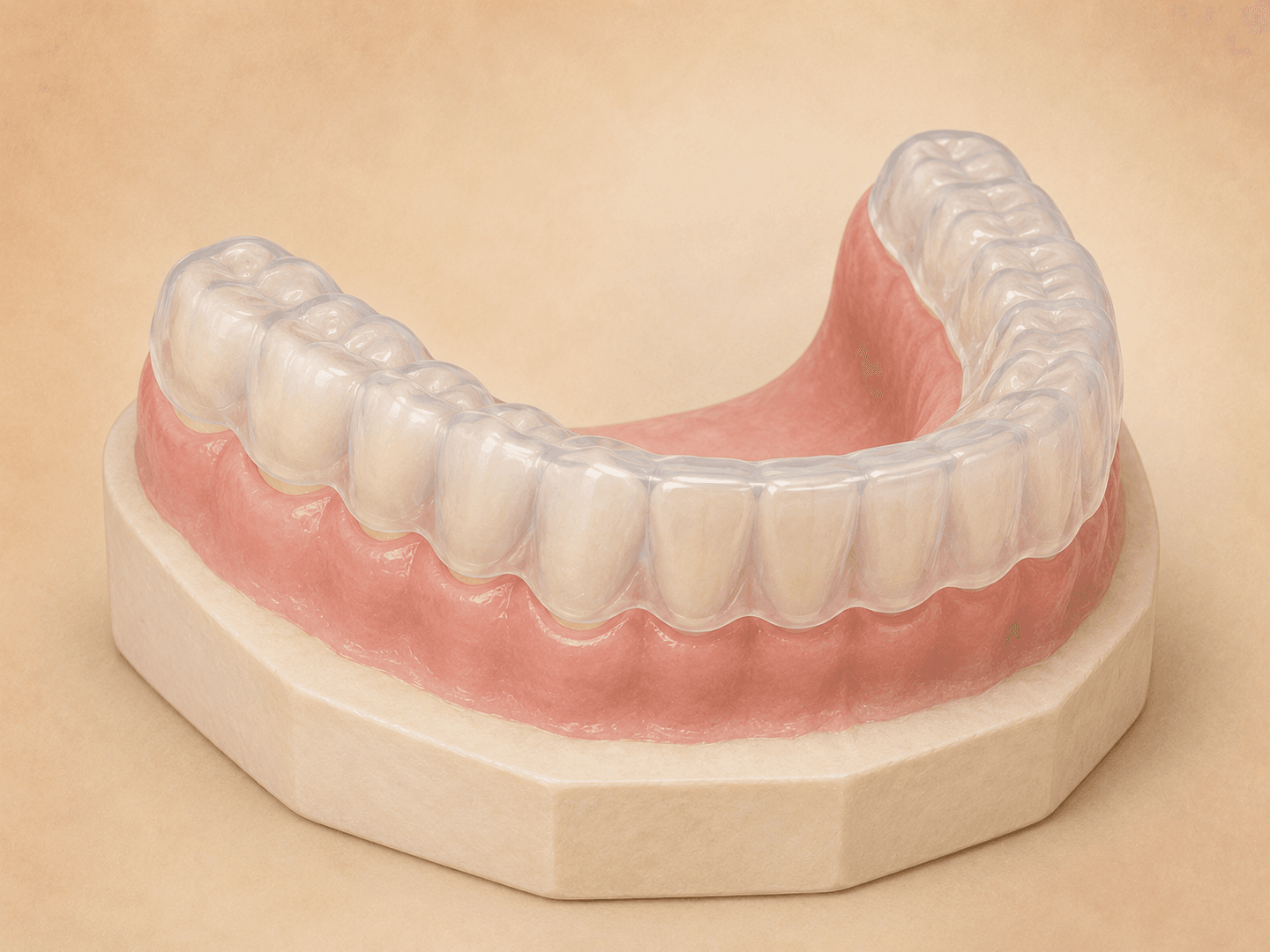
What D9945 covers
D9945 reports a custom-fabricated soft occlusal guard that covers the full upper or lower arch. The material is typically thermoplastic (vacuum-formed) or ethylene-vinyl acetate (EVA). The appliance is made from an impression or digital scan, processed at the lab or in office, and worn at night to protect teeth from grinding and clenching. The soft material absorbs grinding forces and forms a barrier between opposing teeth during sleep.
It does not cover:
- A hard acrylic occlusal guard, or one that is hard at the biting surface over a soft layer. Use D9944 (see the next section).
- A soft guard covering only part of the arch. There is no exact CDT code for partial-arch soft. Report D9999 (unspecified adjunctive procedure, by report) with full documentation, because it misrepresents neither material nor arch. D9945 would report a full arch that was not made, and D9946 is a hard-appliance code that a material note does not convert. Confirm the approach with the specific carrier.
- An athletic mouthguard. Use D9941; the material may be similar but the clinical intent is different.
- A sleep apnea appliance. Use D9947 or the appropriate medical CPT code.
Later work on a guard the patient already owns is also outside D9945. A repair or reline is D9942 and an adjustment is D9943. D9936, new in CDT 2026, covers cleaning and inspecting an existing guard per appliance when nothing about the fit changes. It comes up more on soft appliances, because the porous surface holds staining and calculus sooner.
D9936 is the correct code but rarely a paid one so far. Utah’s PEHP 2026 guide marks it not covered and part of the original guard purchase. Delta Dental Insurance Company’s 2026 code summary calls it not a benefit of most of its plans, leaving the fee with the patient; on plans that do cover it, it is limited to once every 12 months and cannot be billed alongside D9942. Bill it because it describes the visit, and verify the plan before quoting the patient.
Soft throughout is the whole test
D9945 describes an appliance that is soft from the fitting surface out to the occlusal surface. There is no code for a partly soft guard.
The common mix-up is the dual laminate, ordered from some labs as a hard/soft guard: a cushioned inner liner against the teeth under a rigid outer shell. It feels soft, which is why it gets posted here. Published ADA guidance puts any guard combining hard and soft components on the hard codes, because the surface the opposing teeth meet does the therapeutic work. A comfort liner does not change that. Covering the full arch, that appliance is D9944; covering part of an arch, it is D9946.
Check the lab prescription, not the appliance in your hand: what does the opposing dentition bite against? If the answer is acrylic, the code is not D9945.
When to bill D9945
Bill D9945 when a patient with bruxism, clenching, or grinding symptoms receives a custom soft guard that covers the full arch, made from an impression or scan in soft thermoplastic or EVA by the lab or vacuum-formed in office. Post it on the delivery date, after the fit is verified, not on the impression date.
Do not bill D9945 for:
- Hard acrylic appliances, including a laminate with a hard biting surface over a soft liner. Use D9944, or D9946 for part of the arch.
- Athletic mouthguards.
- Sleep apnea appliances.
- TMD-specific treatment splints with bite adjustments.
When soft is the right clinical choice
The choice between hard (D9944) and soft (D9945) is clinical, but it matters for billing because some plans cover one and not the other. General patterns:
- Heavy bruxers usually need hard. Soft material wears through quickly under heavy parafunctional forces and can need replacement within months.
- Mild grinders or clenchers tolerate soft well, such as a patient who grinds occasionally rather than nightly, or clenches without significant lateral grinding.
- Patients who cannot tolerate hard acrylic. Some patients gag, refuse to wear it, or have TMD discomfort with a hard appliance. A soft one may be the only one they will wear.
- Transitional use. A dentist may prescribe soft first to confirm the patient will wear an appliance before investing in a more durable hard one.
- Children and adolescents. Growing dentition makes a long-lasting hard appliance impractical, so soft appliances replaced as the patient grows are more realistic.
The dentist makes the clinical call. The biller codes what was actually fabricated.
Why D9945 sometimes denies when D9944 pays
A patient’s plan covers occlusal guards and paid a D9944 for another patient, but this patient’s D9945 denies as “not a covered benefit.”
Some carriers explicitly exclude soft appliances, with language such as “soft thermoplastic or vinyl appliances inadequate to protect against parafunctional forces.” The plan treats them as an unfavorable risk because they wear out faster than hard ones and generate more replacement claims.
Eligibility reps often read guard coverage off a system that pays D9944 without checking whether D9945 is excluded separately. Ask about D9945 by code, not about “occlusal guards.” If it is excluded, present the full office fee as patient responsibility and get the signed financial agreement before the impression. If the patient asks why hard might pay and soft might not, explain it.
Top reasons D9945 gets denied
- Plan excludes occlusal guards entirely. As with D9944, the plan considers guards cosmetic or non-essential, regardless of material.
- Plan covers hard but excludes soft. Not appealable. The patient owes the full fee.
- No narrative or diagnosis on the claim. Plans that cover D9945 usually require documentation of bruxism or TMD symptoms, and the claim denies or pends without it.
- Frequency limit exceeded. The patient had a guard within the plan’s window, typically 3 years and sometimes 5. Documentation of why the previous appliance no longer works can sometimes overturn this.
- Waiting period. Some plans treat D9945 as a major service with a 6-month waiting period.
Documentation that supports the claim
The narrative needs the same three elements as D9944:
- The complaint. Bruxism symptoms, jaw soreness, partner-reported grinding.
- The clinical findings. Wear facets, attrition, abfraction, fractured restorations.
- The treatment objective, including why soft was chosen. This matters more for D9945 than for D9944, because it defends the code on a plan that questions whether soft was appropriate. Intolerance of a hard appliance is a defensible reason.
Example: “Patient reports nighttime grinding and morning jaw soreness. Clinical exam shows wear facets on canines #6, #11 and abfraction at cervical of #19. Soft thermoplastic full-arch occlusal guard fabricated; soft material chosen due to patient’s documented intolerance of prior hard appliance.” Write each one specifically rather than from a template.
The claim needs the delivery date as the date of service, the arch (upper or lower), the narrative, and the material (soft thermoplastic or EVA), which some carriers ask for specifically.
The patient record should also include tooth-specific wear findings, any TMD symptoms, the material and rationale, impression and delivery dates, home-care instructions (cleaning, storage, expected lifespan), and the follow-up schedule, typically a 30-day comfort check and an annual wear evaluation.
Example case
A 38-year-old patient at recall has mild wear facets and reports occasional morning jaw soreness. The dentist confirms mild parafunctional wear. The patient had a hard guard five years ago, never wore it consistently, and did not tolerate the bulk, so the dentist recommends a soft appliance as more likely to be worn nightly.
- Verify benefits. The eligibility rep confirms D9944 is covered at 50% but is unsure about D9945, so ask specifically.
- The rep confirms D9945 is excluded as “soft appliances inadequate for parafunctional protection.”
- Present the full office fee for the soft appliance, explain that the plan covers hard but not soft, and ask whether she still prefers soft given her history.
- She confirms and signs the financial agreement for the full office fee.
- Take the impression, fabricate the appliance, deliver it, and verify the fit.
- Submit D9945 with the bruxism narrative. The carrier denies it as non-covered, as expected, and the full fee remains patient responsibility.
Submitting the claim still matters when the denial is expected. It gives the patient an EOB documenting the appliance for FSA or HSA purposes and confirms the non-coverage in writing. Patients accept full-fee billing when they are told before fabrication and contest it when they first hear about it from the EOB.
When posting the EOB, a non-covered denial means no write-off. Where a plan does pay D9945, the difference from the allowable is patient responsibility under the plan’s coinsurance.
FAQs
- Why did the carrier deny D9945 when they pay D9944 on the same plan?
- Because some plans cover hard appliances (D9944) but exclude soft ones (D9945), on the grounds that soft material is inadequate against heavy parafunctional forces and can encourage clenching rather than protect against it. The exclusion is plan language. Predetermination before fabrication is the only way to know which appliances a plan covers.
- When should I use D9945 instead of D9944?
- When the appliance is soft, since the code follows the material. Soft appliances are typically chosen for mild grinders, patients who cannot tolerate hard acrylic, or as a transitional device while assessing whether a more durable appliance is needed. Heavy bruxers usually need hard (D9944). The clinical choice is the dentist's.
- Is D9945 less expensive than D9944?
- Generally yes. Lab fees for soft thermoplastic appliances are lower than for processed acrylic, and office fees usually reflect that. On plans that cover both, the D9945 allowable is sometimes lower. On plans that exclude D9945, the patient pays the office fee directly.
- Do I need a different narrative for D9945 than for D9944?
- Mostly the same: bruxism symptoms, clinical wear findings, and the treatment objective. On a plan that questions whether soft is appropriate, add a brief, specific clinical reason for choosing soft over hard. A patient who cannot tolerate hard acrylic is a defensible reason.
- The guard has a soft liner under a hard shell. Is that a D9945?
- No. Published ADA guidance puts a guard with both hard and soft components on the hard codes, because the material the opposing teeth bite against defines the appliance. A soft liner is a comfort feature. Covering the full arch, that guard is D9944; covering part of an arch, it is D9946. D9945 is only for an appliance that is soft throughout, in practice a vacuum-formed thermoplastic or EVA guard with no rigid layer.
- How long do soft occlusal guards typically last?
- Most last 1 to 3 years before significant wear or distortion, shorter than hard appliances. Many carriers limit D9945 to once per 3 years. Some allow earlier replacement with documentation that the previous appliance has worn through.
Related codes
Need help billing this code?
We handle D9945 claims daily.
If your team is spending time on denials, narratives, or carrier follow-up for this code, our outsourced dental insurance billing service can take it off your plate. We submit the claims, post what comes back, and follow up on anything unpaid.
“Claims, posting, denials, all of it gets handled, and it costs far less than hiring another employee. My front desk got hours of their week back, and honestly I just don't think about billing anymore.”
CDT codes are maintained by the American Dental Association. This page is an editorial billing guide, not the official ADA code descriptor. Verify current coverage policies with each carrier before submitting claims.