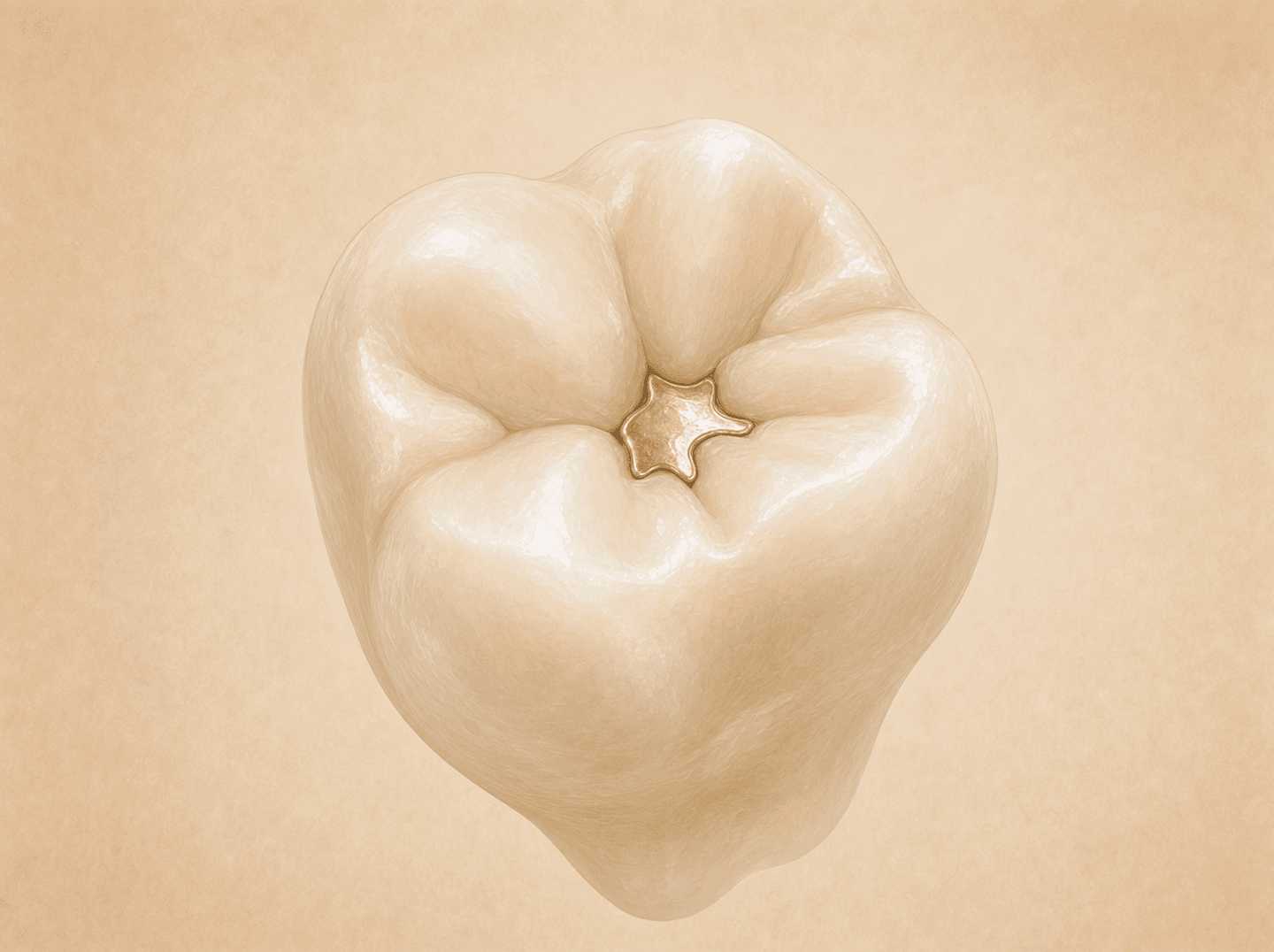
D2510 is the CDT code for a lab-made metal inlay, usually gold, that restores a single surface of a tooth without covering any cusp.
- When to use: A cast-metal restoration fills one surface, such as an occlusal pit, and every cusp tip is still natural tooth after the seat.
- When not to use: Two metal surfaces is D2520, three or more is D2530, porcelain is D2610, resin is D2650, and any cusp coverage makes it an onlay.
- Billing note: Many plans pay inlays at the filling allowable, so verify the alternate benefit and quote the patient the difference before the prep.
The inlay family at a glance
An inlay is an indirect restoration that sits inside the cusps. It is made outside the mouth from a scan or impression, then cemented or bonded into the prepared tooth. The code is set by two facts: the material, and how many surfaces the inlay restores.
| Surfaces | Metallic | Porcelain/ceramic | Resin-based composite |
|---|---|---|---|
| One | D2510 | D2610 | D2650 |
| Two | D2520 | D2620 | D2651 |
| Three or more | D2530 | D2630 | D2652 |
Every family tops out at “three or more,” so a four-surface inlay still uses the third code in its column. The onlay codes work differently: they start at two surfaces and add a separate four-or-more code. A cusp-covering restoration never lands on D2510, and there is no one-surface onlay code to fall back on.
Take the material from the lab slip. A milled ceramic inlay billed on D2510 because the prep “looked like a gold prep” is a material mismatch, and that is the kind of error that can bring a request for the lab invoice.
What counts as one surface
Count the surfaces the inlay restores, not the surfaces the prep touches in passing. The five surfaces are occlusal (or incisal), mesial, distal, facial (buccal or labial), and lingual.
A one-surface metal inlay is uncommon. The usual cases are:
- An occlusal-only inlay replacing a failed filling in the central pits of a molar or premolar, with the marginal ridges intact.
- A facial or lingual pit inlay, such as a buccal pit on a lower molar.
If the prep breaks through a marginal ridge into a proximal box, the inlay now restores two surfaces and moves to D2520. Check the chart note against the radiograph; a reviewer may read the bitewing to confirm the surface count.
How plans pay a D2510
Inlays are usually classed as a major or prosthodontic service, and the plan-side rules decide what the claim is worth.
The filling benchmark. Many plans pay an inlay at what they would pay for a direct filling on the same surfaces. PEHP’s 2026 CDT code guide states it directly: inlays of any surface count are limited to the allowed amount for a composite filling, once per permanent tooth in a three-year period. On plans with an amalgam benchmark, the comparison is D2140, the one-surface amalgam. On a composite benchmark it is D2391 for a back tooth.
Not covered at all. Medi-Cal Dental’s fee schedule lists the entire inlay range, metal, ceramic, and resin, as not a benefit.
Seat date. The inlay is billed on the date it is cemented, not the prep date, since the lab work is not complete until then.
A worked example
A patient has a failing occlusal amalgam on #19 with both marginal ridges sound. The dentist preps an occlusal-only box and sends it out for a gold inlay. The claim goes out at the seat visit as D2510, tooth #19, surface O.
The plan’s inlay clause pays at the one-surface posterior composite level. The EOB shows D2510 processed with an alternate benefit, and the allowed amount matches what the plan pays for D2391. If the treatment-plan estimate was built on the inlay fee, the patient balance is a surprise; if it was built on the composite allowable, it matches.
Had the prep extended through the distal marginal ridge, the same gold inlay would bill as D2520, surfaces OD. If the dentist had also reduced and capped the distobuccal cusp, it would move to the metallic onlay codes: D2542 at two surfaces, or D2543 if the capped cusp is counted as a third surface.
When an inlay comes loose or breaks
- Loose but intact. Recementing or rebonding an inlay is D2910, not a new D2510.
- Damaged restorative material. D2981 covers an inlay repair needed because the material failed. Coverage is thin; PEHP lists it as not covered.
- Replaced. A new inlay is a new D2510 (or whatever the new surface count and material dictate), subject to the plan’s replacement interval.
Documentation that supports the claim
- Tooth number and the single surface restored.
- A pre-op radiograph or photo showing why a direct filling was not the plan, such as a failing restoration or recurrent decay.
- The lab slip naming the alloy.
- The seat date as the date of service.
FAQs
- What is the dental code for a one-surface gold inlay?
- D2510. It covers a metal inlay fabricated outside the mouth that restores one surface and stays inside the cusp tips. The metal can be gold or another cast alloy; the inlay codes do not split by noble content the way crown codes do. A two-surface metal inlay is D2520.
- What are the inlay codes by material?
- There are three inlay families of three codes each. Metallic is D2510, D2520, and D2530. Porcelain or ceramic is D2610, D2620, and D2630. Resin-based composite is D2650, D2651, and D2652. In each family the first code is one surface, the second is two, and the third is three or more.
- Why did the plan pay my D2510 like a filling?
- Because the plan has an alternate benefit for inlays. PEHP's 2026 code guide, for example, limits inlay reimbursement to the allowed amount for a composite filling. Other plans use an amalgam benchmark. The claim is processed, not denied, and the reduced allowable leaves a patient balance where the provider contract allows it.
- Is a one-surface metal inlay still an inlay if it is very large?
- Yes, as long as it covers no cusp tip. Size does not move a restoration from the inlay codes to the onlay codes; cusp coverage does. Once the metal caps a cusp, the restoration is an onlay, and the metallic onlay codes start at two surfaces with D2542.
Related codes
Need help billing this code?
We handle D2510 claims daily.
If your team is spending time on denials, narratives, or carrier follow-up for this code, our outsourced dental insurance billing service can take it off your plate. We submit the claims, post what comes back, and follow up on anything unpaid.
“Claims, posting, denials, all of it gets handled, and it costs far less than hiring another employee. My front desk got hours of their week back, and honestly I just don't think about billing anymore.”
CDT codes are maintained by the American Dental Association. This page is an editorial billing guide, not the official ADA code descriptor. Verify current coverage policies with each carrier before submitting claims.