D2391 is the CDT code for a single-surface resin-based composite filling on a back tooth — a premolar or molar — covering the restoration and its cure, finish, and polish.
It's the most-billed restorative code in many practices and the one carriers most often downgrade to the amalgam fee. The recurring problems are an alternate-benefit downgrade that pays the lower amalgam rate, and a surface-count audit when the chart shows two surfaces restored but only one was billed (or vice versa).
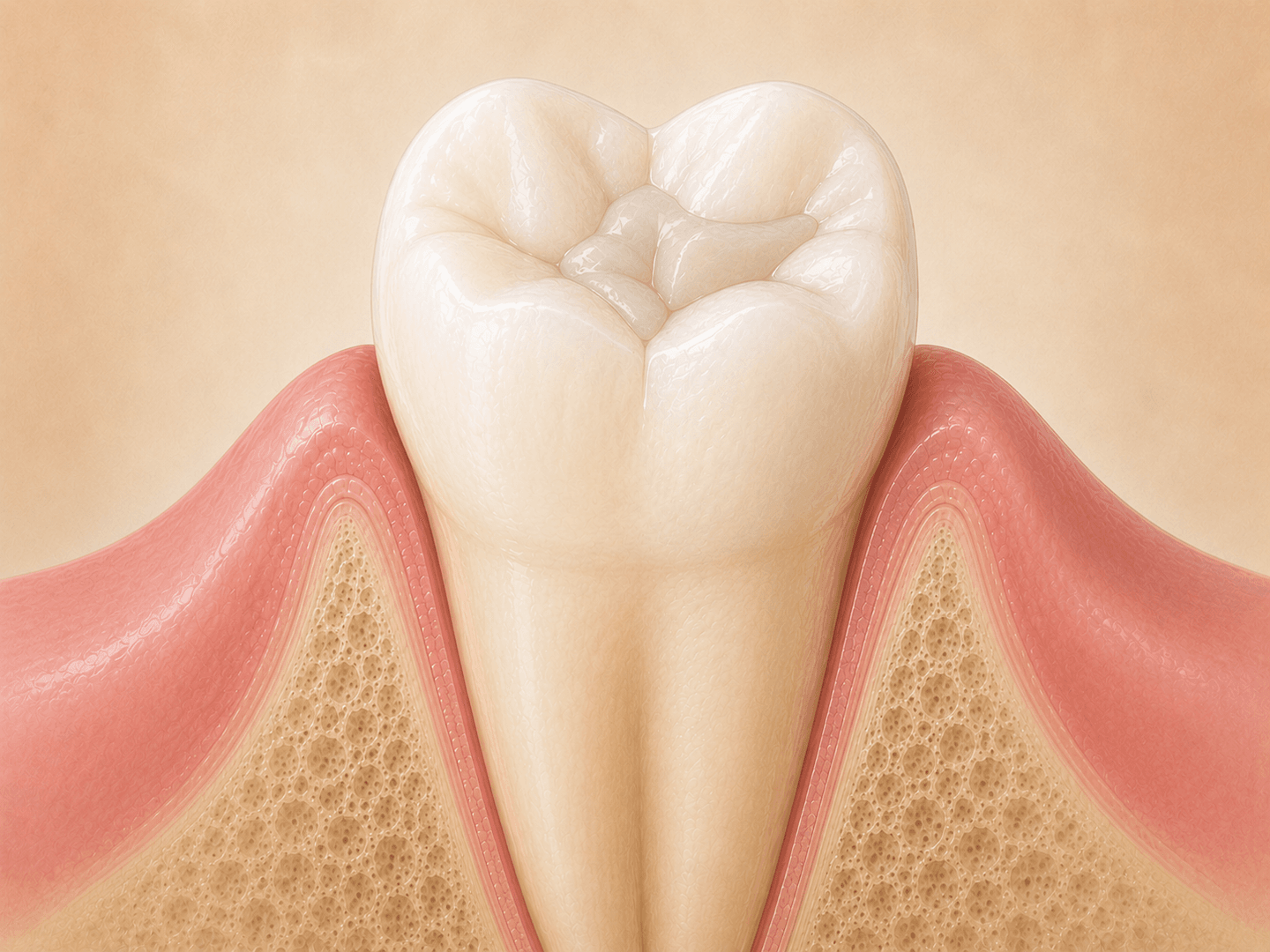
What D2391 covers
D2391 reports a single-surface resin-based composite restoration on a posterior tooth: a premolar or a molar. The fee covers the restoration, the cure, finish, and polish. It does not include the diagnostic exam, the radiograph, any indirect pulp cap or other adjunctive procedure, or the anesthetic.
It does not cover:
- A composite on an anterior tooth. That’s D2330.
- A two-surface posterior composite. That’s D2392.
- A three-surface posterior composite. That’s D2393.
- A four-or-more-surface posterior composite. That’s D2394.
- An amalgam restoration of any kind. Those are D2140 through D2161.
- A sealant on an unrestored pit and fissure. That’s D1351.
- An indirect inlay or onlay. Those are in the D2510 through D2664 range.
What the D1352 deletion moved onto this code
CDT 2026 is the first year D2391 absorbs work that used to have its own code, and offices that only updated their code table without reading why will misquote these cases.
D1352 was the preventive resin restoration: a restoration on a permanent tooth in a patient at moderate-to-high caries risk, for an early lesion in the pits and grooves that was past a sealant but short of a conventional filling. The ADA deleted it effective January 1, 2026. In the same change, it deleted D2391’s descriptor, which had limited the code to restorations reaching into dentin. D2391 now reports a one-surface posterior composite without regard to how deep the lesion goes or what the diagnosis was, which is why the separate preventive code was no longer needed. The ADA’s stated reasoning is that the procedure is performed the same way either way, and that no other restorative code is gated on lesion depth.
For the biller, the code change matters less than the benefit category change. D1352 sat in the D1xxx preventive block; D2391 sits in D2xxx restorative. All of the following are plan-dependent and have to be checked against the specific contract, but the direction of the change is consistent:
- Coinsurance tier. Preventive services are commonly paid at or near 100% with no patient share. Basic restorative typically pays at a lower percentage, often somewhere around 80%, and that share is now the patient’s. Same tooth, same procedure, different patient portion than last year.
- Deductible. Many plans waive the annual deductible on preventive and apply it to restorative. A patient who has not met the deductible may now owe the whole allowable on the first one of these.
- Annual maximum. Some plans exempt preventive services from the annual maximum or track them separately. Restorative claims generally draw the maximum down, so these restorations now compete with the crowns and the endo later in the year.
- Frequency rules. The old sealant-adjacent limits, per-tooth caps and patient age cutoffs, stop applying. What applies instead is the restorative lookback on the same tooth and surface, commonly around 24 months, which is a different question entirely on a patient who has recent work on that tooth.
- Waiting periods. Plans that impose a waiting period on basic restorative and none on preventive will now pend or deny these for a new enrollee.
- The alternate-benefit downgrade. This is the one most likely to be missed. If the plan downgrades posterior composites to the amalgam allowable, it does so on D2391 claims, and these restorations are D2391 claims now. The shallow early-lesion composite that used to pay as a preventive service can come back allowed at the D2140 rate. See the downgrade section below for who absorbs the difference, because that turns on the participating-provider agreement rather than on the code.
Two things stay the same. A sealant on a sound tooth with no lesion is still D1351 and always was; the D1352 deletion does not fold sealants into the restorative code. And a restoration that crosses more than one surface still moves up the series to D2392, D2393, or D2394.
The practical step is to verify benefits on D2391 for these cases rather than reusing the preventive-side estimate, and to have the financial conversation before the appointment. A patient who paid nothing for this restoration in 2025 and gets a bill for it in 2026 will read that as a billing error.
When to bill D2391
Bill D2391 when:
- The restoration is on a single surface of a posterior tooth.
- The material is resin-based composite.
- The restoration is direct (placed and cured in the mouth), not indirect.
Do not bill D2391 for:
- A restoration on an anterior tooth. Use D2330.
- A two-surface restoration. Use D2392.
- A sealant on an unrestored surface. Use D1351.
- A core buildup. Use D2950.
- A temporary restoration. Use D2940.
- A restoration that is part of a larger crown prep workflow. The crown code covers the prep.
Top reasons D2391 gets denied or downgraded
- Alternate-benefit downgrade to amalgam. The most common pattern. The plan pays the D2140 fee against the D2391 claim. Whether the difference becomes a patient balance or an in-network write-off depends on the PPO contract. This is not a denial. It’s a plan-design payment.
- Surface-count audit. The chart documents a two-surface restoration but the claim was billed as one surface (or vice versa). Carriers verify against the operative note and adjust.
- Frequency on the same tooth. A restoration billed on a tooth that had a restoration paid inside the carrier’s lookback window (often 24 months) gets denied as a repeat. A narrative explaining recurrent decay or fracture usually resolves on appeal.
- Submitted with the wrong tooth number. A clerical entry of an anterior tooth number on a D2391 claim gets denied because the code is posterior-only.
- Bundled with the same-day crown prep. A composite on a tooth that’s being prepped for a crown on the same day pays nothing on the composite line. The crown prep encompasses the restoration.
Surface count, in practice
The carrier’s audit is on what the prep touched, not what the patient asked for. Carriers apply these rules consistently:
- Occlusal only (one surface): D2391.
- Occlusal plus buccal pit (a single connected prep on the occlusal extending into the buccal): generally still D2391 if the prep is confined to one surface. Two clearly separate restorations on the same tooth: each its own code if they are clinically separate.
- Mesial-occlusal (the prep crosses two surfaces): D2392.
- Mesial-occlusal-distal (three surfaces): D2393.
The operative note language that matches what the carrier expects: “Tooth #19, occlusal composite, one surface, isolated from #20 contact and #18 contact.” A vague note like “filling on #19” leaves the surface count to interpretation and invites the audit.
D2391 versus D2330
The two codes report the same procedure (one-surface direct composite) on different parts of the mouth. The fee schedule treats them differently because posterior composites take longer (better isolation, harder access, occlusal force considerations). Coding the wrong tooth location gets the claim denied or downgraded.
- D2391 for premolars (teeth 4, 5, 12, 13, 20, 21, 28, 29) and molars (teeth 2, 3, 14, 15, 18, 19, 30, 31, plus third molars).
- D2330 for incisors and canines (teeth 6, 7, 8, 9, 10, 11, 22, 23, 24, 25, 26, 27).
Anterior composites that wrap around to the lingual or labial surface can move to D2331 (two surfaces) or D2332 (three surfaces). The same surface-count logic applies. The tooth location moves the code into the anterior range.
The alternate-benefit downgrade
The downgrade is plan design, not a coding error. The plan documents the amalgam fee as the maximum allowed for any posterior restoration, on the theory that amalgam is the functional standard and composite is an aesthetic upgrade. The EOB typically reads:
- Billed: D2391 (one-surface posterior composite)
- Allowed: D2140 (the one-surface amalgam rate)
- Plan pays: percentage of the allowed amount
- Responsibility for the difference: depends on network status and contract (see below), plus any copay or deductible
The downgrade itself generally cannot be appealed into a higher carrier payment. The plan is paying what its contract says, and that is plan design, not a coding error. Who absorbs the composite-minus-amalgam difference is a separate question that turns on the participating-provider agreement. Some PPO contracts make the patient responsible for the difference up to the dentist’s full fee, which makes it a billable patient balance. Others hold the patient responsible only for the difference in the allowed amount, which turns the composite-vs-amalgam gap into a contractual write-off; billing it to the patient would violate the agreement and, in some states, the law. Out-of-network providers, with proper up-front disclosure, can generally bill the difference. Check the specific contract and fee schedule before treating the difference as a patient balance. Where it is billable, practices that don’t have a clear posterior-composite financial conversation at the treatment plan stage see that balance roll into 90+ AR.
Documentation that supports the claim
The claim needs:
- Date of service.
- Tooth number.
- Surface count and the specific surfaces restored (occlusal, buccal, mesial, etc.).
- Material (composite, brand if requested).
For the patient record, document:
- The clinical reason for the restoration (occlusal caries, recurrent decay around a prior restoration, fractured cusp).
- Surface count and isolation notes.
- Anesthetic if used, base or liner if placed.
- A post-op note on occlusion and patient instructions.
Example case
A 38-year-old established patient presents with occlusal caries on tooth #30. The dentist places a one-surface resin composite, isolated to the occlusal pit. The patient’s plan downgrades posterior composites to amalgam.
Billing steps:
- Code D2391 with tooth #30 and the operative note specifying one surface, occlusal.
- Submit on the same claim as any other services that day.
- Expect the EOB to allow the D2140 fee against D2391 and pay the plan’s percentage of that allowed amount.
- Post the carrier’s payment, then check the PPO contract: if the agreement makes the patient responsible for the difference, bill it; if it caps patient responsibility at the allowed-amount difference, write off the composite-vs-amalgam gap rather than billing it.
- Where the difference is billable and the financial conversation at treatment planning covered the downgrade, the patient understands the balance. If it didn’t, expect a phone call.
What to get right in your PMS
- Match the tooth number to the code’s anterior or posterior range. Coding a D2391 on tooth #8 gets the claim denied.
- Document the surface count in the operative note, not just the claim. Carrier audits cross-check against the chart.
- Have the alternate-benefit conversation at treatment planning, not at posting. Patients who hear about the downgrade after the work is done assume the practice failed to verify benefits.
- Don’t bill D2391 on the same date as a crown prep on the same tooth. The restoration pays nothing and creates a denial on the line.
- Use D2392 or higher when the prep crosses surfaces. Down-coding to D2391 to avoid scrutiny costs the practice the legitimate fee difference.
FAQs
- What is the dental code for a one-surface composite filling?
- D2391 for a posterior tooth, D2330 for an anterior tooth. Both report a single-surface resin-based composite. The body of the tooth matters more than the patient's request: a one-surface occlusal composite on a molar is D2391, regardless of whether the patient or the dentist calls it a 'white filling.'
- Why did the carrier pay D2391 at the amalgam rate?
- Alternate-benefit downgrade. Many plans pay the lesser of the composite fee or the amalgam fee for posterior restorations, on the theory that amalgam is the standard treatment and composite is an aesthetic upgrade. The carrier pays D2140 (amalgam) rates against the D2391 claim. Who absorbs the composite-minus-amalgam difference depends on network status and the PPO contract: out-of-network providers can generally bill the patient the difference, but many participating-provider agreements require the in-network office to write it off rather than bill it. Check the specific contract and fee schedule before treating the difference as a patient balance.
- Can I bill D2391 with an occlusal-only filling that involves a small extension into a pit?
- Yes, as long as the restoration is on one surface. A pit-and-fissure restoration confined to the occlusal surface is D2391. If the prep extends into the buccal or lingual surface as a separate restoration, that becomes a two-surface composite (D2392). Carriers verify surface count against the operative note.
- What's the difference between D2391 and D2330?
- Tooth location. D2391 is for a posterior tooth (premolars and molars). D2330 is for an anterior tooth (incisors and canines). The two codes pay at different fees because posterior composites take longer and use more material. Billing the wrong code for the tooth location gets the claim denied or downgraded.
- What do I bill now that D1352 is deleted?
- D2391, when the restoration is a one-surface composite on a posterior tooth. The ADA deleted D1352, the preventive resin restoration, effective January 1, 2026, and in the same change deleted D2391's descriptor, which had limited the code to restorations reaching dentin. D2391 now covers the one-surface posterior composite at any lesion depth, so the shallow early-lesion work that used to route to D1352 belongs here. A sealant on a sound tooth with no lesion is still D1351. Expect the patient portion to differ from prior years, because the claim moved from the preventive category to restorative: the coinsurance tier, the deductible, the annual maximum, and any alternate-benefit downgrade to amalgam now apply the way they do to any other filling. All of that is plan-dependent, so verify on D2391 rather than reusing an old preventive estimate.
- Does D2391 require a preoperative radiograph?
- Most carriers do not require a radiograph for a single-surface occlusal composite. Bitewings showing the area are usually sufficient if requested on appeal. Carriers more often want a pre-op image when the claim is for a multi-surface or recurrent restoration, or when the chart shows a recent restoration on the same tooth.
Related codes
Need help billing this code?
We handle D2391 claims daily.
If your team is spending time on denials, narratives, or carrier follow-up for this code, our outsourced dental insurance billing service can take it off your plate. We work inside your PMS and post payments the same week.
CDT codes are maintained by the American Dental Association. This page is an editorial billing guide, not the official ADA code descriptor. Verify current coverage policies with each carrier before submitting claims.