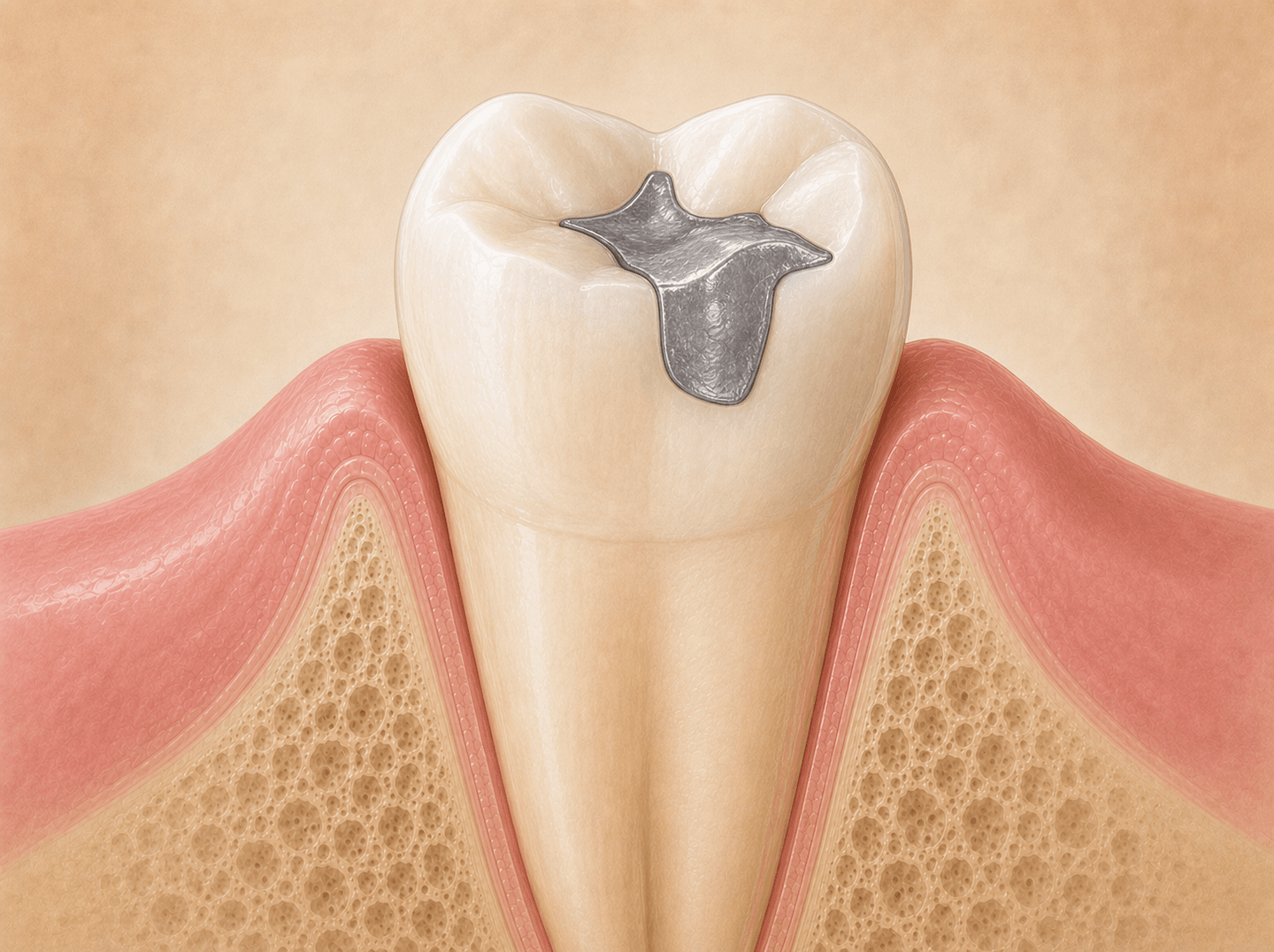
D2140 is the CDT code for a one-surface amalgam restoration on a primary or permanent tooth — a silver filling covering a single tooth surface.
Amalgam billing volume has been falling as practices move to composite, but the code still matters: many plans use the D2140 allowable as the benchmark for posterior alternate-benefit downgrades on composite, and a handful of payers still require amalgam for posteriors as the only covered material.
What D2140 covers
D2140 reports a one-surface amalgam restoration on a primary or permanent tooth. The single surface can be any of the five: mesial (M), occlusal (O), distal (D), buccal (B), or lingual (L). The code includes the restoration material, the cavity preparation cleanup, the placement, the carving and finishing, and the occlusal adjustment.
It does not cover:
- Two-surface amalgam restorations. Use D2150.
- Three-surface amalgam restorations. Use D2160.
- Four or more surface amalgam restorations. Use D2161.
- Resin-based composite restorations. Use D2391 for one-surface posterior composites, D2330 for anterior.
- Glass ionomer or resin-modified glass ionomer restorations placed as definitive fillings. Report under the resin-based composite series, selecting by surface count and tooth position (anterior D2330–D2335, posterior D2391–D2394), the same way you’d code a composite. Reserve D2940 (protective/interim restoration) for interim placements only, not for permanent glass ionomer fillings.
- Sedative or interim restorations. Use D2940.
- Pin retention. Use D2951 in addition to the amalgam code if pins were placed.
The code structure is purely surface-count based. Material is amalgam. Tooth type is either primary or permanent.
When to bill D2140
Bill D2140 when:
- A tooth (primary or permanent, any position) has a carious lesion or failing restoration involving exactly one surface.
- The restoration is placed using amalgam.
- The surface is restored, carved, and the occlusion adjusted.
Do not bill D2140 for:
- Two-surface restorations even when the second surface is minor. Use D2150.
- Composite restorations. Use the appropriate D2330 or D2391 code depending on tooth position.
- Sedative fillings placed as a temporary measure pending a definitive restoration. Use D2940.
The composite-downgrade math
D2140 still drives composite payments even on practices that no longer place amalgam. On plans with alternate-benefit downgrades for posterior composites, the carrier pays the composite at the corresponding amalgam allowable. For a one-surface posterior composite, that’s the D2140 fee from the plan’s schedule.
The flow looks like this:
- The dentist places a composite. The office bills D2391 at its composite fee.
- The carrier processes and applies the alternate-benefit clause.
- The carrier pays D2391 at the D2140 allowable from the same fee schedule.
- The patient owes the difference between the composite office fee and the amalgam allowable.
Practices that have eliminated amalgam still see the D2140 allowable affect their collections every time a downgrade-eligible plan pays a composite claim. Knowing the D2140 fee on each contracted plan helps with pre-treatment estimates and patient conversations about out-of-pocket cost.
Top reasons D2140 gets denied or downgraded
Five issues account for most problems on this code:
- Surface-count miscoding. D2140 billed on a two-surface preparation. The carrier reviews the chart and pays at D2150, or asks for clarification. The reverse (billing D2150 on a one-surface) is less common because offices tend to be more careful when the error would overbill.
- Frequency limit on the same surface. Most plans pay one restoration per tooth surface per benefit year or per two years. A patient with a prior one-surface filling on the same surface hits the frequency cap. A narrative documenting recurrent decay, fracture, or marginal failure of the prior restoration usually clears the pend.
- Plan no longer covers amalgam. Rare but growing. Some consumer-driven plans and a handful of marketplace plans have removed amalgam from their covered procedure list. The claim is denied as non-covered. Convert to composite if clinically appropriate and resubmit, or bill the patient out-of-pocket per the financial agreement.
- Wrong tooth type. Some plans apply different frequency or coverage rules to primary versus permanent teeth. A pediatric claim on a primary tooth may pay differently than a similar claim on a permanent tooth even at the same code. The tooth number tells the carrier which it is.
- Pre-existing condition exclusion. A new patient with new insurance who had a restoration placed shortly before the policy effective date may hit a pre-existing exclusion. Less common than it used to be, but it still happens on certain individual marketplace plans.
The amalgam-versus-composite decision and how it shows up in billing
The clinical decision belongs to the dentist and the patient, but the billing implications shape the conversation:
- Plans that cover composite at composite rates. Either material bills cleanly. The patient pays the same coinsurance regardless of which is placed.
- Plans with alternate-benefit downgrades for posterior composites. Amalgam bills at the D2140 allowable. Composite bills at the D2391 office fee but pays at the D2140 allowable. The patient owes more out-of-pocket on the composite.
- Plans that don’t cover amalgam. Composite is the only covered option. Billing D2140 returns a non-covered denial.
- Pediatric Medicaid. Most state Medicaid programs cover both, often paying composite at composite rates without the alternate-benefit downgrade. State-specific.
The pre-treatment estimate should reflect the plan’s actual behavior on the chosen material, not a generic “your insurance covers fillings.” A specific dollar number for the patient’s expected out-of-pocket prevents the most common post-visit complaint.
Documentation that supports the claim
The claim needs:
- Date of service.
- Tooth number.
- Surface designation (a single letter: M, O, D, B, or L).
- Material code (D2140 carries amalgam implicitly).
For the patient record, document:
- Clinical reason for the restoration (caries on the specified surface, fracture, failing existing restoration).
- Surface restored.
- Material placed (amalgam alloy, lot or batch if your office tracks it).
- Liner or base if placed.
- Occlusion adjusted and verified.
- Patient instructions, including post-op sensitivity expectations.
A chart note that reads only “filling on #19” doesn’t pass audit. The note should specify the surface, the material, and the clinical reason.
Example case
A 52-year-old patient presents with a fractured restoration on tooth #30. The dentist diagnoses the fracture, removes the old amalgam, finds no caries underneath, and places a new one-surface amalgam restoration on the occlusal surface. The patient prefers amalgam and the plan covers both materials.
Billing steps:
- Verify benefits and confirm amalgam coverage on posterior teeth.
- Submit D2140 with surface designation O on the date of service.
- Add a brief narrative if the prior restoration is still within the plan’s frequency window: “Replacement of fractured one-surface amalgam on #30 occlusal. No caries detected under the prior restoration. Replacement indicated for marginal integrity.”
- The carrier processes per the plan’s amalgam coverage and frequency rules.
If the patient had switched to a plan with composite-only coverage, the conversation at treatment planning would have been different. The dentist would have offered composite, the office would have submitted D2391, and the patient would have paid composite coinsurance instead.
What to get right in your PMS
The specifics vary across Open Dental, Dentrix, Eaglesoft, Curve, and Carestream. The steps that matter:
- Code by surface count. One surface is D2140. Two is D2150. Three is D2160. Four or more is D2161. The PMS should enforce the surface-count match before posting.
- Set the surface designation correctly on the claim. A single letter for D2140.
- Keep the D2140 fee accurate on every contracted plan’s fee schedule. That number drives the alternate-benefit math on composite downgrades even when no amalgam is being placed.
- Bill on the date of service. Restorations are completed in a single appointment.
- Track which plans no longer cover amalgam. A short flag on the plan record prevents the office from quoting amalgam to a patient whose plan won’t pay for it.
If your office sees recurring frequency denials on D2140, the cause is usually that the prior restoration on the same surface wasn’t pulled into the patient’s recent history. Check the patient’s full restorative timeline before scheduling the new restoration. Frequency rules count from the date of the prior covered restoration, not from when the patient joined your practice.
FAQs
- What's the difference between D2140, D2150, D2160, and D2161?
- All four are amalgam codes, distinguished by surface count. D2140 is one surface. D2150 is two surfaces. D2160 is three surfaces. D2161 is four or more. The surfaces are M (mesial), O (occlusal), D (distal), B (buccal), L (lingual). The code applies to primary and permanent teeth without distinction.
- Do plans still cover amalgam?
- Most plans still cover amalgam on both anterior and posterior teeth, often at the same allowable they paid a decade ago. A small but growing number of marketplace plans, consumer-driven plans, and pediatric Medicaid programs have moved to composite-only coverage on posteriors. Verify the patient's plan before treatment planning if the practice still offers both materials.
- Why does D2140 matter if we place composite?
- Many plans apply an alternate-benefit clause on posterior composites, paying composite (D2391) at the amalgam (D2140) allowable. The D2140 fee in the plan's schedule sets the cap on what the plan will pay for a one-surface posterior restoration, regardless of which material was actually placed.
- Why was D2140 denied for frequency when the tooth's never been restored?
- The frequency limit usually counts at the tooth-surface level, not the tooth level. If the patient had a previous one-surface restoration on the same surface (often a composite that fell out or was replaced), the carrier may count that against the frequency. Pull the patient's history and identify the prior restoration if there's one in their records.
- Can D2140 be billed alongside composite on the same tooth?
- Rarely, and only if two distinct one-surface restorations are placed on non-contiguous surfaces. A buccal pit amalgam and a separate lingual pit composite on the same molar at the same visit could be billed as D2140 (one surface) plus D2391 (one surface). The chart should show the two surfaces as distinct restorations, not a single multi-surface preparation.
Related codes
Need help billing this code?
We handle D2140 claims daily.
If your team is spending time on denials, narratives, or carrier follow-up for this code, our outsourced dental insurance billing service can take it off your plate. We work inside your PMS and post payments the same week.
CDT codes are maintained by the American Dental Association. This page is an editorial billing guide, not the official ADA code descriptor. Verify current coverage policies with each carrier before submitting claims.