D2929 is the CDT code for a prefabricated porcelain or ceramic crown placed on a primary (baby) tooth — front or back — covering pediatric zirconia and ceramic crowns sold under names like NuSmile ZR and EZCrown.
Most billing problems on this code come from carriers denying coverage on primary teeth, alternate-benefit downgrades to stainless steel crown allowables, and missing medical necessity documentation.
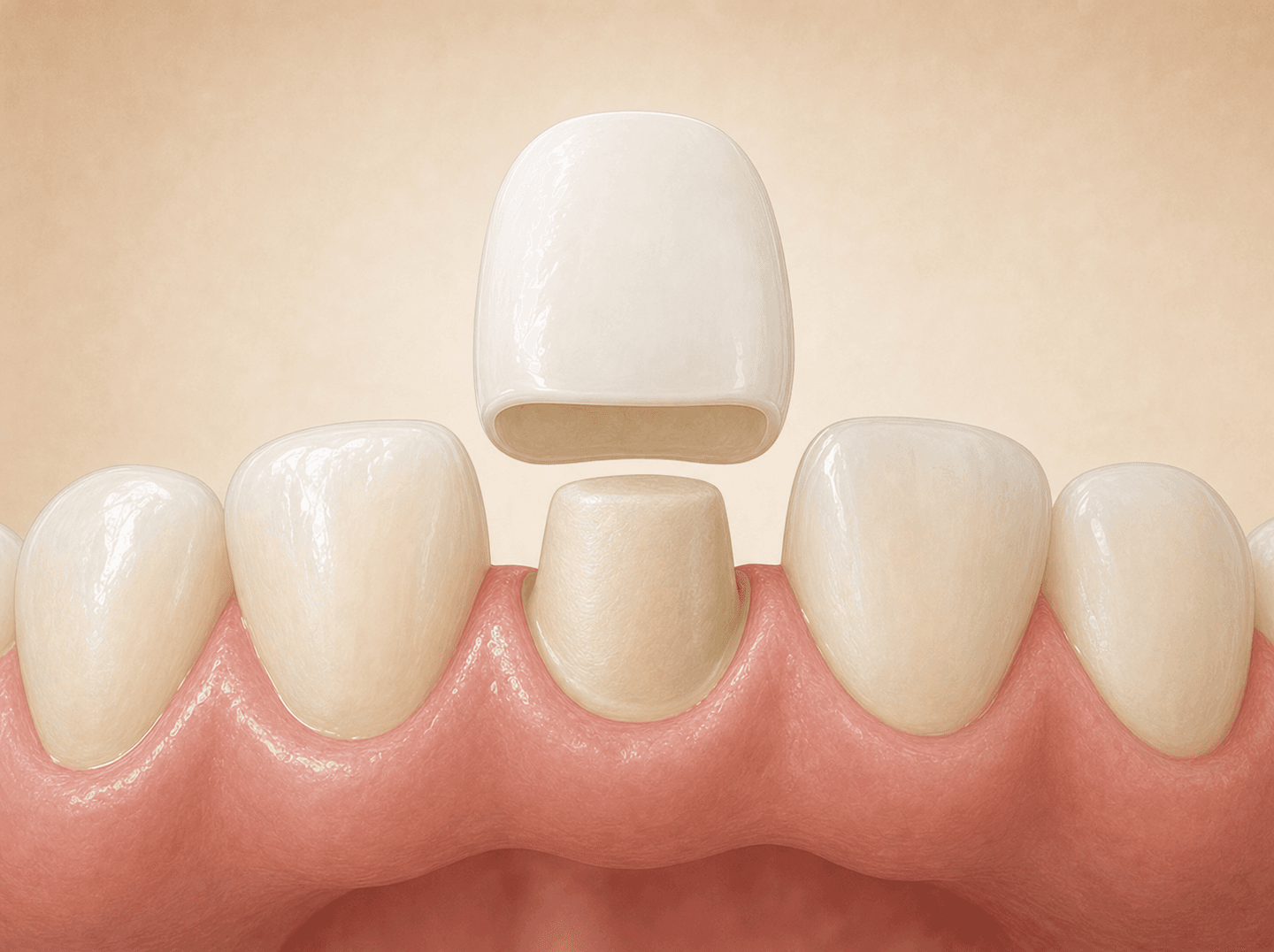
What D2929 covers
D2929 reports a prefabricated porcelain or ceramic crown placed on a primary (baby) tooth. These are sometimes called pediatric porcelain crowns, pediatric zirconia crowns, or by brand names like NuSmile ZR, EZCrown, or Cheng Crowns. Nothing in the code limits it to front teeth: it applies to any primary tooth (lettered A through T), and prefabricated zirconia/ceramic crowns are routinely placed on primary molars as well as front teeth.
It does not cover:
- Stainless steel crowns on primary teeth. Use D2930. (D2931 is the stainless steel crown code for permanent teeth. The D2930/D2931 split is primary vs. permanent, not anterior vs. posterior.)
- Prefabricated porcelain or ceramic crowns on a permanent tooth. Use D2928.
- Prefabricated resin crowns. Use D2932.
- Lab-fabricated crowns on permanent teeth. Use D2740 (all-ceramic) or D2750 (PFM).
- Strip crowns or composite resin crowns. Those are typically coded as direct restorations (D2330 series).
- Implant-supported crowns (D6065 or D6066).
If the crown is a prefabricated porcelain or ceramic unit placed on a primary tooth (anterior or posterior), it’s D2929.
When to bill D2929
Bill D2929 when:
- A prefabricated porcelain or ceramic crown is cemented on a primary tooth (anterior or posterior) that needs full-coverage restoration.
- The tooth has extensive caries that can’t be restored with a direct composite or strip crown.
- Early childhood caries (ECC) has compromised the tooth structure to the point where full coverage is the only viable option.
- A nickel allergy prevents use of a stainless steel crown.
- The parent and dentist agree that esthetics on a visible anterior tooth warrants a tooth-colored crown instead of stainless steel.
Do not bill D2929 for:
- Strip crowns built up with composite resin inside a celluloid form. That’s a direct restoration (D2330 series), not a prefabricated crown.
- A stainless steel crown with a preveneered facing. That’s still D2930 with the esthetic component considered part of the SSC procedure.
- Prefabricated porcelain/ceramic crowns on permanent teeth. Use D2928. (Lab-fabricated permanent crowns use the D2740/D2750 series.)
Top reasons D2929 gets denied or downgraded
Five issues drive most of the problems on this code:
- Plan exclusion on primary-tooth crowns. Some commercial plans exclude crowns on primary teeth entirely. The carrier’s position is that the tooth will exfoliate, so full-coverage restoration isn’t a covered benefit. If the plan excludes it, no appeal will overturn it. You need to verify before treatment and inform the parent of full financial responsibility.
- Alternate-benefit downgrade to D2930. Many plans that do cover primary-tooth crowns will pay D2929 at the stainless steel crown (D2930) allowable. The plan considers SSC clinically adequate, so they pay the lesser amount and the patient owes the difference. This is the most common “surprise” on D2929 claims.
- Missing medical necessity documentation. Without a narrative explaining why a porcelain crown is indicated over a stainless steel alternative, carriers default to denying or downgrading. “Parent prefers esthetics” alone is usually not enough. You need clinical reasoning: nickel allergy, anterior visibility, or structural factors favoring ceramic retention.
- Age limitation. Some carriers impose age floors or ceilings for crowns on primary teeth. A plan might not cover crowns on children under age 3, or might deny coverage for primary-tooth crowns on patients over age 8 or 9 (reasoning that the tooth should exfoliate soon). Check the plan’s age restrictions during verification.
- No pre-authorization. Many plans require predetermination for major restorative on pediatric patients. Skipping this step leads to a denial you could have prevented entirely.
Documentation that supports the claim
The claim needs:
- Pre-operative radiograph showing the extent of caries or structural damage to the primary tooth.
- Clinical photograph of the affected tooth (strongly recommended for pediatric crowns, especially on appeal).
- Narrative explaining why porcelain/ceramic was selected over stainless steel. Acceptable clinical reasons include: nickel allergy documented in the patient’s medical history, anterior tooth in the esthetic zone where a metal crown creates a visible cosmetic issue, or structural factors where the crown form and retention properties of a ceramic prefab are clinically preferred.
- Correct tooth letter. Primary teeth use letters A through T, not numbers 1 through 32. Submitting a primary-tooth crown with a permanent-tooth number will reject.
- Patient’s date of birth confirmed on the claim (required for pediatric-specific codes, and some carriers auto-deny if the DOB doesn’t match a primary-dentition age range).
For the patient record, document:
- Diagnosis (ECC, traumatic fracture, developmental defect).
- Why a direct restoration was not viable (extent of structural loss, number of surfaces involved).
- Material and brand of the prefabricated crown placed.
- Behavior management approach used (relevant for Medicaid documentation in some states).
- Post-cementation occlusion check.
Alternate-benefit downgrades to stainless steel
This is the most common billing frustration with D2929. Here’s the pattern:
- You submit D2929 (prefabricated porcelain crown, primary tooth) at your office fee.
- The carrier processes it but applies an alternate-benefit clause.
- They pay D2929 at the stainless steel crown (D2930) allowable.
- The difference between your D2929 fee and the D2930 allowable becomes patient (parent) responsibility.
This is not a denial. The carrier is saying the plan covers a crown on that tooth, but only at the SSC rate. The porcelain “upgrade” cost falls to the family.
What to do: Disclose this to the parent before treatment. Run the predetermination to confirm the downgrade amount. Collect the estimated difference at the time of service or have a signed financial agreement in place. Posting the payment correctly matters: post the carrier’s payment at the downgraded amount, then bill the parent the difference between your D2929 fee and what the carrier allowed.
Medicaid and state-specific coverage
Medicaid coverage for D2929 varies by state:
- Some state Medicaid programs cover prefabricated porcelain crowns on primary teeth with minimal documentation requirements. These programs recognize the esthetic and functional advantages for anterior teeth.
- Other states restrict coverage to stainless steel crowns only and will not reimburse D2929 under any circumstances.
- A few states cover D2929 but require prior authorization, clinical photos, and a detailed narrative for every claim.
Check your state’s Medicaid dental fee schedule and coverage policy before treatment. If D2929 isn’t listed, the code isn’t covered regardless of medical necessity. In those states, you either place a stainless steel crown under Medicaid or bill the parent privately for the porcelain option.
For dual-coverage pediatric patients (Medicaid primary, commercial secondary), submit to Medicaid first. If Medicaid denies D2929, the secondary carrier often won’t pay either because the primary’s denial signals a coverage limitation, not a coordination issue.
Example case
A 4-year-old patient presents with early childhood caries affecting teeth D and E (upper right primary lateral and central incisors). Both teeth have caries extending to multiple surfaces with significant structural loss. The parent requests tooth-colored restorations for esthetic reasons. The patient has no known nickel allergy. The dentist determines that direct composite restorations won’t hold given the extent of the decay and plans prefabricated zirconia crowns on both teeth.
Billing steps:
- Verify the patient’s plan. Confirm D2929 is a covered benefit, check for age restrictions, and determine whether the plan downgrades to D2930 allowable. Run a predetermination if time allows.
- Document the clinical justification: extensive multi-surface caries on anterior primary teeth where direct restoration is not viable due to insufficient remaining tooth structure. Note that anterior esthetics supports porcelain over SSC.
- Submit D2929 twice (once per tooth, teeth D and E) at office fee. Attach the pre-op radiograph and a narrative covering diagnosis and material rationale.
- If the plan downgrades to D2930 allowable, post the carrier’s payment at the downgraded amount. Bill the parent the difference per the financial agreement signed before treatment.
- If the claim denies outright for plan exclusion, bill the parent for the full amount per the signed consent. There is no appeal path for a plan that excludes the benefit entirely.
What to get right in your PMS
The exact menus and field names vary across Open Dental, Dentrix, Eaglesoft, Curve, and Carestream, and they shift between versions. The steps that matter are the same regardless of system:
- Code the procedure as D2929 on the correct primary tooth letter. Primary teeth are A through T. Submitting D2929 with a permanent-tooth number (1 through 32) will reject. Confirm twice before posting.
- Attach the pre-op radiograph and clinical photo to the claim itself. Many systems store images at the patient level. The clearinghouse needs the images linked to the specific claim, not just floating in the chart.
- Add the narrative before submission. Include the clinical diagnosis, why full coverage is indicated, and why porcelain was selected over SSC. Adding the narrative after a carrier request costs a week or more in turnaround.
- Post the procedure on the cementation date. This drives the date of service the carrier reads.
- Confirm your fee comes from your office fee schedule, not the carrier’s allowable. Submitting at the carrier’s fee corrupts secondary insurance calculations on dual-coverage pediatric patients and limits recovery on downgrades.
- If predetermination was obtained, link it to the claim. Some PMS platforms have a prior-auth field. Populate it. A claim submitted without the pre-auth reference number may deny even though the predetermination was approved.
FAQs
- Does insurance cover porcelain crowns on baby teeth?
- It depends on the plan. Many commercial plans classify D2929 as major restorative and apply waiting periods, coinsurance at 50%, or outright exclusions for crowns on primary teeth. Some plans cover it but downgrade to the stainless steel crown (D2930) allowable. Medicaid coverage varies by state. Always verify before treatment.
- What's the difference between D2929 and D2930?
- D2929 is a prefabricated porcelain or ceramic crown on a primary tooth. D2930 is a prefabricated stainless steel crown on a primary tooth. The clinical difference is the material. The billing difference is that many carriers treat D2930 as the baseline and will downgrade D2929 to the D2930 allowable under alternate-benefit clauses.
- Why does the carrier keep denying D2929 on primary teeth?
- The most common reason is a plan exclusion or limitation on crowns for primary teeth. Some carriers apply age restrictions (won't cover crowns on patients under a certain age, or won't cover primary-tooth crowns on patients over 8 or 9). Others deny because they consider the stainless steel crown clinically adequate. A strong narrative explaining why porcelain is necessary (anterior esthetics, nickel allergy) can overturn some of these denials on appeal.
- Do I need pre-authorization for D2929?
- Many plans require predetermination for major restorative on pediatric patients. Submit a pre-estimate with a radiograph, clinical photo, and narrative before treatment. If you skip this step and the plan requires it, the claim will deny for missing prior authorization even if the procedure was clinically appropriate.
- Can I bill D2929 on a permanent tooth?
- No. D2929 is specifically for primary (baby) teeth. The matching code for a prefabricated porcelain or ceramic crown on a permanent tooth is D2928. (The D2710–D2750 series is for lab-fabricated permanent crowns, not prefabricated ones.) D2929 submitted on a permanent tooth will deny for code-procedure mismatch.
Related codes
Need help billing this code?
We handle D2929 claims daily.
If your team is spending time on denials, narratives, or carrier follow-up for this code, our outsourced dental insurance billing service can take it off your plate. We work inside your PMS and post payments the same week.
CDT codes are maintained by the American Dental Association. This page is an editorial billing guide, not the official ADA code descriptor. Verify current coverage policies with each carrier before submitting claims.