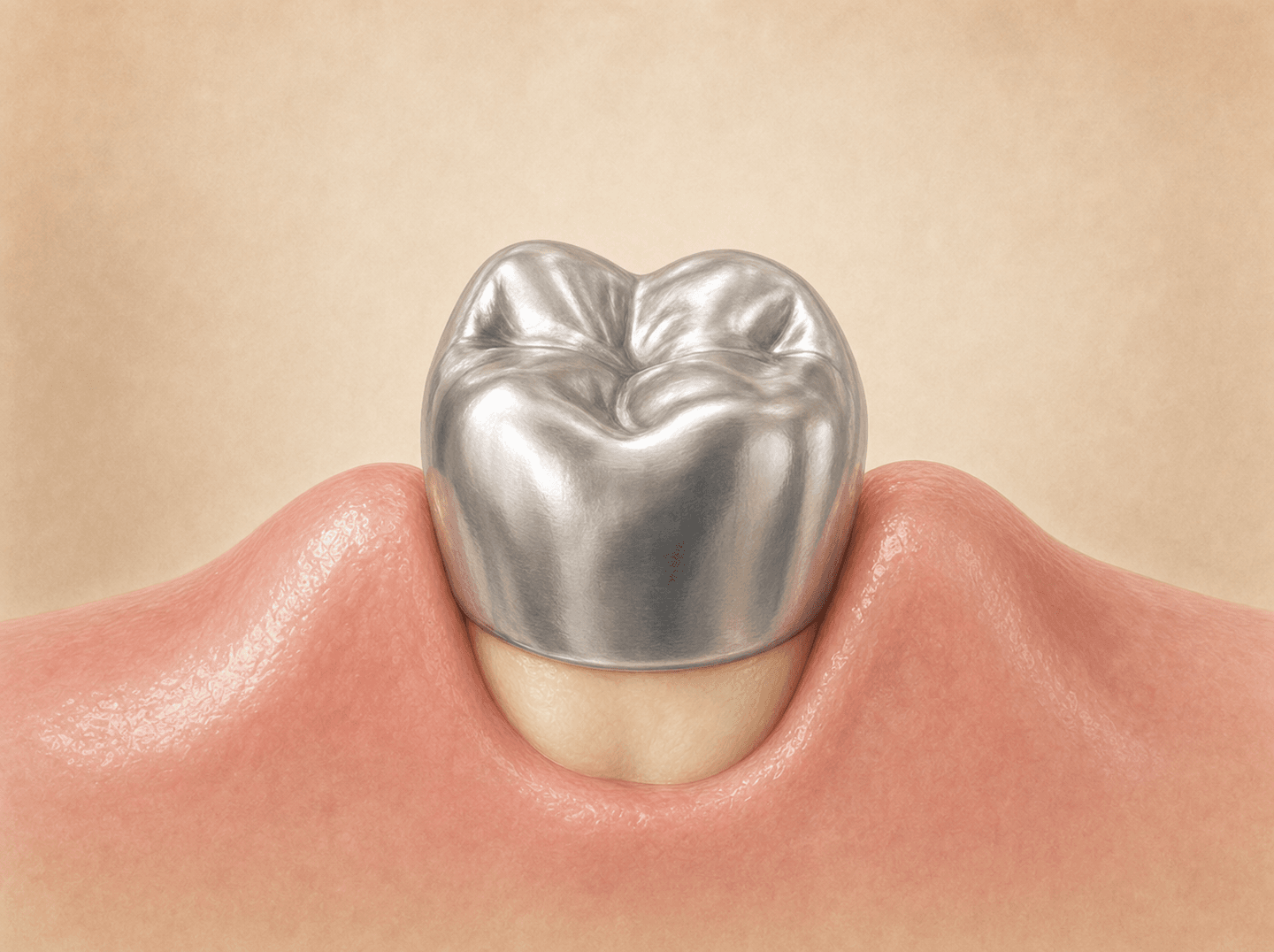
D2930 is the CDT code for a prefabricated stainless steel crown on a primary tooth — a preformed metal cap fitted and cemented chairside, defined by two facts together: the material is steel and the tooth is a baby tooth.
Get either one wrong and the code is wrong: the prefabricated-crown family splits by material and tooth type, so the permanent-tooth version is a separate code and the esthetic and ceramic alternatives carry their own.
What D2930 covers
D2930 reports a prefabricated stainless steel crown placed on a primary (baby) tooth. Two facts define the code together. The crown is stainless steel, a preformed metal cap that comes in stock sizes and is fitted to the tooth chairside. And the tooth is primary, not permanent. Change either fact and the code changes.
A stainless steel crown is the standard full-coverage restoration for a badly broken-down or pulpotomized primary molar. It is prefabricated, so there is no impression-and-lab cycle the way a cast crown has; the crown is selected, adapted, and cemented in one visit.
It does not cover:
- A stainless steel crown on a permanent tooth. That is D2931.
- A prefabricated ceramic (zirconia) crown on a primary tooth. That is D2929.
- A prefabricated resin crown. That is D2932.
- A stainless steel crown with an esthetic resin window on the facial. That is D2933.
- A prefabricated esthetic coated (tooth-colored) stainless steel crown. That is D2934.
- A custom lab-fabricated crown. That is the D2740 / D2750 series.
The prefabricated-crown family splits two ways
The family that D2930 sits in is organized along two axes at once: the tooth type (primary or permanent) and the crown material or finish. Reading the family means tracking both.
By tooth type, for plain stainless steel:
- D2930 is stainless steel on a primary tooth.
- D2931 is stainless steel on a permanent tooth.
By material and finish, all on primary teeth:
- D2929 is prefabricated porcelain/ceramic (commonly zirconia).
- D2932 is prefabricated resin.
- D2933 is stainless steel with a resin (tooth-colored) window on the facial surface.
- D2934 is esthetic coated stainless steel, a metal crown with a tooth-colored exterior coating.
So D2930 and D2931 differ only in the tooth. D2930 and D2929 differ only in the material. D2930 and D2934 differ in the finish (bare metal versus coated). Naming the axis correctly is what keeps these straight.
When to bill D2930
Bill D2930 when:
- The crown is a prefabricated stainless steel crown, and
- The tooth is primary.
Typical case: a primary molar with extensive decay, a fracture, or a pulpotomy/pulpectomy that needs full coverage rather than a filling.
Do not bill D2930 for:
- A stainless steel crown on a permanent tooth. Use D2931.
- A tooth-colored crown on a primary tooth. Use D2929 (ceramic), D2932 (resin), D2933 (resin window), or D2934 (coated).
- A custom crown. Use the D2740 / D2750 series.
Top billing problems with D2930
- Tooth-type mismatch. The code says primary (D2930) but the tooth number is a permanent tooth, or the reverse. Carriers cross-check the tooth number against the code and deny or reclassify. This is the most common clean reason for a problem on this code.
- Esthetic upgrade downgrade. The office places a tooth-colored crown (D2929, D2933, or D2934) and the plan covers only the stainless steel benefit, paying the D2930 amount and leaving the patient the difference. Plan-dependent.
- Frequency or eligibility limit on primary teeth. Some plans limit primary-tooth crowns by frequency or by the patient’s age, and the crown pays at the patient’s expense.
- Buildup billed alongside. D2950 submitted with D2930 is commonly bundled, since a prefabricated crown does not carry a separately benefited foundation the way a cast crown does.
The tooth-type axis is the one carriers check
Because D2930 and D2931 are the same crown separated only by primary versus permanent, the tooth number on the claim is doing real work. A stainless steel crown billed as D2930 on tooth #3 (an adult molar) is a coding error: an adult tooth takes D2931. A stainless steel crown billed as D2931 on tooth #A or a lettered primary tooth is the same error in reverse.
Lettered tooth designations (A through T) are primary teeth and pair with D2930. Numbered designations (1 through 32) are permanent and pair with D2931. The crossover cases that cause trouble are mixed dentition in children and retained primary teeth in adults, where the tooth identification has to be right before the code follows.
The material axis: D2930 versus D2929 and D2934
When the conversation is about a tooth-colored result on a baby tooth, three codes are in play and they are easy to blur:
- D2930 is bare stainless steel. Silver. The standard benefit on most plans.
- D2929 is a prefabricated porcelain/ceramic crown, commonly zirconia. A fully tooth-colored, separate material. It covers any primary tooth, anterior or posterior, so it is not an anterior-only code.
- D2934 is an esthetic coated stainless steel crown: a metal crown underneath with a tooth-colored coating on the outside.
D2929 is a different material; D2934 is the same metal with a coating. Both read as tooth-colored to the parent, but they are distinct codes, and most plans benchmark coverage to the D2930 stainless steel amount and treat the esthetic versions as an upgrade. What the patient owes on an esthetic crown is plan-dependent and should be quoted from the plan, not assumed.
Documentation that supports the claim
For most plans a stainless steel crown on a primary tooth is a routine benefit, but the claim should still carry:
- The correct primary tooth designation (lettered, A through T).
- A radiograph showing the decay, fracture, or post-pulpotomy state that justifies full coverage.
- A note of the clinical reason for a crown over a filling (extent of decay, pulp therapy, fracture).
For the patient record, document the tooth, the material placed, and whether pulp therapy preceded the crown. If an esthetic crown was placed instead of stainless steel, document the material and the patient’s election of the upgrade so the financial conversation is on the chart.
Example case
A pediatric patient has primary tooth K with deep decay and a completed pulpotomy. The tooth needs full coverage. The dentist fits and cements a prefabricated stainless steel crown.
Billing steps:
- Confirm the tooth is primary (lettered, K) so the code is D2930, not D2931.
- Code D2930 with the pulpotomy reported under its own code on the same date.
- Attach the radiograph showing the decay and the pulp therapy.
- Read the EOB. A stainless steel crown on a primary molar usually pays as a routine benefit; if it denies, check the tooth-type match and any primary-tooth frequency rule first.
What to get right in your PMS
- Match the code to the tooth type. Primary takes D2930; permanent takes D2931. The tooth number (lettered versus numbered) has to agree with the code.
- Pick the right material code for tooth-colored crowns. D2929 (ceramic) and D2934 (coated steel) are different things, and both differ from D2930.
- Quote esthetic upgrades from the plan. Most plans benchmark to the stainless steel benefit and bill the patient the difference. That conversation belongs before treatment.
- Expect a buildup billed with D2930 to bundle. A prefabricated crown does not carry a separate foundation benefit the way a cast crown does.
- Verify the patient’s primary-tooth eligibility. Age and frequency limits on primary services are plan rules, not code rules.
FAQs
- What is the difference between D2930 and D2931?
- The tooth type. D2930 is a prefabricated stainless steel crown on a primary (baby) tooth; D2931 is the same crown on a permanent (adult) tooth. The material and the crown are identical. The code is selected by whether the tooth is primary or permanent, so the tooth number on the claim has to match the code.
- How is D2930 different from D2929?
- Material. D2930 is a stainless steel (metal) crown; D2929 is a prefabricated porcelain/ceramic crown (commonly zirconia) for a primary tooth. Both are prefabricated and both go on primary teeth, anterior or posterior. The choice between them is the crown material placed, not the tooth's position in the mouth.
- Does a plan cover a tooth-colored crown on a baby molar?
- It depends on the plan. Many plans cover the stainless steel crown (D2930) as the benefit and treat the esthetic alternatives (D2934 coated stainless steel, D2929 ceramic) as an upgrade, paying the D2930 benefit and leaving the patient the difference. This is plan-dependent. Check the esthetic-crown language before quoting a tooth-colored crown for a posterior primary tooth.
- Is a buildup billable under a stainless steel crown?
- Usually not as a separate benefit. A prefabricated crown like D2930 is placed without the structural buildup that a cast crown needs, and most plans consider any foundation material inclusive to the crown. Billing D2950 with a D2930 on the same primary tooth is commonly bundled or denied. Treatment and coding here are plan-dependent.
- Is there an age limit on D2930?
- The code itself has no age limit; it is defined by the tooth being primary, not by the patient's age. Plans, however, often apply their own age or eligibility rules to primary-tooth services. A primary tooth in an older child or a retained primary tooth in an adult can still take a D2930 clinically, but coverage follows the plan's rules.
Related codes
Need help billing this code?
We handle D2930 claims daily.
If your team is spending time on denials, narratives, or carrier follow-up for this code, our outsourced dental insurance billing service can take it off your plate. We work inside your PMS and post payments the same week.
CDT codes are maintained by the American Dental Association. This page is an editorial billing guide, not the official ADA code descriptor. Verify current coverage policies with each carrier before submitting claims.