D2962 is the CDT code for a lab-fabricated porcelain or ceramic veneer bonded to the labial (front-facing) surface of a tooth — a partial-coverage restoration, not a full crown.
Most porcelain veneer claims get denied. The reason is almost always the same: the plan classifies veneers as cosmetic and excludes them. But D2962 does get covered when there's a clinical reason for the restoration, typically a fractured tooth, peg lateral, or congenital malformation. Knowing when coverage exists and how to document for it is the difference between a write-off and a paid claim.
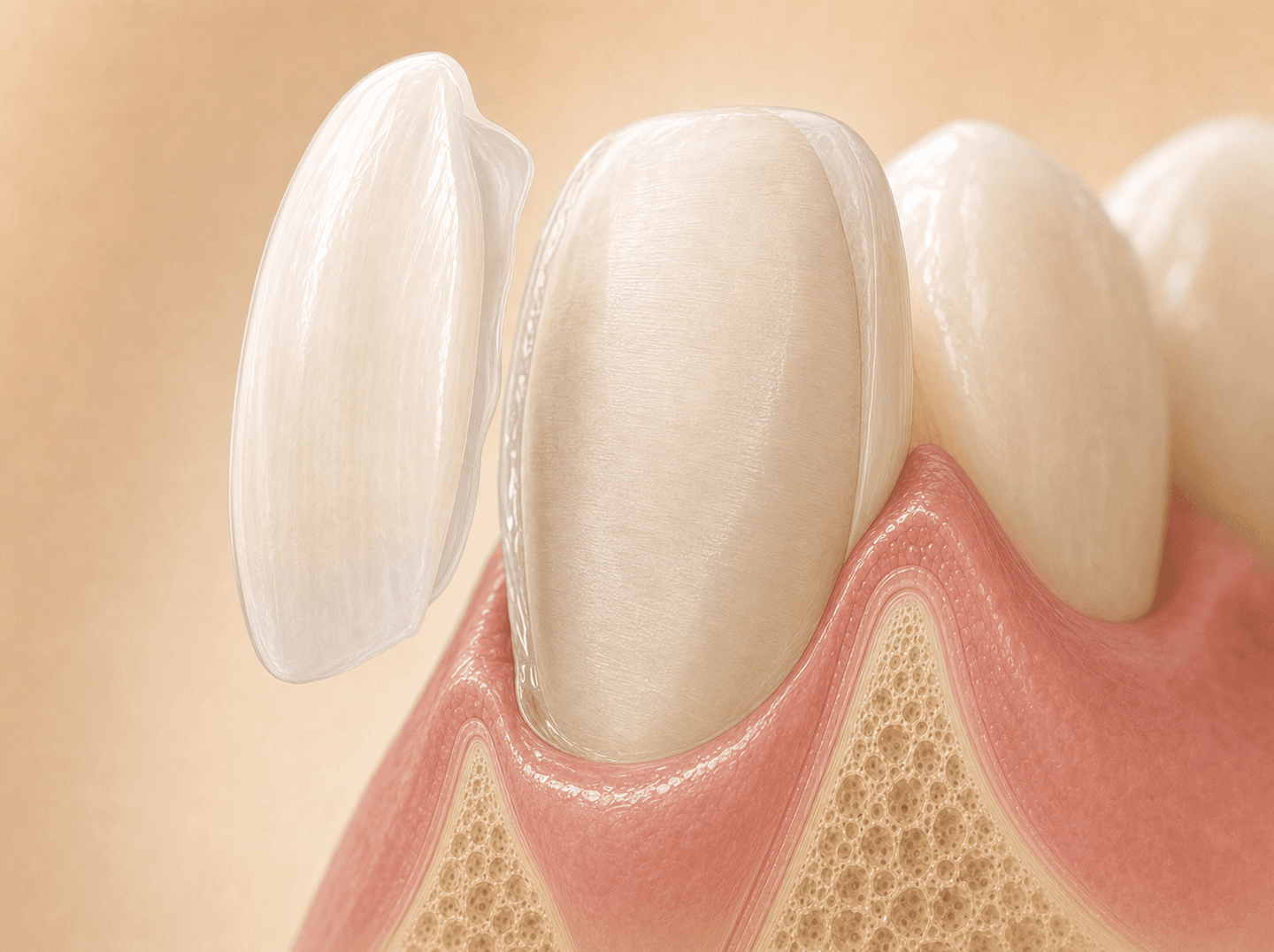
What D2962 covers and doesn’t cover
D2962 reports a laboratory-fabricated porcelain or ceramic veneer bonded to the labial (front-facing) surface of a tooth. The restoration covers only the facial surface and sometimes the incisal edge. It is not a full-coverage crown.
This code is typically used on upper anterior teeth (#6 through #11) and occasionally lower anteriors (#22 through #27). A dental lab fabricates the veneer on a model of the prepared tooth, and the dentist bonds it at a separate seating appointment.
D2962 does not cover:
- Chairside composite veneers. A resin veneer placed directly at chairside in one visit is D2960, the direct chairside resin veneer. Different fabrication method, different code, different coverage pattern.
- Full-coverage crowns. If the restoration wraps around the lingual surface and covers all surfaces of the tooth, it’s a crown (D2740 for all-ceramic). A veneer covers the labial surface only.
- Direct composite bonding. A composite restoration placed and shaped directly on the tooth without a lab-fabricated shell is D2330 or D2331, depending on how many surfaces are involved.
- Implant-supported restorations. Use the D6000 series.
When to bill D2962
Bill D2962 when a lab-fabricated porcelain or ceramic veneer is bonded to the labial surface of a natural tooth. Common clinical scenarios:
- A fractured anterior tooth where the remaining structure supports a veneer but not a full crown.
- A peg lateral that needs esthetic and functional correction.
- A congenitally malformed tooth where the veneer restores normal anatomy.
- Severe tetracycline staining or fluorosis that hasn’t responded to bleaching (though this is harder to get covered).
- Trauma to an anterior tooth resulting in enamel loss on the facial surface.
Do not bill D2962 for:
- Veneers placed purely for cosmetic improvement with no clinical finding. The code itself is valid, but the claim will almost certainly deny.
- A veneer on an implant abutment. Use the appropriate implant-supported restoration code.
- Temporary or diagnostic veneers. There is no specific CDT code for a provisional veneer. Document accordingly.
The cosmetic exclusion (and when veneers get past it)
This is the core billing challenge with D2962. Most dental plans contain a blanket cosmetic exclusion, and veneers are the procedure that triggers it most often. If the plan says “services performed primarily for cosmetic purposes are not covered,” the carrier will deny D2962 unless you prove otherwise.
Veneers get past the exclusion when the clinical record shows a restorative reason for the procedure:
- Fractured tooth. A chipped or fractured anterior where the veneer restores lost structure.
- Peg laterals. Undersized lateral incisors where the veneer builds the tooth to normal proportions.
- Congenital malformation. Teeth with enamel defects, amelogenesis imperfecta, or dentinogenesis imperfecta.
- Trauma. Documented injury resulting in structural damage to the facial surface.
The key word in most plan language is “primarily.” If the primary reason for the veneer is structural or restorative, and the cosmetic improvement is incidental, you have a basis for coverage. But the documentation has to support that framing from the start.
D2962 versus D2960 and D2961
There are three labial-veneer codes, and they split on material and fabrication method. D2961 and D2962 are both lab-fabricated (indirect) and differ only by material; D2960 is the chairside (direct) resin veneer.
D2962 (lab porcelain/ceramic veneer):
- Fabricated by a dental lab on a working model.
- Two appointments (prep and seat).
- Higher fee, typically classified as major restorative.
- 50/50 or 60/40 coinsurance is common when covered.
- Subject to major restorative waiting periods (6 to 12 months on new plans).
D2961 (lab resin/composite veneer):
- Also fabricated by a dental lab on a working model (indirect).
- Two appointments (prep and seat), the same workflow as D2962.
- Differs from D2962 only in material (resin/composite rather than porcelain/ceramic).
- Usually also classified as major restorative, though carriers may set a lower allowable than for porcelain.
D2960 (resin veneer, direct/chairside):
- Placed directly at chairside in one visit.
- Lower fee.
- Some plans classify this under basic restorative, giving it better coverage (70/30 or 80/20).
- Shorter or no waiting period on some plans.
Some carriers will not cover D2962 but will cover the cheaper direct resin veneer (D2960). Others apply alternate-benefit logic and pay D2962 at the D2960 (direct resin veneer) allowable, or at the D2330/D2331 anterior composite allowable. Verify the plan’s benefit booklet before treatment so you can set accurate patient expectations.
Top reasons D2962 gets denied
Five issues account for most D2962 denials:
- Cosmetic exclusion. The plan excludes veneers as cosmetic. This is by far the most common denial. If you didn’t get a predetermination, this is where you find out.
- No clinical documentation supporting medical necessity. Even when the plan covers veneers, the carrier needs proof that the procedure is restorative. A claim submitted without a narrative, photos, or radiographs will deny or pend.
- Alternate-benefit downgrade treated as a denial. The carrier pays at a lower allowable (D2960 or D2330/D2331). This isn’t a denial, but if you don’t understand the EOB, it looks like one. Post the payment correctly and bill the patient the difference.
- Frequency or benefit-period limits. Some plans cap the number of veneers covered per benefit period, or limit coverage to specific teeth. Submitting six veneers on the same date when the plan covers two will result in partial payment.
- Missing pre-authorization. The plan required predetermination for major restorative and it wasn’t obtained. Some carriers will process the claim retroactively, but many won’t.
Documentation that supports the claim
For the carrier:
- Clinical narrative explaining why the veneer is restorative, not cosmetic. Be specific: “Tooth #8 fractured mesio-incisal, existing composite failing, veneer indicated to restore anatomy and function” is useful. “Veneer for esthetics” guarantees a denial.
- Pre-operative photos showing the clinical condition. Intraoral photos of the fractured or malformed tooth are the strongest evidence for a medical-necessity appeal.
- Periapical radiograph when relevant (fracture extending subgingivally, root integrity questions).
- Lab slip documenting the fabrication. This confirms the veneer is lab-fabricated (an indirect veneer, D2962, rather than a chairside direct resin veneer, D2960).
For the patient record:
- The clinical reason for the veneer (fracture, peg lateral, congenital malformation, trauma).
- Tooth preparation details and shade selection.
- Bonding protocol and materials used.
- Post-cementation evaluation of margins and occlusion.
- Consent documentation noting whether insurance coverage was verified or uncertain.
Multiple veneers on the same date
Smile makeovers involving four, six, or eight veneers at once are clinically common. They are also a red flag for carriers. Multiple anterior veneers on the same date increase scrutiny because the pattern looks cosmetic regardless of the clinical reality.
What to expect:
- Some carriers limit the number of veneers covered per benefit period. Two or four is a common cap. Anything beyond the limit denies.
- Claims with six or more veneers on one date will almost always trigger a review. The carrier may request records, photos, and a detailed narrative before processing.
- Each tooth needs its own clinical justification. “Patient wants a nicer smile” covers none of them. Document the specific finding on each tooth (fracture on #8, peg lateral on #7 and #10, enamel defect on #9).
If the case involves multiple teeth with independent clinical findings, document each one separately and submit the supporting evidence upfront. If the case is primarily cosmetic with one or two teeth that have clinical findings, consider billing only the teeth with documented medical necessity and discussing the cosmetic teeth as patient-pay from the start.
Example case
A 29-year-old patient presents after a fall. Tooth #8 has a mesio-incisal fracture extending through the enamel and into dentin. Tooth #9 has a smaller enamel chip on the incisal edge. The patient’s plan is a PPO with major restorative coverage at 50% after a 6-month waiting period (cleared). The plan does contain a cosmetic exclusion.
Billing steps:
- Run a predetermination for D2962 on teeth #8 and #9. Include intraoral photos showing the fractures and a periapical radiograph of both teeth.
- The predetermination comes back: D2962 is covered on tooth #8 at 50% of the plan allowable. Tooth #9 is denied as cosmetic (the carrier considers a small enamel chip insufficient for a veneer). The carrier suggests D2330 (one-surface anterior composite) for #9.
- Discuss options with the patient. Tooth #8 will be partially covered. Tooth #9 is patient-pay for the veneer, or they can accept the composite restoration the carrier will cover.
- Patient elects veneers on both teeth. Submit D2962 on #8 with the narrative and photos. Submit D2962 on #9 with a note that the patient is aware of the cosmetic denial and accepts financial responsibility.
- Post the carrier payment on #8 at 50% of the plan allowable. Post #9 as patient-pay. Collect the patient’s portion on both.
What to get right in your PMS
The exact menus and field names vary across Open Dental, Dentrix, Eaglesoft, Curve, and other systems. The steps that matter are the same:
- Code the procedure as D2962 on the correct tooth. Confirm the tooth number. Transposed numbers on anterior teeth (#8 vs #9, #7 vs #10) are easy mistakes with real consequences.
- Attach photos and the radiograph to the claim, not just the patient chart. The clearinghouse needs the attachments linked to the specific claim. Images sitting in the patient record don’t transmit unless you attach them.
- Write the narrative before you submit. Adding a narrative after a denial costs a corrected-claim cycle and weeks of delay. On veneers, the narrative is the difference between a paid claim and a cosmetic denial.
- Post the procedure on the seating date. The date of service is when the veneer is bonded, not when the tooth is prepped.
- Submit at your office fee, not the carrier’s allowable. This matters for secondary insurance coordination and for alternate-benefit calculations. Submitting at the allowable shortchanges you on both.
- Flag the predetermination number on the claim if one was obtained. This connects the approved predetermination to the submitted claim and reduces processing delays.
FAQs
- Are porcelain veneers covered by dental insurance?
- Usually no. Most dental plans classify veneers as cosmetic and exclude them entirely. When veneers are covered, it's typically under the major restorative benefit category with 50/50 or 60/40 coinsurance and a waiting period. Coverage is more likely when the veneer addresses a clinical problem like a fracture, peg lateral, or congenital tooth malformation.
- What is the difference between D2962 and D2961?
- D2962 is a lab-fabricated porcelain or ceramic veneer. D2961 is a lab-fabricated resin (composite) veneer: same two-visit, indirect process, just a different material. Both typically fall under major restorative with higher coinsurance and longer waiting periods, though carriers may value the resin veneer lower than porcelain. The chairside, single-visit direct resin veneer is a separate code, D2960, which some plans treat like a composite filling under basic restorative.
- Will the carrier pay D2962 at the composite allowable instead?
- Some carriers apply alternate-benefit logic and pay D2962 at the allowable for an anterior composite (D2330 or D2331). The patient owes the difference. This is a plan limitation, not a denial. Verify the plan language before treatment so you can set patient expectations on out-of-pocket cost.
- Do I need pre-authorization before placing veneers?
- Strongly recommended. Many carriers require predetermination for major restorative, and veneers draw extra scrutiny because of the cosmetic exclusion. A predetermination tells you whether the plan covers veneers at all, what the allowable is, and whether alternate-benefit logic applies. Placing veneers without checking first risks a full write-off.
- How do I appeal a cosmetic denial on D2962?
- Submit a written appeal with the clinical narrative explaining the medical necessity (fracture, peg lateral, congenital malformation, trauma), pre-op photos showing the condition, a periapical radiograph if relevant, and the lab slip. The appeal must make the case that the veneer is a restorative procedure, not an elective cosmetic enhancement.
Related codes
Need help billing this code?
We handle D2962 claims daily.
If your team is spending time on denials, narratives, or carrier follow-up for this code, our outsourced dental insurance billing service can take it off your plate. We work inside your PMS and post payments the same week.
CDT codes are maintained by the American Dental Association. This page is an editorial billing guide, not the official ADA code descriptor. Verify current coverage policies with each carrier before submitting claims.