D2330 is the CDT code for a tooth-colored composite filling that restores a single surface of a front tooth — the one-surface, anterior member of the resin-composite family, where the code is decided by how many surfaces are restored.
It is the entry point of the anterior composite family. Most billing problems on it are surface-count errors: a two-surface restoration billed as D2330 (underbilling), or a one-surface restoration padded up to D2331.
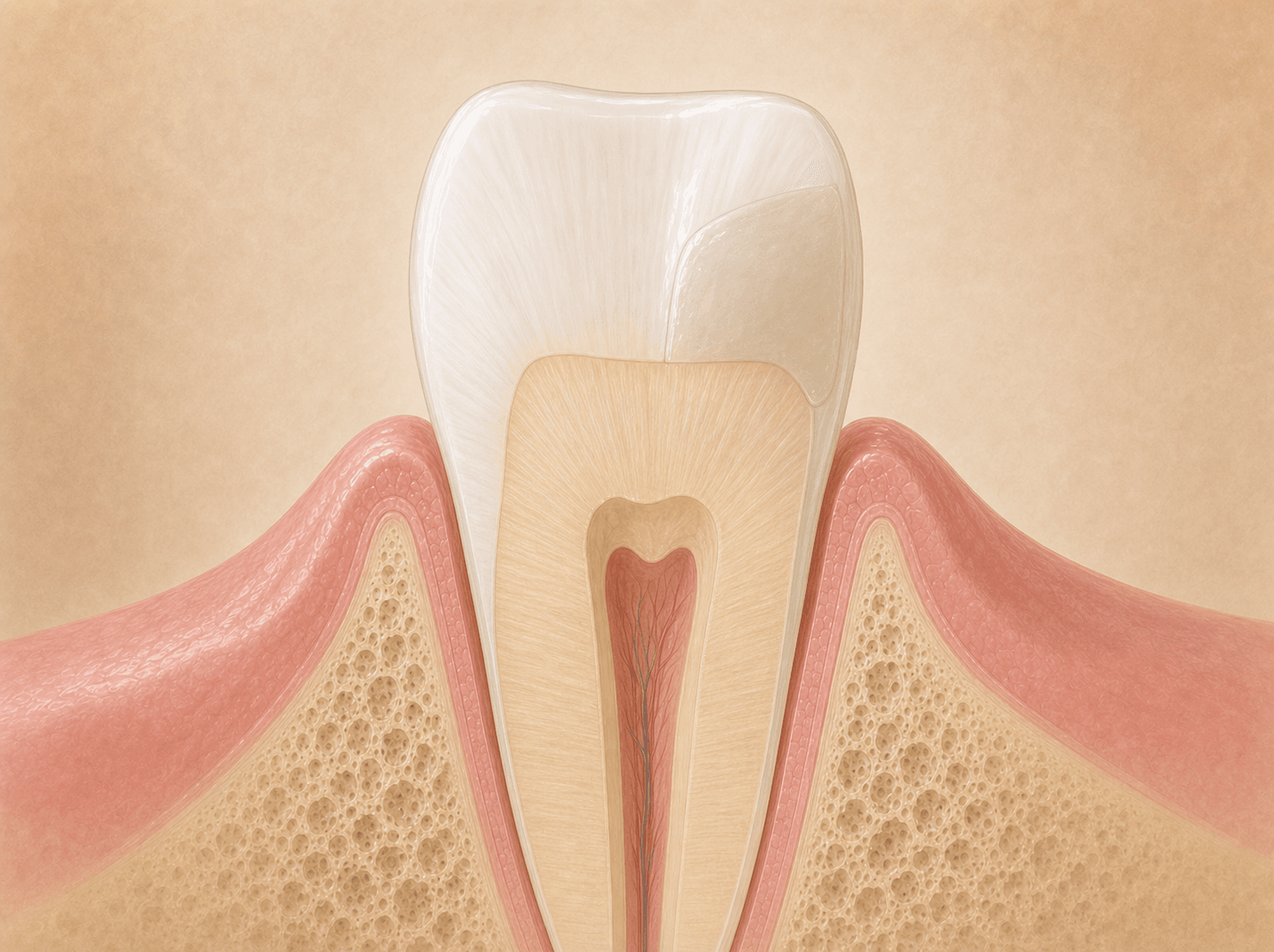
What D2330 covers
D2330 reports a resin-based composite restoration covering one surface of an anterior tooth. The single surface can be the facial, lingual, mesial, distal, or incisal. The code includes the composite material, the placement, the shaping, and the finishing on that one surface.
It does not cover:
- Two-surface anterior composites. Use D2331.
- Three-surface anterior composites. Use D2332.
- Four-or-more-surface anterior composites. Use D2335.
- Composites on posterior teeth (premolars and molars). Use D2391 (one surface), D2392 (two surfaces), D2393 (three surfaces), or D2394 (four or more).
- Indirect restorations, veneers, or crowns on anterior teeth.
The code structure is surface-count based. Material is composite. Tooth type is anterior.
When to bill D2330
Bill D2330 when:
- An anterior tooth (incisor or canine) has a carious lesion, fracture, or failing restoration involving exactly one surface.
- The restoration is placed with resin-based composite material.
Do not bill D2330 for:
- A two-surface restoration. Use D2331 even if the second surface was small.
- A posterior tooth.
- A restoration the practice intends to follow with a crown, where a buildup is the real procedure.
The surface-count rule
The surface count determines the code. For anterior teeth there are five countable surfaces: mesial (M), distal (D), facial or labial (F), incisal (I), and lingual (L).
The incisal surface is the one that trips people up. On an anterior tooth, the incisal is the biting edge, and it counts as a surface the same way the occlusal counts on a back tooth. A restoration confined to the incisal surface alone is one surface and codes as D2330.
A one-surface restoration involves exactly one of those five. The most common single-surface anterior restorations are a small facial composite (a smooth-surface lesion or an old facial filling) or a lingual composite behind an upper incisor.
The incisal angle is not a surface
This is the most misreported detail in the anterior family, and it is worth getting right on the simplest code in the family because the same logic carries through D2331, D2332, and D2335.
Before CDT 2024, D2335 was defined as four or more surfaces or involving the incisal angle. The ADA revised D2335 to drop the incisal-angle clause. The reasoning was plain: the incisal angle is the corner where the incisal edge meets the mesial or distal surface, and a corner is not a tooth surface. You cannot put it on a claim. The only anatomy a claim reports is tooth surface, using the single letters M, D, F, I, L.
So the involvement of the incisal angle no longer forces D2335. You count the actual surfaces restored and pick the matching code. A chip at the corner of a central incisor that the dentist restores across the incisal and facial is two surfaces, D2331, even though it involves the incisal angle.
Top reasons D2330 gets denied or repriced
- Surface-count miscoding. D2330 billed on a two-surface restoration (should be D2331) underbills the work. D2331 billed on what was really one surface gets downcoded to D2330.
- Frequency limit on the same surface. Most plans pay one restoration per tooth surface per benefit period. A facial composite on a tooth that had a facial composite a year ago may pend. A narrative documenting the new clinical reason (recurrent decay, fracture, failed margin) helps.
- No documented clinical indication. Some carriers audit restorations on teeth that looked sound at the last recall. The chart should name the caries, fracture, or failing restoration.
- Posterior code on an anterior tooth, or the reverse. A D2391 billed on tooth 8, or a D2330 billed on tooth 14, is a code-type mismatch the carrier will catch.
Documentation that supports the claim
The claim needs:
- Date of service.
- Tooth number (an anterior tooth, 6 through 11 or 22 through 27).
- Surface designation, a single letter for D2330.
For the patient record, document:
- The clinical reason: caries on a named surface, fracture, or failing existing restoration.
- The surface restored.
- The material used.
- Shade and any liner or base, if relevant.
A note that reads only “composite #9” does not pass audit. Specify the surface, the material, and the clinical reason.
D2330 versus the posterior one-surface code
D2330 and D2391 sit in the same place in their families. The split is tooth position, not technique.
- D2330 is a one-surface composite on an anterior tooth (incisor or canine).
- D2391 is a one-surface composite on a posterior tooth (premolar or molar).
The CDT 2026 cycle revised D2391 to drop its old restriction to lesions penetrating into dentin, so it now covers any one-surface posterior composite regardless of lesion depth. That change does not touch the anterior series. D2330 was not revised. The two are still separated by tooth position and nothing else.
Example case
A 29-year-old patient presents with a small carious lesion on the facial of tooth 9, a maxillary central incisor, caught at recall. The dentist confirms the lesion and places a single-surface composite on the facial.
Billing steps:
- Verify benefits and confirm anterior composite is covered at the composite allowable.
- Place the composite. One surface: F.
- Submit D2330 with surface designation F on the date of service.
- The carrier processes at the D2330 allowable. Anterior composite is rarely downgraded, so the patient owes only any coinsurance or deductible the plan applies.
If the tooth had a facial composite placed within the plan’s frequency window, the claim may pend. Submit a narrative documenting the new clinical reason.
What to get right in your PMS
- Code by surface count. One surface = D2330. Two = D2331. Three = D2332. Four or more = D2335. The number of surfaces restored sets the code, not chair time or material amount.
- Set the surface designation correctly. One letter for D2330, from M, D, F, I, L.
- Use anterior codes only on anterior teeth. Configure the PMS so D2330 cannot post on a posterior tooth number.
- Stop the incisal-angle auto-bump. If a template or a biller routes any incisal-angle case to D2335, fix it. Count surfaces.
- Document the clinical reason in the chart. A restoration without a documented reason invites audit problems.
FAQs
- What's the difference between D2330, D2331, D2332, and D2335?
- All four are anterior composite codes, distinguished by surface count. D2330 is one surface. D2331 is two surfaces. D2332 is three surfaces. D2335 is four or more surfaces. The anterior surfaces are mesial (M), distal (D), facial or labial (F), incisal (I), and lingual (L). The incisal surface on an anterior tooth plays the same counting role the occlusal surface plays on a posterior tooth.
- Does the incisal angle make a one-surface restoration into a D2335?
- No. The ADA removed the incisal-angle language from D2335 effective CDT 2024. The incisal angle is not a tooth surface, so it does not change the code by itself. You count the actual surfaces restored and pick the code that matches. A restoration that involves the incisal angle but only touches one surface is still D2330.
- Which teeth are anterior for these codes?
- The incisors and canines: roughly teeth 6 through 11 on the upper arch and 22 through 27 on the lower. Premolars and molars are posterior and use the D2391 through D2394 series instead. Coding an anterior composite with a posterior code, or the reverse, is a clean reason for the carrier to reject or reprice the claim.
- Will a plan downgrade D2330 to amalgam like it does on posterior composites?
- Rarely. Alternate-benefit downgrades to amalgam are mostly a posterior issue, because amalgam was never an esthetic choice on front teeth. Most plans pay anterior composite at the composite allowable. Confirm the specific plan, because a small number still apply unusual benefit logic.
Related codes
Need help billing this code?
We handle D2330 claims daily.
If your team is spending time on denials, narratives, or carrier follow-up for this code, our outsourced dental insurance billing service can take it off your plate. We work inside your PMS and post payments the same week.
CDT codes are maintained by the American Dental Association. This page is an editorial billing guide, not the official ADA code descriptor. Verify current coverage policies with each carrier before submitting claims.