D5120 is the CDT code for a conventional complete lower denture, made and delivered after the extraction sites have healed.
- When to use: The lower arch has no remaining teeth and the denture is made on a healed, stable ridge and delivered weeks or months after the last extraction.
- When not to use: A lower denture seated the day teeth come out is D5140, the conventional upper is D5110, and relines bill as D5731 chairside or D5751 lab.
- Billing note: A missing tooth clause can deny the whole denture if the teeth were lost before coverage began, so check it and any pre-authorization rule before impressions.
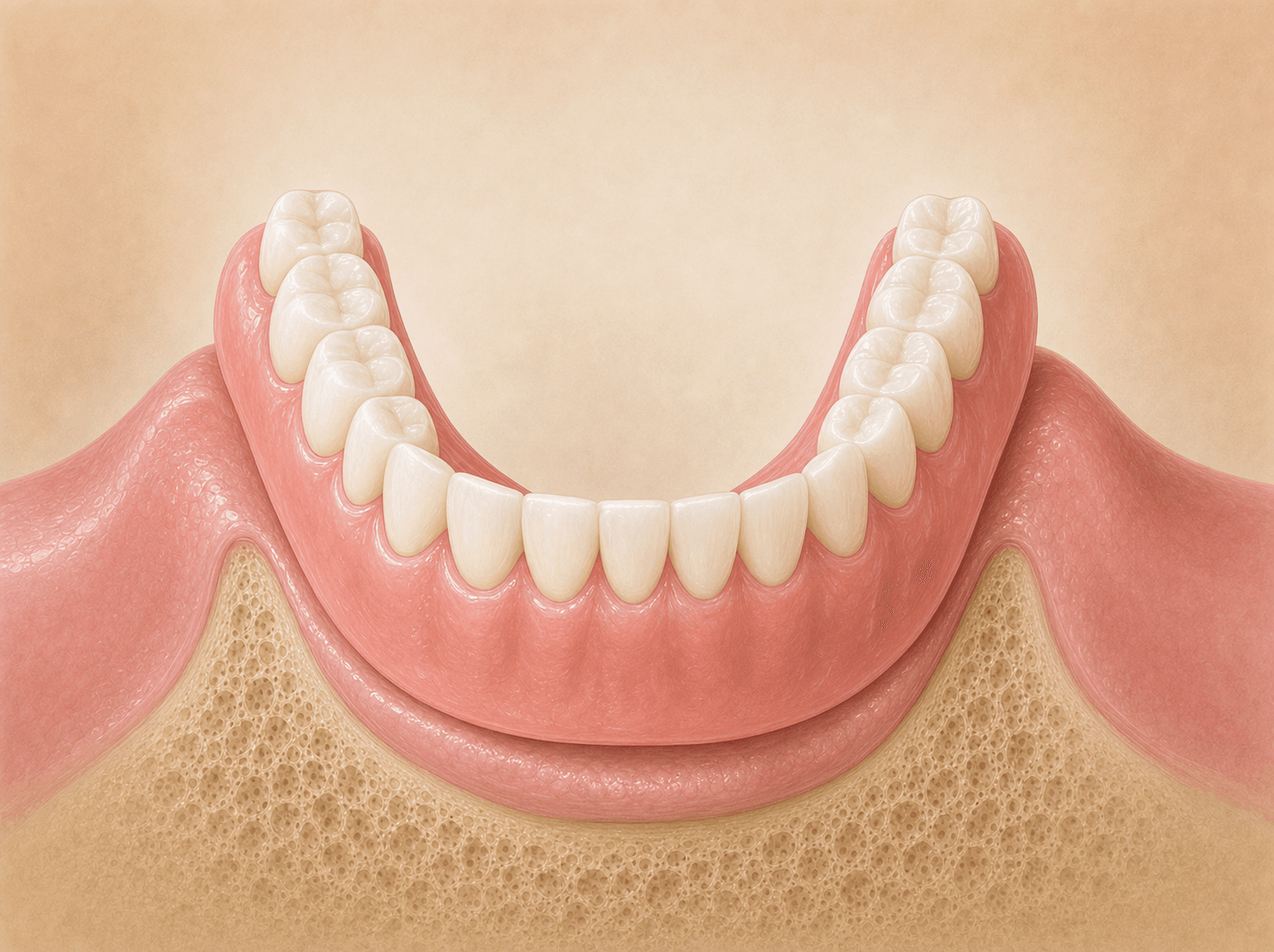
What D5120 covers
D5120 reports a conventional complete denture on the mandibular (lower) arch: a removable prosthesis with a full set of artificial teeth on an acrylic resin base shaped to the healed lower ridge. It applies when the arch has no remaining teeth and all extraction sites have healed enough for definitive impressions, typically at least 6 to 8 weeks after the last extraction and sometimes longer for the mandible.
The code includes diagnostic impressions, bite registration, wax try-in, laboratory fabrication, delivery, and the initial adjustments within the standard delivery workflow. Bill it once, on the delivery date. The earlier visits don’t get separate codes.
It does not cover:
- A conventional complete denture on the maxillary arch. Use D5110.
- An immediate complete denture delivered the same day as extractions. Use D5140 for the lower arch and D5130 for the upper.
- Partial dentures when natural lower teeth remain. Use the D5211 to D5226 series for resin-based partials or D5213 to D5214 for cast metal frameworks.
- Implant-supported overdentures. Use the D6110 to D6113 series.
- Adjustments after the included period, relines, rebases, and repairs on an existing lower denture. See the post-delivery codes below; rebases use D5711.
D5120 versus D5140: conventional versus immediate
The code depends on the delivery workflow, not the prosthesis.
Conventional (D5120):
- All lower teeth are extracted first, followed by weeks to months of healing.
- Final impressions are taken on a healed, stable mandibular ridge.
- The denture is fabricated to the post-healing anatomy and delivered at a later appointment.
- Initial fit is better because the ridge stabilized before fabrication.
Immediate (D5140):
- Impressions are taken before the extractions, typically a few weeks earlier.
- The denture is fabricated on a pre-extraction model with the teeth to be removed cut off the cast.
- It is delivered the same day as the extractions, so the patient has teeth during healing.
- It needs a reline or remake as the ridge resorbs over the following months.
A denture that seats the day the teeth come out is D5140, even if it was fabricated weeks earlier. Billing D5120 on that case misrepresents the procedure, and the extraction dates and clinical notes will show the discrepancy if the carrier reviews.
Top reasons D5120 gets denied
- Missing tooth clause (pre-existing edentulism exclusion). The patient lost their lower teeth before the policy effective date, and the plan denies the entire denture. It is the most common complete-denture denial for patients new to a plan. See the next section.
- Frequency limit. Most plans allow one complete denture per arch every 5 to 10 years. A prior lower denture inside the window denies unless an appeal documents why new fabrication is necessary: ridge changes beyond what a reline can address, structural failure, or loss.
- Immediate denture billed as D5120. The carrier cross-references the extraction dates and either denies or requests a correction to D5140.
- No pre-authorization. Many plans require predetermination on major prosthodontics. Skipping it when required triggers a denial that’s hard to appeal.
- Missing documentation of edentulism. Some carriers require proof the arch is fully edentulous, typically a panoramic radiograph or a chart entry listing all missing teeth with extraction dates. Without it, the claim pends.
The missing tooth clause and dentures
Some plans exclude prosthetic coverage for teeth already missing when the patient enrolled. For a complete denture, if the lower arch was fully edentulous before the policy start date, the plan won’t pay D5120 at all. The clause is more common on individual and marketplace plans than on employer-sponsored group plans, and more common on lower-premium plans.
During benefits verification, ask the carrier directly whether the plan has a missing tooth clause or pre-existing condition exclusion on prosthodontics. If it does, ask what documentation would satisfy an exception; some plans allow coverage when a prior covered denture needs replacement. Get the answer in writing or note the call reference number.
Documentation that supports the claim
The claim needs:
- Date of service matching the delivery date, not the impression or try-in dates.
- Arch designation for the mandibular arch (most PMS systems use area-of-oral-cavity code 02 or the lower arch indicator LA/MA). A wrong arch indicator rejects.
- A panoramic radiograph or other proof of edentulism if the plan requires it, attached to the claim itself and not just the patient chart, so the clearinghouse sends it with the claim.
- Your office fee, not the carrier’s allowable. Submitting at the allowable undercuts secondary insurance coordination and reduces recovery on dual-coverage patients.
In the patient record, document:
- Impression and bite registration dates.
- Wax try-in date and patient acceptance.
- Delivery date.
- Material and shade selected.
- Post-delivery instructions and follow-up schedule.
- Date of the last extractions, to confirm the conventional workflow.
- Condition of the mandibular ridge, which supports later reline claims and answers a carrier asking why a new denture was needed instead of a reline.
For a replacement denture, also document:
- The date the prior denture was first delivered, for the frequency calculation.
- The clinical reason the prior denture can no longer be serviced with a reline (ridge resorption, base fracture, material breakdown).
- A pre-treatment panoramic radiograph showing the current ridge anatomy.
Relines and adjustments after delivery
Lower dentures need more post-delivery work than uppers. The mandibular ridge resorbs faster, and without palatal suction the prosthesis depends entirely on ridge fit and border seal. Each follow-up is a separate procedure on its own date of service, never part of the D5120 claim.
Adjustments:
- D5411 (adjust complete denture, mandibular). Bills per visit after the plan’s included adjustment period, usually 30 to 90 days post-delivery. Frequency varies by carrier.
Relines:
- D5731 (reline complete mandibular denture, chairside), for quick-turnaround changes to the tissue surface at the chair.
- D5751 (reline complete mandibular denture, laboratory), for a lab-processed reline that replaces the entire tissue surface.
Most plans don’t cover relines within 6 to 24 months of the original delivery. After that, reline frequency limits are typically once every 12 to 36 months.
Repairs:
- D5511 (repair broken complete denture base, mandibular).
- D5520 (replace missing or broken teeth on the denture).
Example case
A 62-year-old patient had their remaining lower teeth extracted eight weeks ago. The sites have healed and the ridge is stable. The patient has worn a maxillary complete denture for three years and is ready for a mandibular complete denture.
Treatment sequence:
- Visit 1: diagnostic impressions and shade selection.
- Visit 2: final impressions on custom trays.
- Visit 3: bite registration and verification of vertical dimension with the existing upper denture.
- Visit 4: wax try-in and patient verification of tooth position, phonetics, and esthetics.
- Visit 5: delivery of the completed mandibular denture.
Billing steps:
- Verify denture coverage and the frequency rule, and confirm no prior lower denture falls in the window. Check for a missing tooth clause; with recent extractions it is less likely to apply, but confirm.
- If the plan requires pre-authorization for major prosthodontics, submit a predetermination with a panoramic radiograph showing the healed edentulous ridge.
- After delivery, submit D5120 on the delivery date with arch designation 02 (lower).
- Schedule a post-delivery adjustment at one week. Expect two to three adjustments in the first month as the lower denture settles.
- Plan a reline evaluation at six months. If ridge changes affect retention, submit D5731 or D5751 after verifying the plan’s reline frequency rule.
Most recurring denials on complete denture claims trace to a missed frequency check or an undetected missing tooth clause. Confirm both before the first impression.
FAQs
- What's the difference between D5120 and D5140?
- The delivery workflow. Both are complete lower dentures. D5120 is conventional, fabricated weeks or months later on a healed ridge. D5140 is immediate, delivered the same day the teeth are extracted. If the patient leaves the surgical visit wearing the denture, it's D5140.
- Why do lower dentures need relines more often than upper dentures?
- The mandibular ridge resorbs faster than the maxillary ridge, and a lower denture has no palatal coverage to aid suction retention, so its fit deteriorates sooner. Most lower-denture patients need at least one reline (D5731 chairside or D5751 lab) within the first 12 to 18 months. Reline frequency limits and post-delivery waiting periods vary by plan.
- Can D5120 be denied for a missing tooth clause?
- Yes. A plan with a missing tooth clause, also called a pre-existing condition exclusion, can deny the entire denture if the teeth were lost before the policy effective date. It is one of the most common denials on complete denture codes. Check for the clause during benefits verification, before delivery.
- Does D5120 include the post-delivery adjustments?
- Only those in the plan's included delivery period, typically 30 to 90 days, which commonly covers a handful of adjustments. D5120 covers fabrication and delivery. After that window, adjustments bill per visit as D5411 (adjust complete denture, mandibular), with their own allowable and frequency rules.
- Is pre-authorization required for D5120?
- On many plans, yes, because complete dentures fall under major prosthodontics. Submit a predetermination with a panoramic radiograph showing edentulism and any supporting narrative before starting impressions. If the plan requires pre-auth and it's skipped, the claim denies regardless of medical necessity.
Related codes
Need help billing this code?
We handle D5120 claims daily.
If your team is spending time on denials, narratives, or carrier follow-up for this code, our outsourced dental insurance billing service can take it off your plate. We submit the claims, post what comes back, and follow up on anything unpaid. Already sitting on older claims that never paid? Our AR cleanup project works the backlog.
“Claims, posting, denials, all of it gets handled, and it costs far less than hiring another employee. My front desk got hours of their week back, and honestly I just don't think about billing anymore.”
CDT codes are maintained by the American Dental Association. This page is an editorial billing guide, not the official ADA code descriptor. Verify current coverage policies with each carrier before submitting claims.