D5213 is the CDT code for an upper partial denture built on a cast metal framework, with acrylic saddles carrying the replacement teeth.
- When to use: The patient keeps some upper teeth and the lab work order shows a cast metal framework rather than a resin base with wire clasps.
- When not to use: A resin base upper partial is D5211, the lower cast metal partial is D5214, a flexible upper is D5225, and an interim upper partial is D5820.
- Billing note: Many plans pay D5213 at the D5211 resin allowable, so run a pre-treatment estimate and quote the patient the dollar difference before the first impression.
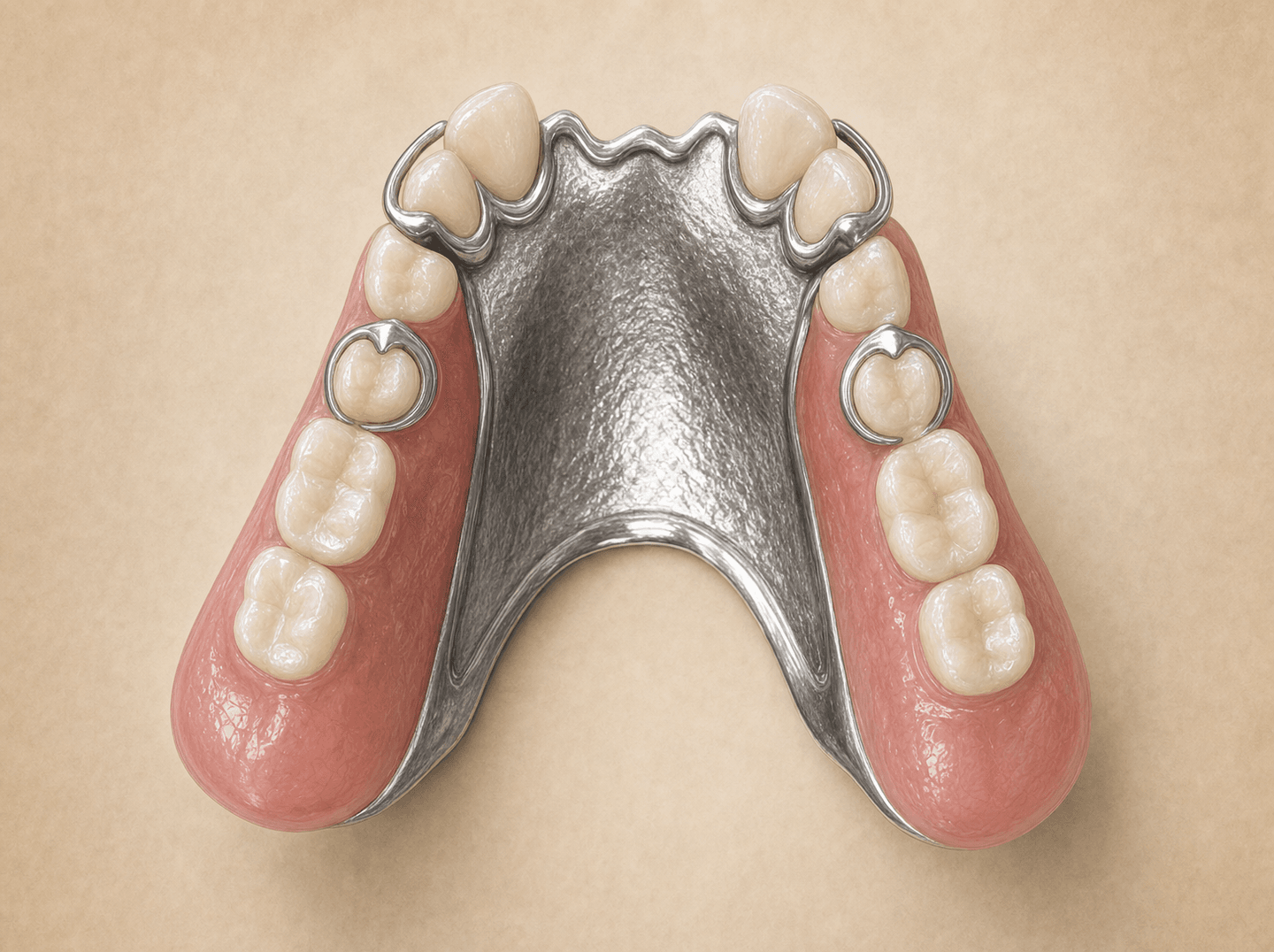
What D5213 covers
D5213 reports a maxillary (upper) partial denture on a cast metal framework supporting resin denture base areas and replacement teeth, for a partially edentulous upper arch. The framework is typically chrome cobalt or another cast alloy, designed from a surveyed cast, and incorporates rests, clasps, indirect retainers, and major and minor connectors.
The code includes the diagnostic impressions, surveyed cast, framework design and try-in, wax try-in with teeth, laboratory fabrication, delivery appointment, and initial post-delivery adjustments within the standard delivery workflow. Bill it on the delivery date; the earlier visits are included.
It does not cover:
- Maxillary partials with a resin base and resin or wrought wire retention, however complex. Use D5211.
- Mandibular cast metal partials. Use D5214.
- Mandibular resin-base partials. Use D5212.
- Flexible-base partials. Use D5225 (maxillary) or D5226 (mandibular).
- Flipper or interim transitional partials. Use D5820 (maxillary interim).
- Complete dentures. Use D5110 (maxillary) or D5120 (mandibular).
- Implant-supported partial dentures or fixed bridges. Use the appropriate D6000 series codes.
- Adjustments after the standard included period. Use D5421 (maxillary partial) or D5422 (mandibular partial). D5410 and D5411 are complete-denture adjustment codes and do not apply.
- Relines, rebases, or repairs. Use the D5710–D5761 series and the partial-denture repair codes (D5611/D5612 resin base, D5621/D5622 cast framework, D5650 add tooth, D5660 add clasp). For this maxillary cast partial, repairs run through D5612 (repair resin partial base, maxillary) and D5622 (repair cast partial framework, maxillary).
The missing-tooth clause and how it actually works
The missing-tooth clause is the biggest source of patient-responsibility surprises on partial cases. It is a per-tooth exclusion: the plan won’t pay to replace a tooth missing before the patient’s current coverage started. The carrier checks the coverage history for those teeth, and the plan’s wording decides the outcome:
- Cigna’s Colorado individual dental policy excludes a partial unless it includes at least one natural tooth extracted while the patient was covered, so one qualifying tooth makes the partial eligible.
- Other plans word the exclusion per tooth, and some drop it after a period of continuous coverage.
- Some plans have no clause at all. Delta Dental of New Jersey publishes a “missing tooth inclusion” for members 16 and over.
So a partial replacing three teeth lost before coverage and one lost during it is eligible under the Cigna wording and mostly or entirely excluded under stricter wording. Our missing tooth clause guide quotes the real plan wording. Most plans document the clause in the benefit booklet. Handle it with the pre-treatment estimate below, because a patient told “your insurance covers partials” who then gets an EOB denying the whole prosthesis will not be happy.
The alternate-benefit downgrade to acrylic partial
Many plans apply an alternate-benefit clause on cast metal partials. The plan considers the acrylic partial functionally adequate, so it pays only the lower allowable:
- The office submits D5213 at the cast metal office fee.
- The carrier applies the alternate-benefit clause and pays at the D5211 allowable.
- The patient owes the difference between the cast metal office fee and the acrylic allowable, plus the standard coinsurance on the lower allowable.
The gap is typically larger than in most alternate-benefit scenarios, because cast metal and acrylic partial fees differ by hundreds of dollars.
Top reasons D5213 gets denied or downgraded
- Missing-tooth clause exclusion. How a partial replacing several teeth is treated depends on the plan’s wording, so verify it before quoting the case. The most common patient-responsibility surprise on this code.
- Alternate-benefit downgrade to acrylic. The plan pays at the D5211 allowable. Not a denial. Bill the patient the difference plus coinsurance on the lower allowable.
- Frequency limit. A prior partial falls inside the plan’s five- or seven-year window. An appeal documenting clinical necessity (structural failure, ridge or anatomic change, abutment loss) succeeds on some plans.
- Pre-existing condition exclusion on the entire prosthesis. Newer commercial plans sometimes exclude prosthetic coverage for arches already partially edentulous before the policy started. Check the benefit booklet.
- Documentation gaps. Some carriers require a panoramic radiograph or periodontal charting showing the abutment teeth can retain a partial. A pre-op pano usually clears the request.
The pre-treatment estimate as the workflow checkpoint
With this many coverage modifiers on an expensive procedure, run a pre-treatment estimate before the first impression. Submit the planned D5213, get the carrier’s payment estimate, and turn it into a specific dollar number for the patient. A useful estimate shows:
- The plan’s quoted allowable, whether D5213 or downgraded to D5211.
- The missing-tooth clause adjustment, if any.
- The standard coinsurance.
- The patient’s expected out-of-pocket amount.
This one document prevents most “my insurance was supposed to cover this” conversations after delivery. Recurring patient-responsibility complaints on partials usually trace to an estimate that wasn’t done or wasn’t turned into a dollar figure.
Documentation that supports the claim
The claim needs:
- Date of service (the delivery date).
- Arch designation (maxillary).
- Panoramic radiograph or periodontal charting for carriers that require it.
- Framework design detail if requested. Most carriers don’t ask, and the lab work order filed in the patient record is usually sufficient on audit.
In the patient record, document:
- Diagnostic impression and surveyed cast dates.
- Framework design (rests, clasps, indirect retainers, connector type).
- Framework try-in date and fit verification.
- Wax try-in date and patient verification of esthetics.
- Delivery date and post-delivery adjustment schedule.
- Date of last tooth loss on the arch, for the missing-tooth clause.
- Any prosthetic history (prior partial, prior bridge, prior immediate temporary partial), which affects frequency and missing-tooth determinations.
Example case
A 58-year-old patient has a failing 12-year-old maxillary cast metal partial. The framework is fractured at the major connector, and the patient reports daily discomfort. The dentist confirms the failure, finds the remaining abutment teeth sound, and treatment-plans a new maxillary cast metal partial.
Treatment sequence:
- Visit 1: diagnostic impressions, abutment evaluation, periodontal charting.
- Visit 2: framework design impressions, surveyed cast.
- Visit 3: framework try-in, fit verification.
- Visit 4: wax try-in with teeth, patient verification.
- Visit 5: delivery of the new partial.
Billing steps:
- Verify benefits. Pull the frequency rule (most likely 5 or 7 years); the 12-year-old prior partial is outside the window.
- Check the missing-tooth clause and determine when each replaced tooth was lost relative to current coverage.
- Submit a pre-treatment estimate and quote the patient an expected out-of-pocket amount.
- Submit D5213 with arch designation 01 (upper) on the delivery date.
- Attach a panoramic radiograph and periodontal charting if the carrier requires either.
If the plan applies the alternate-benefit downgrade, the EOB pays at the D5211 allowable and the patient owes the difference, which the pre-treatment estimate should already have communicated.
FAQs
- What's the difference between D5211 and D5213?
- The base. D5211 is a maxillary partial with a resin base and resin or wrought wire retention. D5213 is a maxillary partial with a cast metal framework supporting the resin saddle areas and replacement teeth. The cast framework is sturdier, fits more precisely, and costs more.
- What's the missing-tooth clause?
- A plan exclusion for prosthetic replacement of teeth missing before the patient's current coverage started. It typically applies to bridges, partials, and complete dentures. The patient owes the full replacement cost for those teeth, even if the prosthesis is otherwise covered. The exclusion is documented in the plan's benefit booklet.
- Why was D5213 paid at the D5211 allowable?
- An alternate-benefit clause. Many plans pay a cast metal partial at the D5211 (acrylic partial) allowable because they consider the acrylic partial functionally adequate. This is plan language, not a denial. The patient owes the difference between the cast metal office fee and the acrylic allowable.
- Does D5213 include rest seats and surveying?
- Yes. The framework design, including the undercut survey, clasp design, and rest seat preparation on the abutment teeth, is part of D5213. If a rest seat requires more extensive tooth modification, such as occlusal recontouring or equilibration, the additional work may be billable separately depending on the carrier and the procedure.
- Why was D5213 denied for a 7-year-old prior partial?
- Because some plans use a seven-year frequency window. Most plans pay one partial per arch every five years, sometimes seven, so a 7-year-old prior partial usually clears a 5-year plan but may still hit a 7-year one. The clock starts from the date of the prior covered partial, not when the patient joined the plan.
Related codes
Need help billing this code?
We handle D5213 claims daily.
If your team is spending time on denials, narratives, or carrier follow-up for this code, our outsourced dental insurance billing service can take it off your plate. We submit the claims, post what comes back, and follow up on anything unpaid. Already sitting on older claims that never paid? Our AR cleanup project works the backlog.
“Claims, posting, denials, all of it gets handled, and it costs far less than hiring another employee. My front desk got hours of their week back, and honestly I just don't think about billing anymore.”
CDT codes are maintained by the American Dental Association. This page is an editorial billing guide, not the official ADA code descriptor. Verify current coverage policies with each carrier before submitting claims.