D5211 is the CDT code for an upper partial denture on a resin base, with the clasps, rests, and teeth included and no cast metal framework.
- When to use: The patient keeps some upper teeth and receives a resin base partial retained by clasps, usually wrought wire, set into the acrylic.
- When not to use: A cast metal framework upper partial is D5213, the lower resin partial is D5212, and a flexible nylon upper partial is D5225.
- Billing note: The missing-tooth clause can exclude teeth lost before coverage started, so record when each tooth was lost and give the patient a pre-treatment estimate.
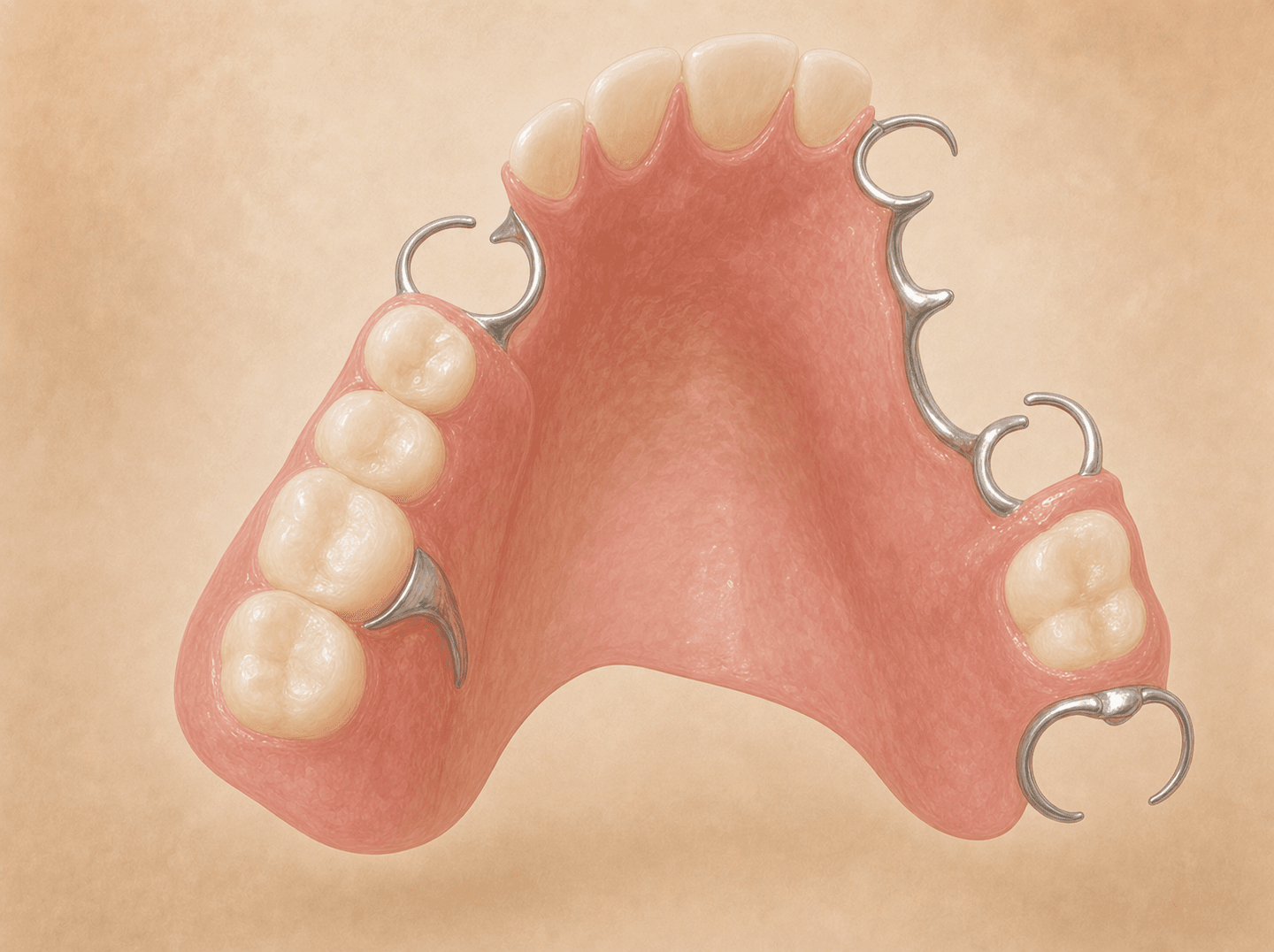
What D5211 covers
D5211 reports a maxillary (upper) partial denture on a resin base, for a partially edentulous upper arch. The base is acrylic, and the partial is retained by clasps set into or extending from it, commonly wrought wire clasps adapted to the abutment teeth. There is no cast metal framework. The clasps, rests, and replacement teeth are all part of the one code, so retention is not billed separately.
The code includes the diagnostic impressions, lab fabrication, delivery appointment, and initial post-delivery adjustments within the standard delivery workflow. Bill it on the delivery date; the impression and try-in visits are included.
It does not cover:
- Mandibular resin-base partial dentures. Use D5212.
- Maxillary partials on a cast metal framework. Use D5213, regardless of how many teeth it replaces.
- Mandibular cast metal framework partials. Use D5214.
- Flexible-base (nylon) partial dentures. Use D5225 (maxillary) or D5226 (mandibular).
- Complete dentures. Use D5110 (maxillary) or D5120 (mandibular).
- Interim or transitional partials (flippers), including a temporary partial worn while the definitive prosthesis is made. Use the interim partial codes.
- Relines, rebases, or repairs after delivery. Those run through their own series.
D5211 versus D5213: the material axis
These two codes describe a maxillary partial, separated only by the base material:
- D5211 has a resin (acrylic) base. Retention comes from clasps and rests built into the acrylic, usually wrought wire. It is lighter, cheaper, and easier to add to or reline later.
- D5213 has a cast metal framework supporting resin saddle areas and teeth. The framework is surveyed and cast, often in chrome cobalt, fits more precisely, and carries rest seats, indirect retainers, and connectors as designed.
Picking the wrong one is a common coding error, and it matters because carriers price them differently and often downgrade one to the other.
The alternate-benefit relationship with D5213
D5211 is the code carriers downgrade cast metal partials to. When the plan has an alternate-benefit clause, it treats the acrylic partial as functionally adequate and pays a D5213 claim at the D5211 allowable:
- The office submits the cast metal partial as D5213 at the cast metal fee.
- The carrier applies the alternate-benefit clause and pays at the D5211 (acrylic) allowable.
- The patient owes the difference between the cast metal office fee and the D5211 allowable, plus coinsurance on the lower allowable.
The gap is usually larger than in most alternate-benefit scenarios, because cast metal and acrylic partial fees differ by hundreds of dollars. If the patient wants the cast framework, quote the actual gap at treatment planning rather than after the EOB arrives.
Top reasons D5211 gets denied or reduced
- Missing-tooth clause exclusion. A per-tooth exclusion for teeth lost before coverage started, and the most common patient-responsibility surprise on partial cases. See the next section.
- Frequency limit. A prior partial on the same arch falls inside the plan’s five- or seven-year window, counted from the prior covered partial’s date. An appeal documenting clinical failure succeeds on some plans.
- Pre-existing condition exclusion. Some newer commercial plans exclude prosthetic coverage for arches already partially edentulous when the policy started. Check the benefit booklet.
- Coded D5211 when a cast framework was delivered. The correct code is D5213, and the mismatch invites a downgrade or a records request.
- Documentation gaps. Some carriers want a panoramic radiograph or periodontal charting showing the abutment teeth can support the partial. A pre-op pano usually clears the request.
The missing-tooth clause and how it actually works
The missing-tooth clause is a per-tooth exclusion: the plan won’t pay to replace a tooth already missing when the patient’s current coverage started. The carrier checks the coverage history for teeth lost before that date, and the plan’s wording decides the outcome:
- Some clauses make the whole partial eligible if it replaces at least one tooth extracted during coverage, which is how Cigna’s Colorado individual policy reads.
- Others apply tooth by tooth, and some expire after a stretch of continuous coverage.
- Some plans carry no clause at all, such as Delta Dental of New Jersey’s missing tooth inclusion for members 16 and over.
So a partial replacing three teeth lost before coverage and one lost during it can be fully eligible on one plan and largely excluded on another. The missing tooth clause guide collects published plan wording. Before the first impression, run a pre-treatment estimate that combines the clause and the frequency rule, and give the patient a specific out-of-pocket dollar amount. Recurring patient-responsibility complaints on partials almost always trace to an estimate that wasn’t done or wasn’t turned into a dollar figure.
Documentation that supports the claim
The claim needs:
- Date of service (the delivery date).
- Arch designation (maxillary).
- Panoramic radiograph or periodontal charting for carriers that require it.
In the patient record, document:
- Diagnostic impression dates.
- Which teeth the partial replaces, and the date each was lost. The carrier uses this to apply the missing-tooth clause, and you will need it on appeal.
- The clasp and rest design, and the abutment teeth.
- Delivery date and post-delivery adjustment schedule.
- Any prosthetic history (prior partial, prior bridge, prior immediate temporary partial), which affects frequency and missing-tooth determinations.
Example case
A 49-year-old patient is missing three maxillary posterior teeth and wants a removable option rather than implants or a bridge. Two teeth were lost two years ago under the current plan; one was lost eight years ago under a prior employer’s coverage. The dentist treatment-plans a resin-base partial with wrought wire clasps on the remaining premolars.
Billing steps:
- Verify benefits. Pull the frequency rule (likely five or seven years) and confirm no prior covered partial is inside the window.
- Check the missing-tooth clause and identify which replaced teeth predate the current coverage. Here, one of the three does.
- Run a pre-treatment estimate and quote a specific out-of-pocket amount, accounting for the missing-tooth adjustment on that tooth.
- Submit D5211 with the maxillary arch designation on the delivery date.
- Attach a panoramic radiograph or periodontal charting if the carrier requires it.
If the plan applies the clause per tooth, the EOB reflects the adjustment on the pre-existing tooth and the patient owes that portion. If the plan denies the whole prosthesis on the clause, the pre-treatment estimate should already have set that expectation.
FAQs
- What's the difference between D5211 and D5213?
- The base material. Both are maxillary partials. D5211 has a resin (acrylic) base retained by clasps and rests set into that base, typically wrought wire. D5213 is built on a cast metal framework that supports the resin saddle areas and teeth. The cast framework fits more precisely and is sturdier; D5211 is lighter and cheaper.
- Why does the carrier pay our D5213 cast metal partial at the D5211 rate?
- An alternate-benefit clause. Many plans pay a cast metal partial at the acrylic partial (D5211) allowable, reasoning that the acrylic version is functionally adequate. This is plan language, not a denial. The patient owes the difference between the cast metal office fee and the D5211 allowable, so quote the actual dollar gap at treatment planning.
- Does the missing-tooth clause apply to D5211?
- Yes. The clause excludes prosthetic replacement of teeth missing before the patient's current coverage started, and it applies to partials, bridges, and complete dentures. Because a partial replaces several teeth at once, plans differ on how a mix of qualifying and non-qualifying teeth is treated. Check the benefit booklet before treatment planning.
- How often will a plan pay for a D5211 partial?
- One partial per arch every five years on most plans, sometimes seven. The clock runs from the date of the last covered partial on that arch, not the patient's enrollment date. A prior partial inside the window typically denies on frequency, and an appeal documenting clinical failure (fractured base, lost abutment, anatomic change) succeeds on some plans.
- Can a D5211 resin partial be relined or repaired later?
- Yes, which is one practical advantage over flexible-base partials. Relines and repairs bill on their own codes, not D5211. A maxillary partial reline is D5740 chairside or D5760 in the lab (D5730 and D5750 are the complete-denture reline codes), and a fractured resin base or broken clasp runs through the partial-denture repair codes. Verify the exact code against the current CDT before submitting.
Related codes
Need help billing this code?
We handle D5211 claims daily.
If your team is spending time on denials, narratives, or carrier follow-up for this code, our outsourced dental insurance billing service can take it off your plate. We submit the claims, post what comes back, and follow up on anything unpaid. Already sitting on older claims that never paid? Our AR cleanup project works the backlog.
“Claims, posting, denials, all of it gets handled, and it costs far less than hiring another employee. My front desk got hours of their week back, and honestly I just don't think about billing anymore.”
CDT codes are maintained by the American Dental Association. This page is an editorial billing guide, not the official ADA code descriptor. Verify current coverage policies with each carrier before submitting claims.