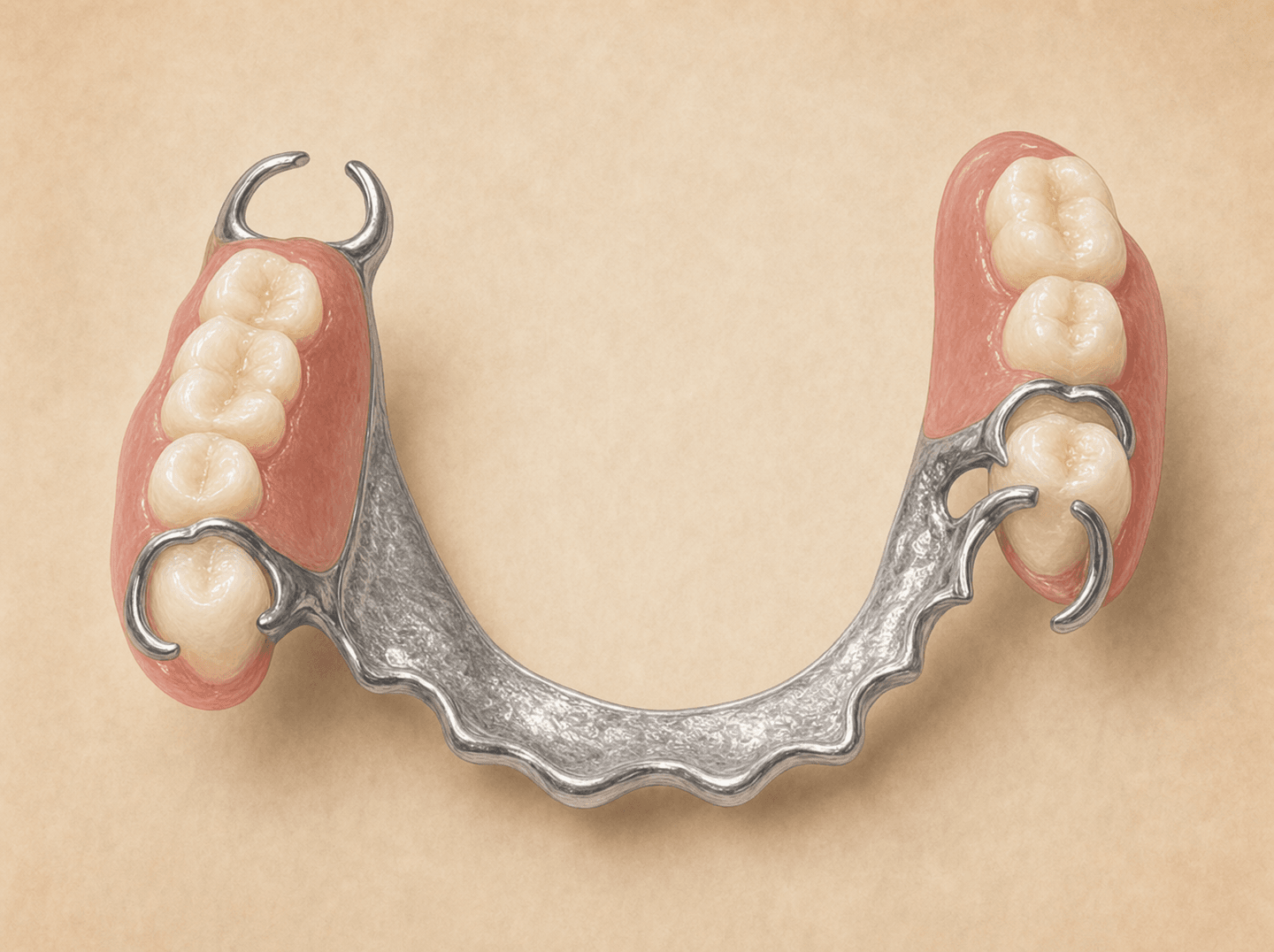
D5214 is the CDT code for a lower partial denture built on a cast metal framework, with acrylic saddles carrying the replacement teeth.
- When to use: The patient keeps some lower teeth and the lab slip shows a cast metal framework, whatever the clasp material, number of teeth, or case complexity.
- When not to use: The upper cast metal partial is D5213, a lower resin base partial is D5212, a lower flexible partial is D5226, and a lower interim partial is D5821.
- Billing note: Many plans pay D5214 at the D5212 resin allowable, so run a pre-treatment estimate that shows the patient the dollar gap before the first impression.
On this page
What D5214 covers
D5214 reports a mandibular (lower) partial denture built on a cast metal framework that supports resin denture base areas and replacement teeth. The framework is typically a chrome cobalt or comparable cast alloy, designed from a surveyed cast and incorporating rests, clasps, indirect retainers, and major and minor connectors. The code covers the full fabrication workflow: the diagnostic impressions, the surveyed cast, the framework design and try-in, the wax try-in with teeth, the laboratory work, the delivery appointment, and the routine post-delivery adjustments within the standard delivery period.
The defining feature is the cast metal framework on the lower arch. A lower partial with a resin base and wire clasps is D5212, not D5214, no matter how the case is built up.
It does not cover:
- Maxillary cast metal partial dentures. Use D5213.
- Mandibular partial dentures with a resin base and resin or wrought wire retention. Use D5212.
- Flexible-base partial dentures. Use D5226 for the mandibular arch.
- Complete dentures. Use D5120 for the mandibular arch.
- Implant-supported partials or fixed bridges. Use the appropriate D6000-series codes.
- Interim or transitional partials. The mandibular interim partial is D5821.
The distinguishing axis: arch and framework, nothing else
D5214 sits inside a four-code grid that splits on two variables, and getting the grid straight is the whole job:
- D5211 is the maxillary resin-base partial.
- D5212 is the mandibular resin-base partial.
- D5213 is the maxillary cast metal partial.
- D5214 is the mandibular cast metal partial.
Two axes, four codes. The first axis is the arch: maxillary (upper) or mandibular (lower). The second is the base construction: a resin base with wire retention, or a cast metal framework. D5214 is the lower arch with a cast framework. Change the arch and you’re in D5213. Drop the cast framework and you’re in D5212.
The arch is the part that gets fat-fingered. D5213 and D5214 are identical except for which jaw the partial sits in, so a delivery note that says “lower” while the claim shows D5213 is the kind of mismatch a reviewer catches. The framework distinction is the part that gets upcoded: a resin-base partial with wrought wire clasps billed as D5214 will not survive a records review, because the lab work order shows no cast framework.
Coverage reality: the downgrade and the missing-tooth clause
Two plan provisions drive most of the patient-responsibility surprises on this code, and both are plan-dependent, so verify them per case rather than assuming.
The alternate-benefit downgrade to resin
Many plans apply an alternate-benefit clause (sometimes called least-expensive-alternative-treatment) to cast metal partials, paying D5214 at the D5212 resin-partial allowable. The plan considers the resin partial functionally adequate and owes only the lower amount.
The math runs the same way every time it happens:
- The office submits D5214 at the cast metal office fee.
- The carrier applies the alternate-benefit clause.
- The carrier pays at the D5212 allowable.
- The patient owes the difference between the cast metal fee and the resin allowable, plus the standard coinsurance on the lower allowable.
The dollar gap here is usually larger than on a typical downgrade, because cast metal and resin partial fees can differ by hundreds of dollars. Whether a given plan downgrades at all varies, so confirm it on each case and quote the patient the actual gap rather than “the plan covers partials.”
The missing-tooth clause
The missing-tooth clause excludes prosthetic replacement of teeth that were already missing before the patient’s current coverage started. Because a single partial replaces several teeth at once, the way it lands varies by carrier:
- The carrier processes the D5214 claim.
- The carrier checks coverage history to see which replaced teeth were lost before coverage started.
- Some carriers deny the entire prosthesis if even one replaced tooth predates the policy, leaving the patient owing the full cost.
- Other carriers prorate by tooth, paying only for the teeth lost during current coverage and leaving the patient the rest plus coinsurance.
The whole-prosthesis denial is the larger risk. A patient who lost three lower teeth before the policy started and is now getting a partial that also replaces one tooth lost during coverage can see the entire partial denied rather than partially paid. Some plans (a number of Delta Dental plans, for example) apply no missing-tooth exclusion at all. The range is wide enough that the treatment-planning conversation has to account for it, because a patient who hears “insurance covers partials” and then sees the whole prosthesis denied on the EOB will not take it well.
When to bill D5214
Bill D5214 when:
- The patient has a partially edentulous mandibular arch (some lower teeth remaining, some missing).
- A cast metal framework partial denture has been fabricated and delivered for the lower arch.
- The framework was designed from a surveyed cast and incorporates rests, clasps, and connectors appropriate to the case.
Do not bill D5214 for:
- A resin-base lower partial with wire clasps. That’s D5212.
- A maxillary cast metal partial. That’s D5213.
- A flexible-base lower partial. That’s D5226.
- An interim or transitional lower partial. That’s D5821.
- A complete lower denture. That’s D5120.
Repairs, relines, and adjustments come later under their own codes
D5214 covers fabrication and delivery. Once the partial is in service, later work runs on separate codes, and these are an easy place to grab the wrong arch or the wrong prosthesis type:
- Adjustment: D5422 is the adjustment code for a mandibular partial denture (D5421 is the maxillary partial). The complete-denture adjustment codes are different, so don’t reach for those on a partial.
- Repair of the cast framework: D5621 repairs a cast partial framework on the mandibular arch (D5622 is the maxillary equivalent).
- Repair of the resin base: D5611 repairs a resin partial denture base on the mandibular arch (D5612 is the maxillary equivalent).
- Add a tooth or a clasp: D5650 adds a tooth to an existing partial; D5660 adds a clasp.
- Reline: D5741 is the chairside reline of a mandibular partial; D5761 is the laboratory reline.
- Rebase: D5721 rebases a mandibular partial denture.
Whether any of these is a covered benefit and when the frequency clock allows it are plan-dependent, so verify before promising the patient that a repair or reline is covered.
Documentation that supports the claim
The claim itself needs:
- Date of service (the delivery date).
- Arch designation (mandibular).
- A panoramic radiograph or periodontal charting for carriers that require it on partial cases.
- Framework design detail if the carrier requests it, though most do not.
For the patient record, document:
- Diagnostic impression and surveyed cast dates.
- The framework design (rests, clasps, indirect retainers, connector type), usually captured on the lab work order.
- Framework try-in date and fit verification.
- Wax try-in date and patient verification of esthetics.
- Delivery date and the post-delivery adjustment schedule.
- The date of last tooth loss on the lower arch, which matters for the missing-tooth determination.
- Any prosthetic history (prior partial, prior bridge, prior interim partial), which matters for frequency calculations.
What to get right in your PMS
The exact menus differ across Open Dental, Dentrix, Eaglesoft, Curve, and Carestream, but the setup that prevents miscodes is the same:
- Keep the four base partial codes distinct and labeled by arch and base type. D5211 (maxillary resin), D5212 (mandibular resin), D5213 (maxillary cast metal), and D5214 (mandibular cast metal) should be separate, clearly labeled line items so the arch and the framework are deliberate choices, not a default pick. The D5213 and D5214 swap is the most common one to catch.
- Set up the alternate-benefit downgrade as an expected outcome, not a surprise. If the plan pays cast metal at the resin allowable, the estimate should already reflect the D5212 number so the patient portion is right the first time.
- Run a pre-treatment estimate before the first impression. The downgrade and the missing-tooth clause combine into out-of-pocket numbers the patient needs before treatment, not after.
- Confirm the frequency rule and the prior denture date on every partial case. A five-year interval per arch is typical, some plans run seven, and the clock starts from the prior covered partial.
- File the lab work order in the patient record. It documents the cast framework that justifies D5214 over D5212 if a carrier reviews the claim.
If your office sees recurring patient-responsibility complaints on lower partial cases, the cause is usually a pre-treatment estimate that wasn’t run or wasn’t translated into a specific dollar amount. One workflow change at treatment planning clears most of them.
FAQs
- What is the dental code for a lower cast metal partial denture?
- It's D5214: a mandibular (lower) partial denture built on a cast metal framework, with acrylic saddles carrying the replacement teeth. The matching upper code is D5213. The only difference between the two is the arch. D5214 is the lower jaw, D5213 is the upper. If the partial has a resin base with wire clasps and no cast framework, it's D5212 (mandibular) instead.
- What's the difference between D5212 and D5214?
- Both are mandibular partial dentures. D5212 has a resin (acrylic) base with retentive or wrought wire clasps and no cast framework. D5214 is built on a cast metal framework supporting the resin saddle areas and teeth. The cast framework fits more precisely and lasts longer, and it costs more. Many plans pay D5214 at the D5212 allowable through an alternate-benefit clause, so verify how the specific plan handles cast metal before treatment planning.
- Why was D5214 paid at the D5212 rate?
- Many plans apply an alternate-benefit (least-expensive-alternative) clause to cast metal partials, paying D5214 at the D5212 (resin partial) allowable. The plan treats the acrylic partial as functionally adequate and only owes the lower amount. The patient owes the difference between the cast metal office fee and the resin allowable. This is plan language, not a true denial, and whether a given plan does it is plan-dependent, so confirm it on each case.
- What's the missing-tooth clause and how does it affect D5214?
- The missing-tooth clause excludes coverage for replacing teeth that were already missing before the patient's current coverage started. Because one partial replaces several teeth at once, the effect varies by carrier: some deny the whole prosthesis if any replaced tooth predates the policy, and some prorate and pay only for teeth lost during coverage. Pull the patient's coverage history and the plan booklet before treatment so the out-of-pocket estimate is right.
- How often will insurance replace a D5214 partial?
- A five-year replacement interval per arch is the most common rule, though some plans run seven years and a few differ. The clock starts from the date of the last covered partial on that arch, not from when the patient joined the plan. A prior mandibular partial inside the window is a frequent denial reason. An appeal documenting clinical necessity (a fractured framework, ridge or abutment changes) gets paid on some plans. Confirm the interval and the prior denture date before you plan treatment.
- Is D5214 a current CDT code for 2026?
- Yes. D5214 is active in CDT 2026, unchanged. The four base partial-denture codes split by arch and base type remain in place: D5211 (maxillary resin), D5212 (mandibular resin), D5213 (maxillary cast metal), and D5214 (mandibular cast metal). Flexible-base partials are coded separately as D5225 (maxillary) and D5226 (mandibular).
Related codes
Need help billing this code?
We handle D5214 claims daily.
If your team is spending time on denials, narratives, or carrier follow-up for this code, our outsourced dental insurance billing service can take it off your plate. We submit the claims, post what comes back, and follow up on anything unpaid. Already sitting on older claims that never paid? Our AR cleanup project works the backlog.
“Claims, posting, denials, all of it gets handled, and it costs far less than hiring another employee. My front desk got hours of their week back, and honestly I just don't think about billing anymore.”
CDT codes are maintained by the American Dental Association. This page is an editorial billing guide, not the official ADA code descriptor. Verify current coverage policies with each carrier before submitting claims.