D5286 is the CDT code for a one-piece acrylic resin partial that replaces teeth on one side of an arch, reported once per quadrant.
- When to use: A one-sided resin appliance is the patient's definitive replacement for that space, with no connector to the other side of the arch.
- When not to use: A temporary acrylic flipper is D5820 or D5821, a flexible unilateral is D5284, a cast metal one is D5282 or D5283, and a cross-arch resin partial is D5211 or D5212.
- Billing note: Report the quadrant, not the arch, and confirm the plan covers unilateral partials at all, since many exclude them as a category.
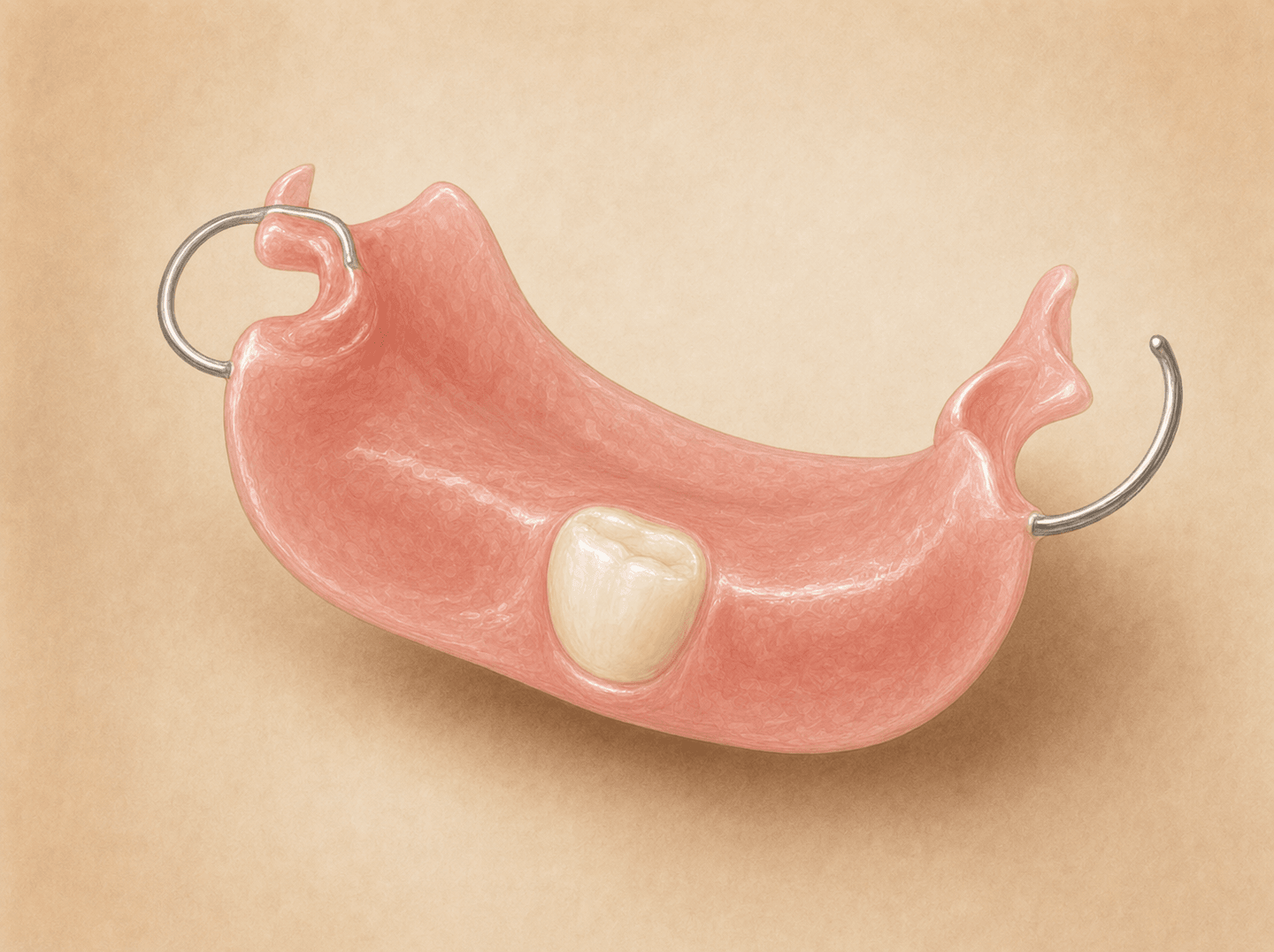
What D5286 reports
D5286 reports a removable partial denture made as a single piece of acrylic resin that sits on one side of the arch only. It carries its own clasps, any rests, and the replacement teeth, and it holds on by clasping the teeth around the space. Nothing crosses the midline or the palate.
The unit is the quadrant. Report one D5286 per quadrant treated, with the quadrant designated and the replaced tooth numbers in that quadrant.
It does not cover:
- A flexible one-piece unilateral, which is D5284.
- A cast metal one-piece unilateral, which is D5282 on the upper arch or D5283 on the lower, reported by arch.
- A resin partial with a connector to the other side of the arch, which is D5211 upper or D5212 lower.
- A temporary appliance worn until other treatment is finished, which is D5820 upper or D5821 lower.
The flipper problem: same appliance, two codes
A small acrylic appliance with wire clasps and one denture tooth is one of the most common removable prostheses in a general practice, and it is billed under two different code families depending on why it was made.
- Interim (D5820 / D5821). The appliance is a placeholder. The treatment plan shows an implant, a bridge, or a definitive partial coming later.
- Definitive unilateral (D5286). The appliance is the end of treatment for that space. The patient has declined or can’t have the alternatives.
The lab builds both the same way, so the lab invoice can’t settle it. The treatment plan and the chart note can. Write the intent into the note on the delivery date: “definitive replacement for tooth 19; patient declined implant and bridge” supports D5286. “Interim during implant healing” supports D5821.
Example: the declined implant
A patient lost tooth 19 two years ago. The dentist presents an implant and a three-unit bridge; the patient declines both for cost and asks for “the little removable one.” The dentist prescribes a one-piece acrylic appliance clasping teeth 18 and 20 as the long-term replacement.
The claim carries one unit of D5286 for the lower left quadrant, with tooth 19 as the replaced tooth. Two verification questions decide what the patient pays:
- Are unilateral partials a covered benefit by code? Many plans exclude them, some pay an alternate benefit, and some cover them like any partial.
- Does the missing-tooth clause apply? Tooth 19 was lost before the current coverage started on many patients in this situation, and the clause can remove the benefit even where the category is covered.
If the patient later changes course and gets the implant, the D5286 was still the right code on its date. The treatment plan at the time decides.
Coverage notes
Unilateral partials draw more resistance than conventional ones. Delta Dental of Ohio’s published removable-partial criteria call the unilateral design generally inadvisable, citing the missing cross-arch stabilization and the risk of a small appliance being swallowed or inhaled. Some public fee schedules leave the codes off entirely; South Dakota Medicaid’s July 2026 adult dental schedule lists the conventional resin partials and the interim partials but no unilateral codes.
That is why the coverage question has to be asked by code number. “Does the plan cover partials?” gets a yes that doesn’t apply to D5286.
Top reasons D5286 gets denied
- Category exclusion for unilateral partials. The most common outcome on plans that exclude them, and not fixable on appeal.
- Arch reported instead of quadrant, or a quadrant that doesn’t match the tooth numbers.
- Interim appliance billed as definitive, caught when a later implant or partial claim on the same arch shows the original was a placeholder.
- Missing-tooth clause on a tooth lost before coverage began.
- Wrong material code. A flexible appliance billed as resin, or the reverse. The lab slip’s material line settles it.
FAQs
- What is the D5286 dental code?
- D5286 is the removable unilateral partial denture made as one piece of resin, including the clasps, rests, and replacement teeth, reported per quadrant. It replaces teeth on one side of an arch without crossing to the other side. It is a definitive prosthesis; a temporary acrylic appliance uses the interim partial codes.
- Is a one-tooth acrylic flipper D5286 or D5821?
- It depends on the treatment plan, not the appliance. If the flipper fills a lower space while an implant heals or a bridge is made, it is the interim partial D5821 (D5820 on the upper). If the patient has chosen it as the long-term replacement, it is D5286. The two can look identical on the lab slip, so the chart note stating intent is what supports the code.
- How many units of D5286 go on the claim?
- One per quadrant treated. A resin unilateral replacing tooth 19 is one unit of D5286 for the lower left quadrant. The arch-level partial codes, and the cast metal unilaterals D5282 and D5283, are reported by arch instead.
- What's the difference between D5286 and D5284?
- The material. Both are one-piece unilateral partials reported per quadrant. D5284 is a flexible nylon-type base, and D5286 is rigid acrylic resin. Resin is generally easier for a lab to adjust or add to than flexible material, which tends to be replaced rather than repaired.
- When was D5286 added to CDT?
- CDT 2020, together with the flexible unilateral D5284. Both were written per quadrant. The cast metal unilaterals, D5282 and D5283, had been added a year earlier, in CDT 2019, split by arch when the single code D5281 was deleted.
Related codes
Need help billing this code?
We handle D5286 claims daily.
If your team is spending time on denials, narratives, or carrier follow-up for this code, our outsourced dental insurance billing service can take it off your plate. We submit the claims, post what comes back, and follow up on anything unpaid. Already sitting on older claims that never paid? Our AR cleanup project works the backlog.
“Claims, posting, denials, all of it gets handled, and it costs far less than hiring another employee. My front desk got hours of their week back, and honestly I just don't think about billing anymore.”
CDT codes are maintained by the American Dental Association. This page is an editorial billing guide, not the official ADA code descriptor. Verify current coverage policies with each carrier before submitting claims.