D5282 is the CDT code for a one-piece cast metal removable partial that replaces teeth on one side of the upper arch only.
- When to use: A definitive one-sided upper appliance is cast as a single metal piece, clasps the neighboring teeth, and has no connector crossing the palate.
- When not to use: The lower version is D5283, a flexible or resin unilateral is D5284 or D5286, a cross-arch cast partial is D5213, and a temporary is D5820.
- Billing note: Many plans exclude unilateral partials or pay an alternate benefit, so confirm coverage for D5282 by code before the casting is ordered.
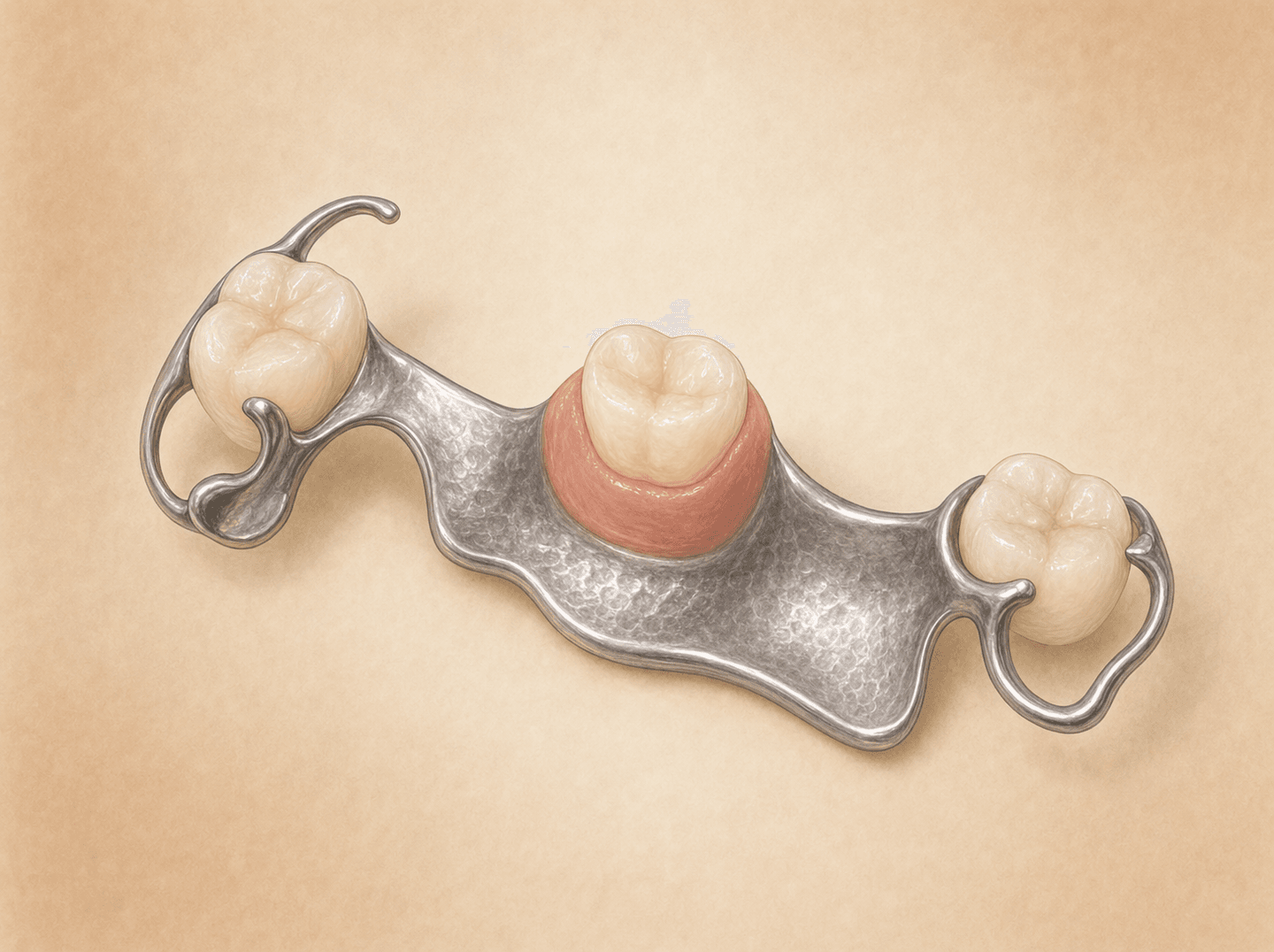
What D5282 reports
D5282 reports a removable partial denture for the upper arch that sits entirely on one side, made as a single piece of cast metal. The clasps, rests, and replacement teeth are included in the fee. It typically replaces one or two teeth in a short span and holds on by clasping the teeth on either side of the gap, with no palatal connector reaching across to the other side.
It is a definitive prosthesis, and the descriptor is arch-specific: D5282 is maxillary only.
It does not cover:
- The same one-piece casting on the lower arch. That is D5283.
- A one-piece flexible unilateral. That is D5284, per quadrant.
- A one-piece resin unilateral. That is D5286, per quadrant.
- A cast metal partial with a connector across the palate. That is D5213, even if it replaces teeth on one side only.
- An upper resin or flexible partial that crosses the arch: D5211 or D5225.
- A transitional appliance worn while an implant or bridge is completed. That is D5820.
Arch, not quadrant
The four unilateral codes don’t share a unit, and that split decides what goes on the claim line.
| Material | Upper | Lower | Unit of report |
|---|---|---|---|
| One-piece cast metal | D5282 | D5283 | Per arch |
| One-piece flexible | D5284 | D5284 | Per quadrant |
| One-piece resin | D5286 | D5286 | Per quadrant |
The history explains the asymmetry. Cast metal unilaterals had a single code, D5281, until CDT 2019 deleted it and split the work into D5282 and D5283 by arch. The flexible and resin codes arrived a year later, in CDT 2020, written per quadrant.
For billing, that means a D5282 line carries the maxillary arch and the tooth numbers. If the PMS forces a quadrant, it is a template carried over from D5284, not a requirement of the code.
Unilateral or cross-arch: the extent test
D5282 and D5213 are both cast metal upper partials, so the material line on the lab slip won’t separate them. The design does. If the framework has a major connector crossing the palate to rests or clasps on the other side, it is a conventional cast partial, D5213, no matter how few teeth it replaces. If the casting is confined to one side and retained only by the teeth bordering the space, it is D5282.
Ask for the framework design before coding. A lab invoice that says “cast partial, tooth 13” doesn’t answer the question.
Example: a one-tooth upper casting
A patient lost tooth 13 and declines both an implant and a bridge. The dentist prescribes a one-piece cast metal appliance clasping teeth 12 and 14, with no palatal coverage, as the long-term replacement.
The claim carries one unit of D5282 for the maxillary arch, with tooth 13 as the replaced tooth. During verification the office asks whether the plan covers removable unilateral partials by code number. In this case the answer is an alternate benefit priced against the plan’s least costly adequate option, and the patient signs an estimate showing the difference before the case goes to the lab.
Had the dentist added a palatal strap to rests on teeth 3 and 4 for stability, the same replacement tooth would bill as D5213.
Coverage positions to expect
Plans take one of three positions on D5282, and the certificate rarely says which without a direct question:
- Category exclusion. Unilateral removable partials are not a benefit. Some carriers cite safety, since a small one-sided appliance can be swallowed or inhaled.
- Alternate benefit. The plan pays toward the replacement at a lower-cost prosthesis’s allowable.
- Covered as billed, with the usual missing-tooth clause and replacement frequency.
Unilateral codes are also absent from some public fee schedules. South Dakota Medicaid’s July 2026 adult dental schedule, for example, lists the conventional and interim partials but none of D5282 through D5286.
Top reasons D5282 gets denied
- Category exclusion. Usually not appealable on documentation. Catch it at verification.
- Wrong arch code. A D5282 line with lower tooth numbers is likely to be returned or denied. The lower appliance is D5283.
- Quadrant field instead of arch. A D5282 line built from a D5284 template can go out with a quadrant and no arch designation, which gives the payer a reason to return it.
- Design doesn’t match the code. A framework with a palatal connector billed as unilateral draws a records request, or a recode to D5213.
- Missing-tooth clause. One-sided replacements are often for teeth lost years earlier, before current coverage began.
FAQs
- What's the difference between D5282 and D5283?
- The arch. D5282 is the one-piece cast metal unilateral partial for the upper (maxillary) arch, and D5283 is the same appliance for the lower (mandibular) arch. The material, the one-sided design, and the included clasps, rests, and teeth are identical. Pick the code from the arch of the replaced tooth.
- Does D5282 need a quadrant on the claim?
- No. D5282 is defined by arch, so the claim reports the maxillary arch and the tooth numbers. The quadrant convention belongs to the flexible (D5284) and resin (D5286) unilateral codes, which are reported per quadrant. Offices that clone their D5284 setup to build D5282 often carry the quadrant field over, so check the template.
- Is a Nesbit appliance always D5284?
- No. Nesbit describes the one-sided design, not the material. A Nesbit cast in one piece of metal is D5282 on the upper arch or D5283 on the lower. A one-piece flexible Nesbit is D5284, and a one-piece resin version is D5286. The lab slip's material line decides the code.
- When did D5282 replace D5281?
- In CDT 2019. The old one-piece cast metal unilateral code, D5281, was deleted and replaced by two arch-specific codes, D5282 (maxillary) and D5283 (mandibular). The flexible and resin unilateral codes, D5284 and D5286, followed in CDT 2020. A claim still carrying D5281 is an invalid code and rejects.
- Why do some carriers resist paying for unilateral partials?
- Because the design has no cross-arch support. Delta Dental of Ohio's published criteria call unilateral partials generally inadvisable, citing the lack of cross-arch stabilization and the risk that a small appliance is dislodged and swallowed or inhaled. Other plans exclude the category in the certificate or pay an alternate benefit. Coverage varies, so ask about D5282 by number.
Related codes
Need help billing this code?
We handle D5282 claims daily.
If your team is spending time on denials, narratives, or carrier follow-up for this code, our outsourced dental insurance billing service can take it off your plate. We submit the claims, post what comes back, and follow up on anything unpaid. Already sitting on older claims that never paid? Our AR cleanup project works the backlog.
“Claims, posting, denials, all of it gets handled, and it costs far less than hiring another employee. My front desk got hours of their week back, and honestly I just don't think about billing anymore.”
CDT codes are maintained by the American Dental Association. This page is an editorial billing guide, not the official ADA code descriptor. Verify current coverage policies with each carrier before submitting claims.