D5611 is the CDT code for repairing a cracked or broken resin (acrylic) base on a lower partial denture.
- When to use: The acrylic of a lower partial is cracked or broken, whether it is an all-resin partial or the resin saddle on a cast framework.
- When not to use: An upper partial base is D5612, a fractured metal framework is D5621, and a cracked complete lower denture base is D5511.
- Billing note: The pair numbers lower first, so pick D5611 by the word mandibular, and expect many plans to pool repair frequency across all the partial repair codes.
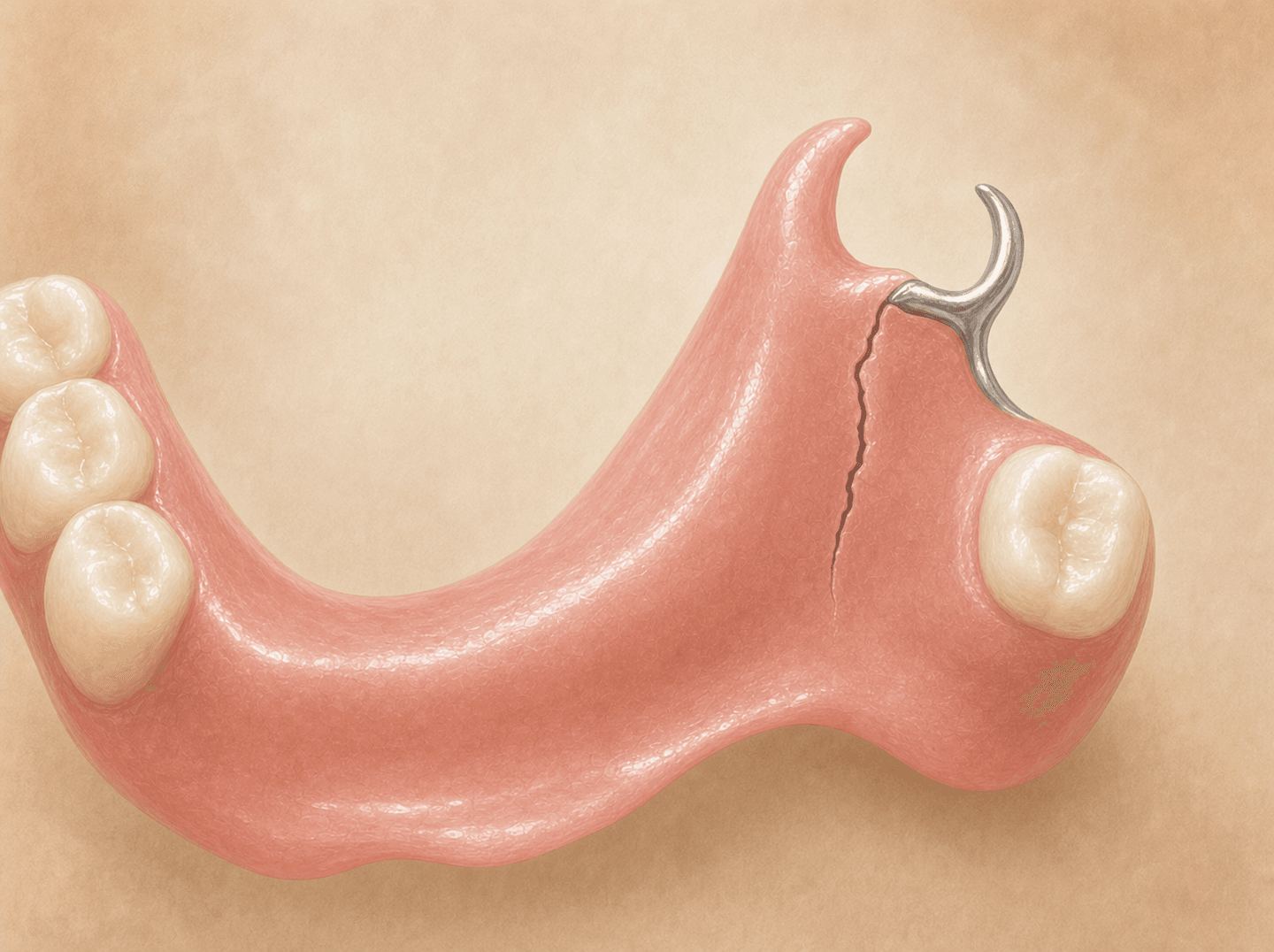
What counts as the resin base
D5611 covers the acrylic portion of a lower partial denture. On an all-resin partial like D5212, that is nearly the whole prosthesis: the pink base that carries the teeth and holds the wire clasps. On a cast partial like D5214, it is the resin saddles bonded to the metal framework over the edentulous ridges.
Typical D5611 work includes rejoining a base that split in two, filling a chipped flange, and rebuilding a saddle where the acrylic pulled away from the framework retention. The code is reported once per repair on the arch, not per tooth or per crack.
The resin base does not include the metal or the teeth. Those have their own repair codes, covered below.
Acrylic or metal: D5611 versus D5621
The deciding question is what material broke. Resin is D5611. A fractured cast framework (lingual bar, minor connector, a rest that snapped off the casting) is D5621 on the lower arch.
The lab ticket usually answers it. Framework repairs need soldering or welding, so the lab describes the metal work and charges accordingly. If the ticket only mentions acrylic, the claim is D5611.
When a lower cast partial comes in with both a broken saddle and a cracked lingual bar, bill both codes. Picking only one undercharges the repair and leaves the chart incomplete if the partial fails again.
Lower first: the arch trap
The 2018 split of D5610 created D5611 for the mandibular arch and D5612 for the maxillary arch. That is the reverse of the fabrication codes, where the upper arch takes the lower number. The cast framework repair pair (D5621 lower, D5622 upper) follows the same lower-first order.
A swapped arch is the classic D5611 error. Arch-specific repair codes are checked against the tooth numbers and the prosthesis history on file, so an upper repair billed as D5611 tends to deny or come back for correction. Choose the code by reading “mandibular” in the descriptor, not by assuming the odd digit is upper.
When the right answer is a reline or a new partial
A base that cracked once usually cracked for a reason. Lower partials often flex and fracture because the ridge has resorbed and the saddle no longer seats on tissue. Repairing the acrylic without fixing the fit can mean a second fracture within months.
If the dentist relines the repaired partial, the lab reline is D5761 for a mandibular partial. Same-day repair and reline is a common combination, though some plans limit how soon a reline can follow delivery or a prior reline, so check the history before scheduling both.
When the base has been repaired more than once, or the teeth and framework are also failing, the repair may cost close to what the plan would pay toward replacement. Replacement runs on the plan’s prosthesis frequency clock, often five years or more, so confirm eligibility before recommending it over another repair.
Example: a split lower resin partial
A patient brings in a three-year-old lower resin partial replacing teeth 19, 20, and 30. The base snapped across the lingual flange beside tooth 29, and the wire clasp on that side pulled loose from the acrylic in the same break.
The lab rejoins the base and sets a new wrought wire clasp on tooth 29. The claim carries two lines:
- D5611, mandibular arch, for the base repair.
- D5630, tooth 29, for the clasp.
The chart note names both failures and the cause (the partial was dropped while cleaning). If the plan counts same-day repairs against a single repair limit, one of the two lines may come back denied, which is worth checking before quoting the patient’s portion.
A broken prosthetic tooth found at the same visit would add D5640 per tooth. A cracked complete lower denture, by contrast, is never D5611; that base repair is D5511.
FAQs
- Is D5611 the upper or lower partial base repair?
- Lower. D5611 is the mandibular resin partial base repair and D5612 is the maxillary one. Some fee lookups and code pick-lists show the arch labels swapped, so confirm against the full descriptor in your PMS before the code goes on a fee schedule.
- Does D5611 apply to a cast metal partial?
- Yes, when the break is in the acrylic. A cast partial carries its teeth on resin saddles, and a crack or chip in that resin is a base repair. If the metal itself fractured, such as a lingual bar or a minor connector, the code is D5621 for a lower framework. A single accident can damage both, which is two lines.
- Can D5611 be billed with D5640 on the same partial?
- Yes, if both failures are documented. A cracked saddle and a broken prosthetic tooth are separate repairs with separate codes, so the claim carries D5611 once and D5640 per tooth replaced. Reviewers look for a chart note that describes each failure, so a vague 'partial repaired' note invites a request for records or a bundled payment.
- What replaced D5610?
- D5611 and D5612. The ADA deleted D5610, the single resin partial base repair code, effective 2018 and split it by arch. A claim that still goes out under D5610 rejects as an invalid code, so purge it from fee schedules and any old macro that still points to it.
Related codes
Need help billing this code?
We handle D5611 claims daily.
If your team is spending time on denials, narratives, or carrier follow-up for this code, our outsourced dental insurance billing service can take it off your plate. We submit the claims, post what comes back, and follow up on anything unpaid. Already sitting on older claims that never paid? Our AR cleanup project works the backlog.
“Claims, posting, denials, all of it gets handled, and it costs far less than hiring another employee. My front desk got hours of their week back, and honestly I just don't think about billing anymore.”
CDT codes are maintained by the American Dental Association. This page is an editorial billing guide, not the official ADA code descriptor. Verify current coverage policies with each carrier before submitting claims.