D5630 is the CDT code for repairing or replacing a broken clasp or other retentive part of a partial denture, billed per tooth.
- When to use: A clasp the partial already had is broken, bent past adjustment, or pulled loose, and the lab repairs or replaces it on the same tooth.
- When not to use: A clasp on a tooth that was never clasped is D5660, a cracked metal framework is D5621 or D5622, and a broken prosthetic tooth is D5640.
- Billing note: Bill one unit per clasped tooth with the tooth number on the line, since many payers check the unit count against the teeth charted.
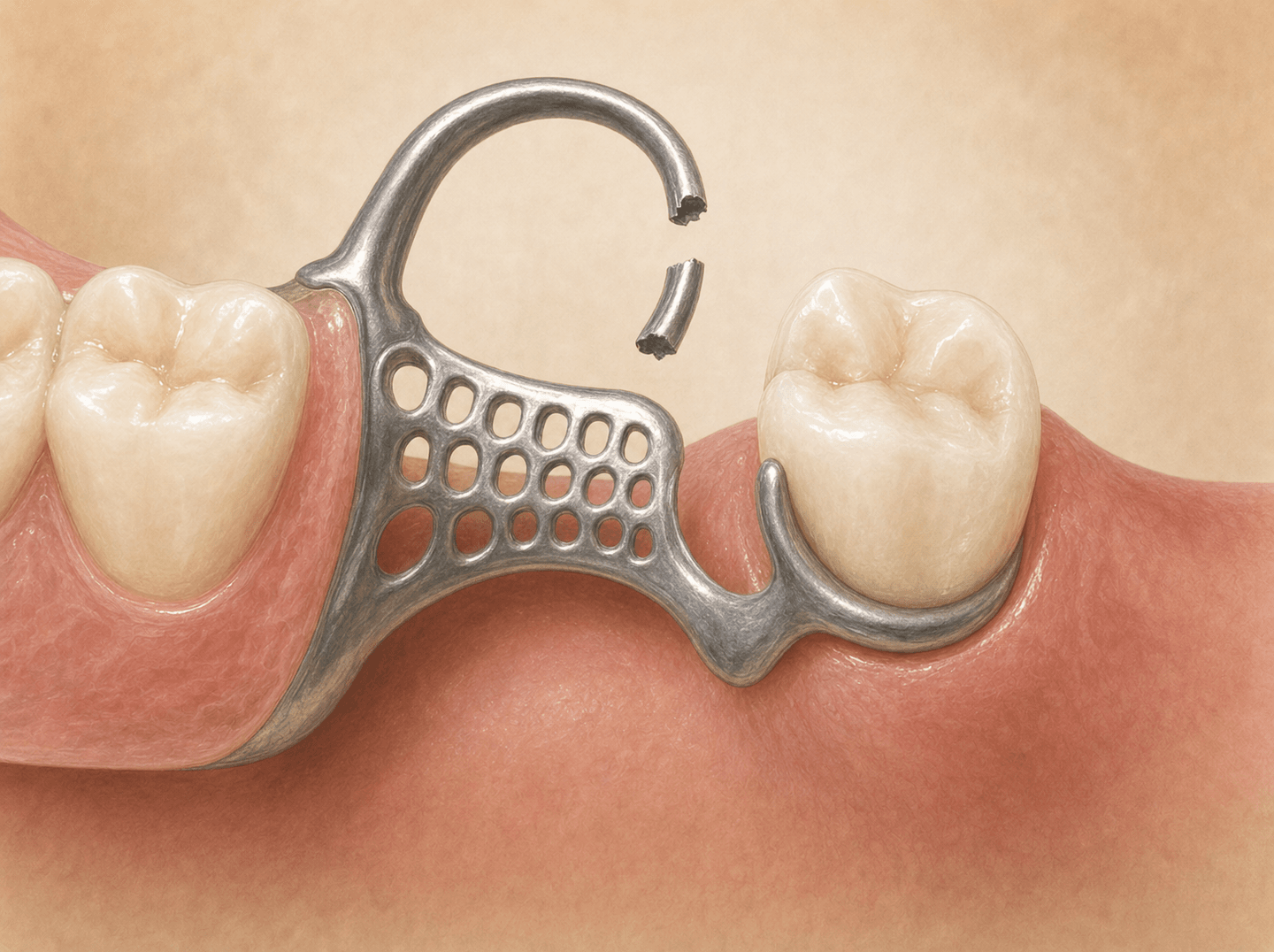
What D5630 covers
D5630 reports fixing the retentive part of a partial denture that broke. Most of the time that is a clasp arm: a cast clasp that fatigued and snapped at its shoulder, or a wrought wire clasp that fractured or pulled out of the acrylic. The descriptor’s wording also reaches other retentive material on the same tooth, so the code is not limited to the classic C-shaped arm.
The lab may repair the original clasp, solder on a new arm, or replace a cast clasp with a wrought wire one. The method doesn’t change the code. What matters is that the clasp was already part of the partial’s design on that tooth.
Counting units
The unit is the tooth the clasp engages, not the number of arms or the number of breaks. Chart each tooth by number and put it on the claim line.
| Situation | Units |
|---|---|
| One cast clasp on tooth 13 snapped | 1 (tooth 13) |
| Clasps on teeth 4 and 13 both replaced with wire | 2 (teeth 4 and 13) |
| Two arms on tooth 3 rebuilt at once | 1 (tooth 3) |
Under-counting is the quiet loss with this code. A two-clasp repair billed as a single unit pays as a single unit and rarely gets caught.
Where the clasp ends and the framework begins
A cast clasp is part of the framework casting, so a break near the junction can look like either. The working line is the location of the fracture. A break in the clasp arm itself is D5630. A fracture through a minor connector, rest, or major connector is a framework repair: D5621 for a lower partial and D5622 for an upper, numbered lower first.
Ask the lab to describe the break on the ticket. That one sentence settles the code and supports the claim if the carrier asks why a clasp repair cost what a framework repair costs.
Example: a cast clasp that failed on an upper partial
A patient wears a six-year-old upper cast partial, D5213 when it was made, clasping teeth 4 and 13. The clasp on tooth 13 snapped at the shoulder, and the partial now rocks when the patient chews. The framework is otherwise intact.
The dentist takes a pick-up impression with the partial in place, and the lab solders a wrought wire clasp onto the framework for tooth 13. The claim is one line of D5630 for tooth 13. The chart note says the original cast clasp fractured in function and was replaced with wire on the same tooth. That last detail is what keeps the claim from being read as a D5660 addition.
Denials worth expecting
- Shared repair limit. A D5640 tooth replacement or D5611 base repair earlier in the plan year used the benefit this claim needed.
- Missing tooth number. Many payers require it for per-tooth prosthetic repair codes and reject the line without it.
- Adjustment billed as repair. A loose clasp tightened chairside, billed as D5630, draws a records request.
- Repair versus remake. Several clasps failing at once on an old partial can prompt a reviewer to weigh the repair cost against what the plan would pay toward a replacement.
FAQs
- Is D5630 billed per clasp or per tooth?
- Per tooth. The unit is the clasped tooth, so a broken clasp on tooth 5 and another on tooth 12 is two units with both tooth numbers on the claim. A tooth carries one unit even when the lab rebuilds more than one retentive arm on it.
- What's the difference between D5630 and D5660?
- Whether the clasp existed before. D5630 repairs or replaces a clasp the partial already had on that tooth. D5660 adds a clasp to a tooth the partial did not engage, usually because a neighboring abutment was lost or the design changed. A lab replacing a broken cast clasp with a wire one is still D5630, because the tooth was already clasped.
- Can you bill an adjustment for a loose clasp as D5630?
- No. Tightening or bending a clasp chairside to restore retention is an adjustment, not a repair. Partial denture adjustments have their own codes and are often included in the fee during the period after delivery. D5630 is for a clasp that is broken, detached, or too damaged to adjust.
- The patient needs a new crown on a clasped tooth. Is that D5630?
- No. If the clasp is intact and the new crown is shaped to fit under the existing framework, the extra crown work is D2971, reported with the crown code. D5630 applies only if the clasp itself was broken and repaired. Some cases need both, for example when the clasp fractured during crown preparation.
- Does insurance cover D5630?
- Most plans that cover partial dentures cover clasp repair, usually under the major or prosthodontic benefit. Repair limits are plan-dependent and are often shared across all the partial repair codes, so a base or tooth repair earlier in the year can block this claim. Check the partial's repair history before the lab appointment.
Related codes
Need help billing this code?
We handle D5630 claims daily.
If your team is spending time on denials, narratives, or carrier follow-up for this code, our outsourced dental insurance billing service can take it off your plate. We submit the claims, post what comes back, and follow up on anything unpaid. Already sitting on older claims that never paid? Our AR cleanup project works the backlog.
“Claims, posting, denials, all of it gets handled, and it costs far less than hiring another employee. My front desk got hours of their week back, and honestly I just don't think about billing anymore.”
CDT codes are maintained by the American Dental Association. This page is an editorial billing guide, not the official ADA code descriptor. Verify current coverage policies with each carrier before submitting claims.