D5863 is the CDT code for a complete upper overdenture, a removable denture that covers and rests on retained natural teeth or roots.
- When to use: The upper denture replaces the whole visible dentition but seats over one or more natural roots the dentist deliberately kept.
- When not to use: An implant-retained upper overdenture is D6110, a conventional upper denture on a bare ridge is D5110, and the lower is D5865.
- Billing note: Many plans want pre-op x-rays of the retained roots and may pay only the conventional denture allowable, so predetermine before the abutments are prepared.
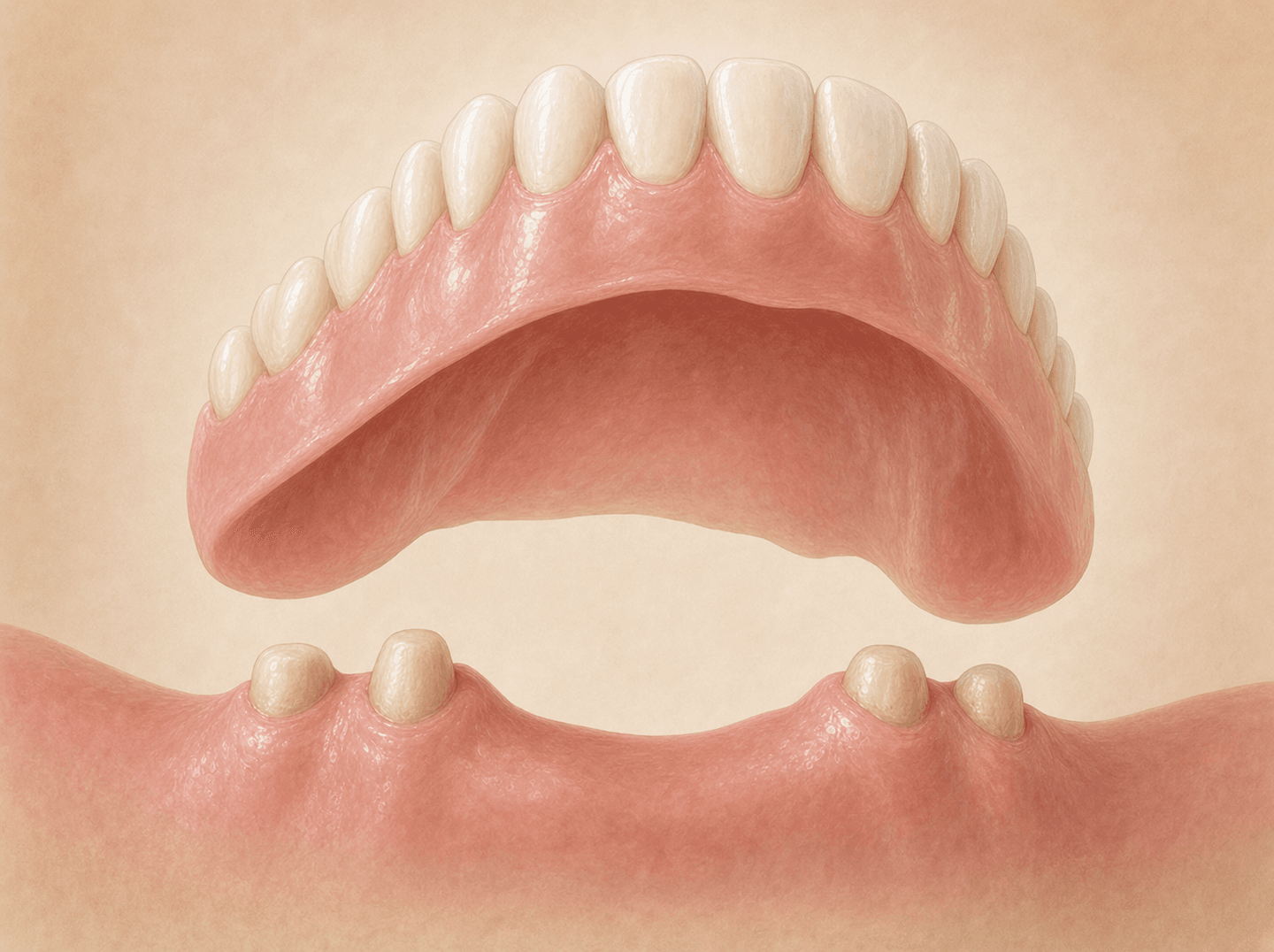
What D5863 reports
D5863 is a removable complete upper denture that rests on natural tooth structure the dentist chose to keep. The retained teeth are usually cut down to or near the gumline, root canal treated, and sealed or capped, and the denture base is shaped to fit over them. Some cases add precision attachments in the roots for retention.
The point of keeping the roots is support and bone. A root left in the ridge helps preserve the alveolar bone around it and gives the denture something firmer than soft tissue to rest on. “Complete” refers to the prosthesis: it replaces the whole upper dentition, even though roots remain under it.
Report D5863 once for the arch on the delivery date. It does not cover:
- Implant support. An upper overdenture on implants or implant abutments is D6110 on an edentulous arch, or D6112 when natural teeth remain.
- A partial overdenture. If the upper prosthesis replaces only some teeth and natural crowns remain in function, it is D5864.
- The lower arch. A complete lower overdenture is D5865.
- A conventional denture. No retained roots under the base means D5110.
The CDT 2026 nomenclature change
For CDT 2026 the ADA took editorial action on the overdenture family. D5863, D5864, D5865, and D5866 now carry “natural tooth borne” in their names, and D5867 (the replacement attachment part) was reworded the same way. Delta Dental of Tennessee’s CDT 2026 update lists them as nomenclature-only revisions, so the codes mean what they meant before. The wording just closes the door on reading them as implant codes.
The practical problem is that fee schedules lag. Maryland Medicaid’s CDT 2026 fee schedule, revised in August 2026, still prints the overdenture codes without the natural tooth borne qualifier. A team that maps codes from a payer’s table may never see the change. The rule to follow: retained natural roots go to D5863 through D5866, and implants go to D6110 through D6113.
The overdenture code grid
| Support under the denture | Upper, complete | Lower, complete | Upper, partial | Lower, partial |
|---|---|---|---|---|
| Retained natural teeth or roots | D5863 | D5865 | D5864 | D5866 |
| Implants or implant abutments | D6110 | D6111 | D6112 | D6113 |
| Ridge only (conventional) | D5110 | D5120 | n/a | n/a |
The implant row splits on a different axis than the natural-tooth row. D6110 and D6111 are for an arch with no natural teeth, while D6112 and D6113 are for an arch where natural teeth remain. The natural-tooth row splits on whether the prosthesis replaces the whole arch or part of it.
What carriers look for
UnitedHealthcare’s removable prosthodontics clinical policy (DCP020.17, effective January 1, 2026) states the clinical case in plain terms. It supports an overdenture to preserve the ridge and when the teeth used as retainers have a good long-term prognosis. It does not support one where the ridge has already deteriorated significantly or where hygiene and compliance are poor.
That tells you what the claim file needs:
- Pre-op radiographs of each retained root, showing bone support and the root canal status.
- A note on why the roots were kept, tied to ridge preservation or denture support.
- Periodontal findings and hygiene status for the abutment teeth.
- Post-op images if the plan asks for proof the abutments were prepared.
Requirements differ by plan, so check the predetermination checklist before the case starts.
The supporting work bills separately
D5863 is the prosthesis only. A typical natural-tooth overdenture produces several other lines, usually on earlier dates:
- Root canal treatment on each retained abutment, such as D3310 for an anterior tooth.
- A coping over the reduced root, when one is placed, as D2975.
- Precision attachments in the roots, as D5862, which is by report. Each attachment pair (the part in the root and the part in the denture) counts as one.
- Later replacement of a worn attachment part as D5867, per attachment.
If the patient already has an upper denture and it is only being modified, that is not a new D5863. Converting an existing prosthesis after implant surgery is D5875, and that applies only to implant cases.
Example case
A 71-year-old patient has a failing upper dentition. The dentist extracts most of the remaining teeth but keeps both upper canines, which have sound roots and good bone. The canines get root canal treatment, are reduced to domes just above the gumline, and receive copings. Ten weeks later a complete upper denture is delivered over them.
The claim lines:
- D3310 for each canine on the endodontic dates.
- D2975 for each coping.
- D5863 on the delivery date, arch designated as the upper.
The predetermination went in with a panoramic image, periapicals of both canines, and a narrative about preserving anterior bone. The plan approved D5863 but applied an alternate benefit at the D5110 allowable, which the office had quoted to the patient up front.
FAQs
- What is the dental code for an overdenture?
- It depends on what holds the denture up and which arch it is on. A complete upper overdenture over natural roots is D5863, and the lower is D5865. Partial overdentures over natural roots are D5864 (upper) and D5866 (lower). An overdenture carried by implants or implant abutments is D6110 or D6111 on an edentulous arch and D6112 or D6113 when natural teeth remain.
- Can D5863 be used for an implant overdenture?
- No. Since CDT 2026 the D5863 nomenclature says natural tooth borne, so the code is limited to dentures supported by retained teeth or roots. A removable upper overdenture on implants is D6110. Before 2026 the name did not say what supported the denture, and some offices put implant cases on it. That habit now produces a code that contradicts the chart.
- Is D5863 the same as a regular upper denture?
- No, although it replaces the same teeth. D5110 is a conventional complete upper denture sitting on a healed, toothless ridge. D5863 sits over natural roots that were kept on purpose, usually reduced to the gumline, root canal treated, and capped. The retained roots are the difference, and the x-rays have to show them.
- Are the root canals and attachments included in D5863?
- No. D5863 is the denture. Root canal treatment on each retained abutment tooth, any coping placed over the root (D2975), and any precision attachment (D5862, by report) are separate lines with their own coverage. Plans decide each one independently, so a covered denture can sit on top of denied abutment work.
- Why did the plan pay D5863 at a lower amount than we billed?
- Most often an alternate benefit. Some plans treat the overdenture as an optional upgrade to a conventional upper denture and pay toward D5110, leaving the difference to the patient where the contract allows. Others pay D5863 at its own allowable. Check the plan's alternate-benefit language at the predetermination stage, before the abutment teeth are reduced.
Related codes
Need help billing this code?
We handle D5863 claims daily.
If your team is spending time on denials, narratives, or carrier follow-up for this code, our outsourced dental insurance billing service can take it off your plate. We submit the claims, post what comes back, and follow up on anything unpaid. Already sitting on older claims that never paid? Our AR cleanup project works the backlog.
“Claims, posting, denials, all of it gets handled, and it costs far less than hiring another employee. My front desk got hours of their week back, and honestly I just don't think about billing anymore.”
CDT codes are maintained by the American Dental Association. This page is an editorial billing guide, not the official ADA code descriptor. Verify current coverage policies with each carrier before submitting claims.