D3310 is the CDT code for a completed root canal on a permanent front tooth, an incisor or canine, covering the access, cleaning, shaping, and filling of the canal, with the composite or crown that rebuilds the tooth billed separately.
Anterior endo is more straightforward than molar endo (single canal, simpler access, lower allowable), but the billing rules are largely the same: pre-op and post-op radiographs, retreatment versus initial coding decisions, and the question of whether the tooth needs a crown after.
What D3310 covers
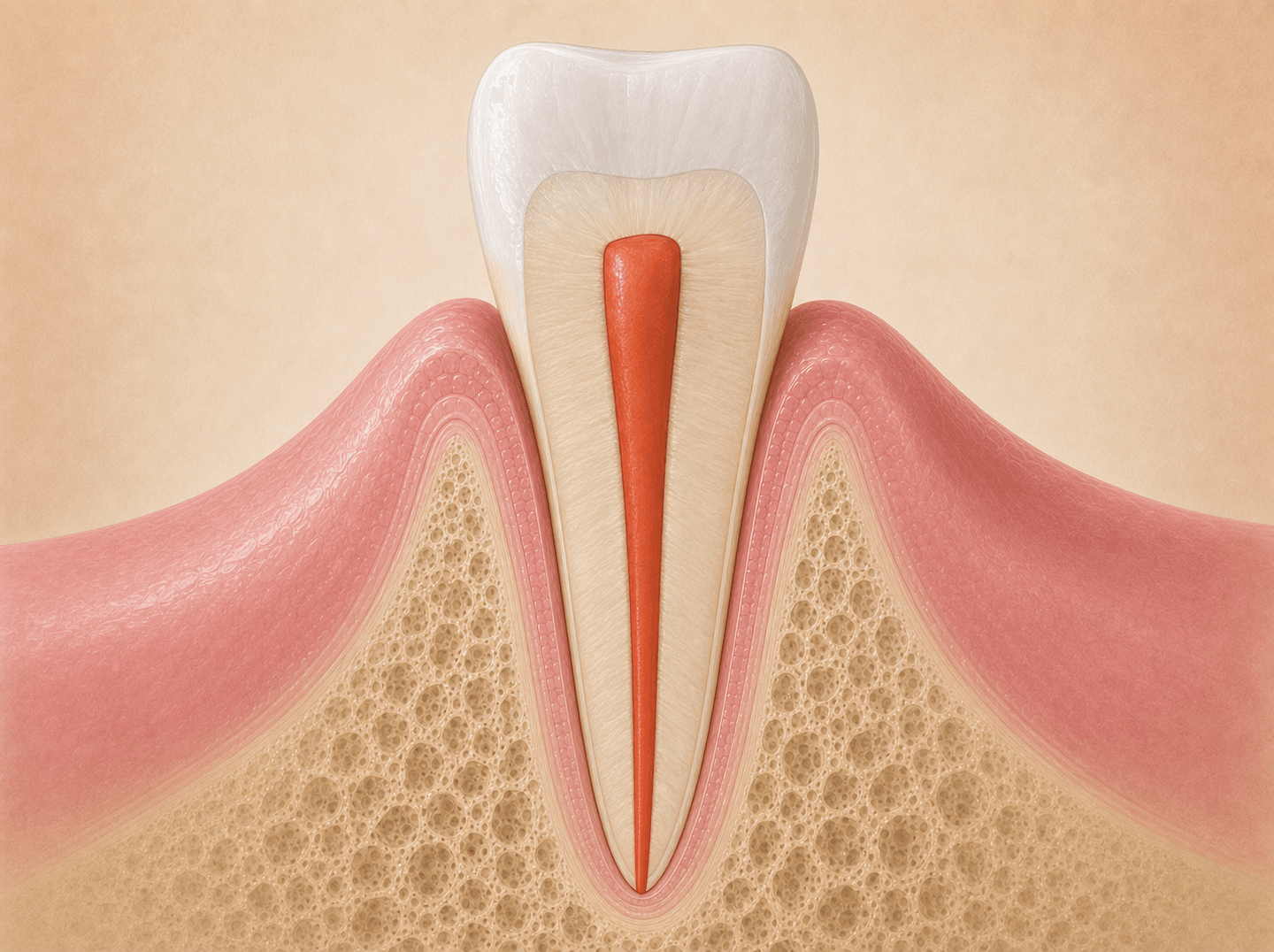
D3310 reports complete endodontic therapy on a permanent anterior tooth (incisors and canines, typically teeth #6–#11 and #22–#27). The procedure includes opening the tooth, debriding the pulp chamber and canal, shaping and cleaning the canal, and obturating with a permanent root canal filling material. The code includes routine intraoperative radiographs and the temporary restoration placed at the completion appointment.
It does not cover:
- Bicuspid root canal therapy. Use D3320.
- Molar root canal therapy. Use D3330.
- Retreatment of a previously root-canaled anterior tooth. Use D3346.
- Pulpotomy or interim pulpal treatment. Use D3220 or D3221.
- Apicoectomy. Use D3410.
- The final restoration (composite, buildup, crown). Those are separately billable codes.
Anterior endo is the simplest of the three RCT categories anatomically (most anterior teeth have a single canal). The clinical procedure is the same as molar endo conceptually: open, debride, shape, fill.
When to bill D3310
Bill D3310 when:
- An anterior tooth has been diagnosed with pulpal pathology and root canal therapy has been completed.
- The obturation is complete with a permanent root canal filling material.
- The tooth has been temporized for the patient to return for final restoration.
Do not bill D3310 for:
- Incomplete treatment.
- Bicuspid or molar teeth (even if the case is unusually simple).
- A retreatment of a previously root-canaled anterior tooth. Use D3346.
- The final restoration.
What separates D3310 from D3320/D3330
Tooth type, not canal count, not difficulty. An anterior tooth with two canals (anatomically possible, particularly on mandibular incisors) is still D3310. The code is structural.
This matters less for anterior teeth than for posterior because most anterior cases are straightforward single-canal procedures. The clinical complexity tends to come from access difficulty, calcification on older patients, or post-traumatic changes rather than canal count.
Top reasons D3310 gets denied or downgraded
Five issues account for most denials on this code:
- Missing or insufficient radiographs. Same as D3330. Pre-op and post-op periapicals are usually required. Anterior teeth are easier to image than molars, so radiograph quality is rarely the issue, but attachment workflow problems (image not linked to the claim) are common.
- Retreatment coded as initial. D3310 was billed on a tooth that already had endo done previously. The carrier reviews the pre-op film, sees existing fill, and denies with a request to recode as D3346.
- Medical necessity questioned. Some plans request documentation of the pulpal diagnosis, especially when the tooth appears clinically intact on the radiograph (asymptomatic apical periodontitis, internal resorption, post-trauma necrosis that doesn’t show obvious radiographic findings). A short narrative noting the diagnostic findings clears most of these.
- Vital pulp extirpation without sufficient justification. RCT on a tooth that doesn’t yet show pathology can be questioned by carriers. This is rare but happens when a tooth is being prepared for a planned restoration that the dentist judges will compromise the pulp.
- Same-day buildup and crown bills. Less common on anterior teeth than on molars (because crowns are less commonly needed), but when the dentist does crown an anterior post-RCT, billing the RCT, buildup, and crown on the same date triggers the same denials as on molar workflows.
When an anterior tooth needs a crown after RCT
This is the most common question on D3310 cases that distinguishes the billing path from D3330. Molars almost always need crowns after endo. Anterior teeth often don’t.
The general clinical rules:
- Anterior tooth with conservative access and minimal structural loss: composite restoration (D2330, D2331, D2332) is usually sufficient.
- Anterior tooth with extensive structural loss, large existing restoration, or fracture: crown (D2740 or other appropriate code) is appropriate.
- Anterior tooth that has darkened post-trauma: crown or veneer may be requested for esthetics regardless of structural need.
- Anterior tooth that will serve as an abutment for a bridge or partial denture: crown is typically needed for retention and prosthetic design.
The billing implication is that an anterior RCT case may stop at D3310 + composite. There may be no follow-up crown claim. This is normal and not a billing red flag. Patients sometimes ask “doesn’t a root canal always need a crown?” The honest clinical answer is no, particularly for anterior teeth, and the billing path reflects that.
The trauma-history narrative
Anterior endo is more commonly trauma-related than posterior endo. A history of dental trauma (sports injury, vehicle accident, fall, assault) can be relevant for two billing reasons:
- Documenting medical necessity for plans that question why a clinically intact-looking tooth needs RCT.
- Establishing crossover potential for medical insurance in cases where the trauma was a covered medical event.
A useful narrative phrasing: “Patient reports history of dental trauma to tooth #9 in [year]. Tooth has remained asymptomatic until current presentation with discoloration and apical sensitivity. Pre-op periapical shows apical radiolucency consistent with chronic apical periodontitis from prior pulpal injury. RCT initiated to address the developing pathology.”
Specific. Documents the trauma history. Documents the current findings. Defensible if audited.
Documentation that supports the claim
The claim needs:
- Pre-op periapical radiograph.
- Post-op periapical radiograph showing complete obturation.
- Date of service (completion of obturation).
- Correct tooth number.
- Narrative for unusual cases (post-trauma, asymptomatic with subtle radiographic findings, retreatment cases coded as D3346).
For the patient record, document:
- Diagnosis (irreversible pulpitis, pulpal necrosis, apical periodontitis, trauma sequela).
- Pulp testing results (cold, electric, percussion, palpation).
- Working length.
- Obturation material.
- Planned final restoration (composite alone vs crown).
- Patient instructions.
Example case
A 26-year-old patient presents with discoloration of tooth #8 and intermittent sensitivity. She reports a sports injury to the tooth at age 14, treated with a composite restoration at the time but no further follow-up. Pulp testing confirms non-vital. Pre-op periapical shows a small apical radiolucency.
Treatment sequence:
- Visit 1: pulpal debridement, working-length film, calcium hydroxide placed, temporary restoration.
- Visit 2 (two weeks later): obturation completed, post-op periapical taken, composite restoration placed in the access opening.
Billing steps:
- Submit D3310 on the date of obturation (visit 2). Attach pre-op and post-op periapicals.
- Add a narrative: “Patient with history of dental trauma to #8 at age 14. Tooth currently non-vital on testing. Pre-op periapical shows apical radiolucency consistent with chronic apical periodontitis. RCT completed.”
- Submit D2330 (or D2331/D2332 depending on the composite size) for the access restoration on the same date or on the follow-up visit if it was done separately.
- No crown is planned. The case is complete after the composite.
If the carrier pends D3310 for additional documentation, supply the chart notes documenting pulp testing and diagnosis. The trauma history narrative is usually sufficient.
What to get right in your PMS
The specifics vary across Open Dental, Dentrix, Eaglesoft, Curve, and Carestream. The steps that matter:
- Code by tooth type. D3310 for anterior, D3320 for bicuspid, D3330 for molar.
- Post on the date of obturation, not the start date.
- Attach pre-op and post-op films to the claim.
- Don’t assume a crown will follow. Anterior cases often end with a composite. The PMS treatment plan should reflect what the dentist actually plans, not a template assuming RCT-plus-crown.
- Check the pre-op film for prior endodontic treatment. If present, use D3346 (anterior retreatment), not D3310.
If your office is seeing D3310 claims pend more often than D3330 claims, the issue is usually narrative on subtle cases. Anterior RCTs are sometimes performed on teeth that look almost normal on the pre-op film. A short narrative explaining the diagnosis prevents most of those pends.
FAQs
- What's the difference between D3310, D3320, and D3330?
- Anterior, bicuspid, and molar. D3310 is anterior teeth (typically a single canal). D3320 is bicuspid teeth (one or two canals). D3330 is molar teeth (three or more canals). The tooth type dictates the code, not the actual canal count.
- Does an anterior tooth always need a crown after RCT?
- No. Anterior teeth with minimal structural loss can often be restored with a composite restoration alone (D2330, D2331, or D2332). Anterior teeth with extensive structural loss, large access preparations, or fractures benefit from full-coverage crowns. The clinical decision drives the post-RCT restoration choice.
- What's the narrative for an anterior RCT after trauma?
- Document the trauma history, the date of the original injury if known, and the diagnostic findings. A typical phrasing: 'Patient sustained dental trauma to #8 in vehicle accident on [date]. Tooth tested non-vital at presentation. Pre-op periapical shows apical radiolucency consistent with chronic apical periodontitis from prior pulpal injury.' This narrative helps with plans that question whether the endo was medically necessary.
- Can D3310 be billed for a retreatment?
- No. Retreatment of a previously root-canaled anterior tooth uses D3346, not D3310. Coding a retreatment as initial therapy underbills the case and can trigger an audit denial when the carrier reviews the pre-op film and sees the existing fill.
- Why did the carrier pay less than expected for D3310?
- Anterior endodontic allowables are the lowest of the three RCT codes (D3310, D3320, D3330). A 'less than expected' payment usually means the plan is paying at the standard D3310 allowable, which is sometimes substantially below the office fee. The patient owes the difference per the plan's coinsurance structure.
Related codes
Need help billing this code?
We handle D3310 claims daily.
If your team is spending time on denials, narratives, or carrier follow-up for this code, our outsourced dental insurance billing service can take it off your plate. We work inside your PMS and post payments the same week.
CDT codes are maintained by the American Dental Association. This page is an editorial billing guide, not the official ADA code descriptor. Verify current coverage policies with each carrier before submitting claims.