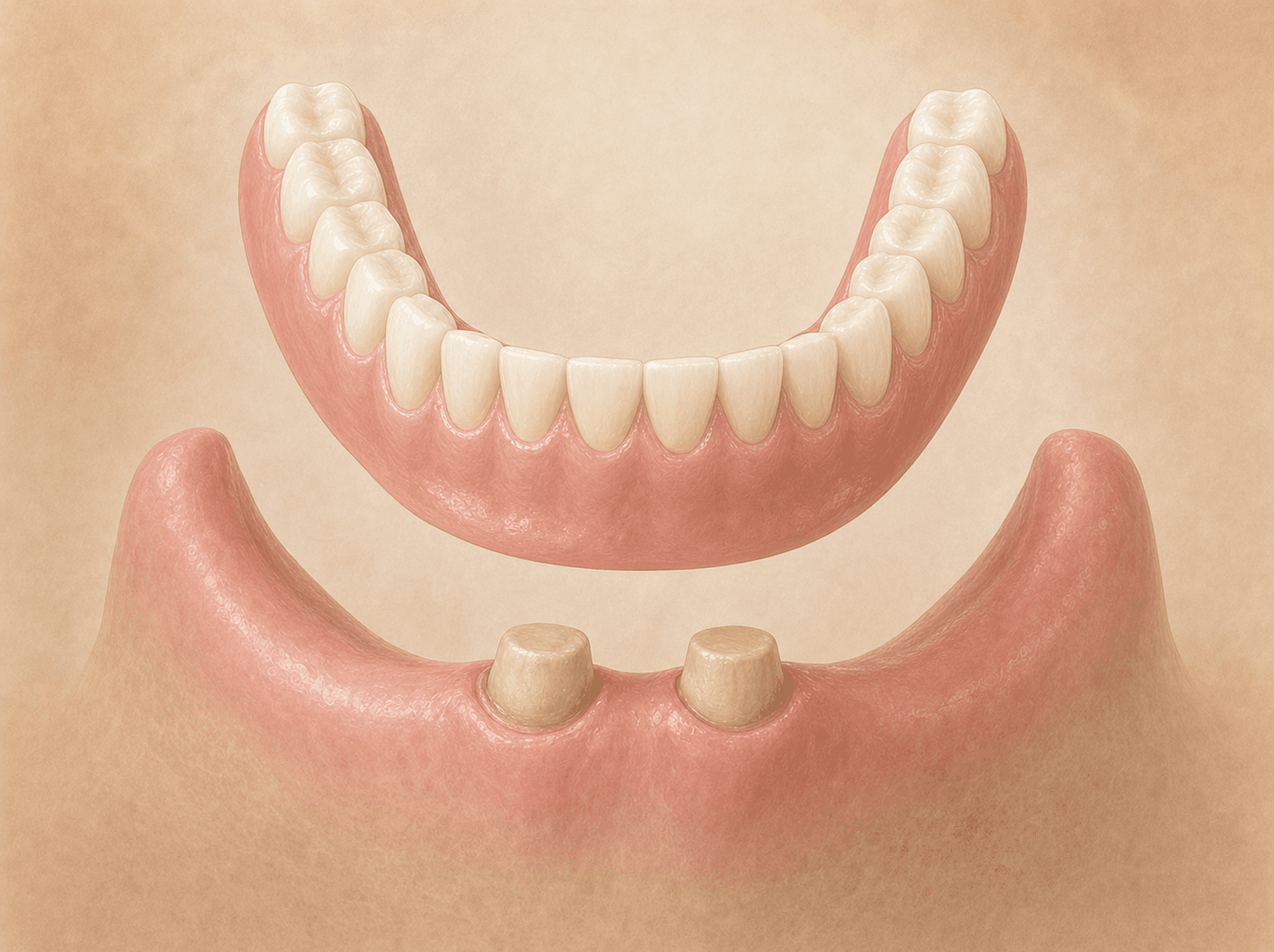
D5865 is the CDT code for a complete lower overdenture, a removable full lower denture seated over natural roots kept in the jaw.
- When to use: A full lower denture is delivered over one or more retained natural roots, most often the canines, kept to support it and slow bone loss.
- When not to use: A lower overdenture on implants is D6111, a lower denture on a bare ridge is D5120, and the upper natural-root version is D5863.
- Billing note: Send periapicals of each retained root with the predetermination, and expect some plans to pay the conventional lower denture allowable instead.
When D5865 is the right code
D5865 fits a narrow set of facts: a full lower denture, delivered over natural roots that were kept on purpose. All three parts have to be true. A lower denture over implants is D6111. A lower denture over a fully healed, toothless ridge is D5120. A lower prosthesis that leaves natural teeth in function is the partial overdenture, D5866.
The upper-arch twin is D5863, which also carries the full overdenture code grid and the background on the CDT 2026 nomenclature change.
Why the lower arch is where this comes up
The lower ridge is narrow, the tongue and floor of the mouth work against a denture, and a lower complete denture has far less surface to grip than an upper. Keeping two lower roots, usually the canines, gives the denture a firm stop and helps hold bone in the front of the jaw.
That clinical reasoning is what the claim has to show. A plan reviewing D5865 wants to see that the retained roots are healthy enough to be worth keeping, not roots left in place because extraction was skipped.
Fee schedules that still use the old name
The 2026 editorial change added natural tooth borne to the names of D5863 through D5866. Payer documents have been slow to follow. Maryland Medicaid’s CDT 2026 fee schedule, revised August 18, 2026, still prints D5865 without the qualifier. The same schedule lists the overdenture codes at $325 against $375 for a conventional complete denture, a reminder that some payers price the overdenture below the plain denture.
Commercial plans vary just as widely. Some pay D5865 at its own allowable, some apply an alternate benefit at the D5120 rate, and some require prior authorization. Verify which applies before the abutment teeth are prepared, since that is the point the treatment can no longer change course cheaply.
Claim setup for a two-canine lower overdenture
A 64-year-old patient has periodontally failing lower incisors and premolars but two lower canines with solid bone. The plan is to extract the failing teeth, keep both canines as overdenture abutments, and deliver a full lower denture.
Billing runs in this order:
- Extractions for the failing teeth, each with its own code and tooth number.
- Root canal treatment on teeth 22 and 27, as D3310 each.
- A coping over each reduced canine root, if placed, as D2975 per tooth. Plans vary on whether they pay it.
- D5865 on the delivery date, with the lower arch designated.
The office sent the predetermination with a panoramic image, periapicals of 22 and 27, and a note that the canines were retained to support the denture and preserve anterior bone. The plan approved the endodontics and paid the denture at the D5120 allowable as an alternate benefit.
Denial scenario: implant case on the natural-tooth code
A practice placed two lower implants and delivered a snap-in denture, then billed D5865 out of habit. The carrier’s review asked for radiographs, saw implants and no natural roots, and denied the line as inconsistent with the record.
The fix is recoding to D6111 and resubmitting with the implant documentation. On many plans that does not guarantee payment, because many plans exclude implant prosthetics or limit them more tightly than conventional dentures. Code it correctly the first time so the coverage question gets answered at predetermination, not on appeal.
After delivery
Post-delivery care follows the complete lower denture codes. Adjustments are D5411. Relines are D5731 chairside and D5751 in the lab. When the patient wears through an attachment insert in a root, the replacement part is D5867, reported per attachment. Most plans include adjustments for a set period after delivery, so check the window before billing the first one.
FAQs
- What is the difference between D5865 and D6111?
- What sits under the denture. D5865 rests on retained natural teeth or roots, and D6111 is retained by implants or implant abutments on a lower arch with no natural teeth. CDT 2026 added natural tooth borne to the D5865 name, so an implant overdenture reported as D5865 now contradicts the code's own wording.
- Is D5865 a complete or a partial denture?
- Complete. D5865 replaces the entire lower dentition, even though natural roots remain under the base. If the lower prosthesis replaces only some teeth and natural crowns stay in function, the partial overdenture code D5866 applies instead.
- What happens to the D5865 denture if a retained root has to come out later?
- The denture is usually adapted rather than replaced, and there is no new overdenture code to bill. The extraction takes its own code, and the denture base over the lost root is typically refitted with a lower reline, D5731 chairside or D5751 in the lab. A reline soon after delivery may hit a plan's waiting period, so send a narrative explaining the root loss.
- Does D5865 cover the attachments in the roots?
- No. Precision attachments placed in the roots bill as D5862, by report, and replacing a worn attachment part later is D5867, per attachment. Neither is folded into D5865, and plans often cover attachments less generously than the denture itself.
Related codes
Need help billing this code?
We handle D5865 claims daily.
If your team is spending time on denials, narratives, or carrier follow-up for this code, our outsourced dental insurance billing service can take it off your plate. We submit the claims, post what comes back, and follow up on anything unpaid. Already sitting on older claims that never paid? Our AR cleanup project works the backlog.
“Claims, posting, denials, all of it gets handled, and it costs far less than hiring another employee. My front desk got hours of their week back, and honestly I just don't think about billing anymore.”
CDT codes are maintained by the American Dental Association. This page is an editorial billing guide, not the official ADA code descriptor. Verify current coverage policies with each carrier before submitting claims.