D9245 is the CDT code for moderate (conscious) sedation reached with drugs given by the enteral route, meaning swallowed or given rectally. It is new in CDT 2026 and applies when more than one enteral drug is given, or a single enteral drug exceeds the FDA maximum recommended dose.
It's new in CDT 2026. Before 2026, moderate enteral sedation was reported under more general sedation codes like D9248. Many carriers have not yet loaded the 2026 sedation codes into their fee schedules, so expect early rejections for 'code not recognized' through mid-2026 and possibly beyond.
On this page
- What D9245 covers and doesn’t cover
- The sublingual question is open, not settled
- When to bill D9245
- D9245 versus D9244 and other sedation codes
- New code, carrier lag
- Provider licensure and sedation permits
- Top reasons D9245 gets denied
- Documentation that supports the claim
- Example case
- What to get right in your PMS
- FAQs
What D9245 covers and doesn’t cover
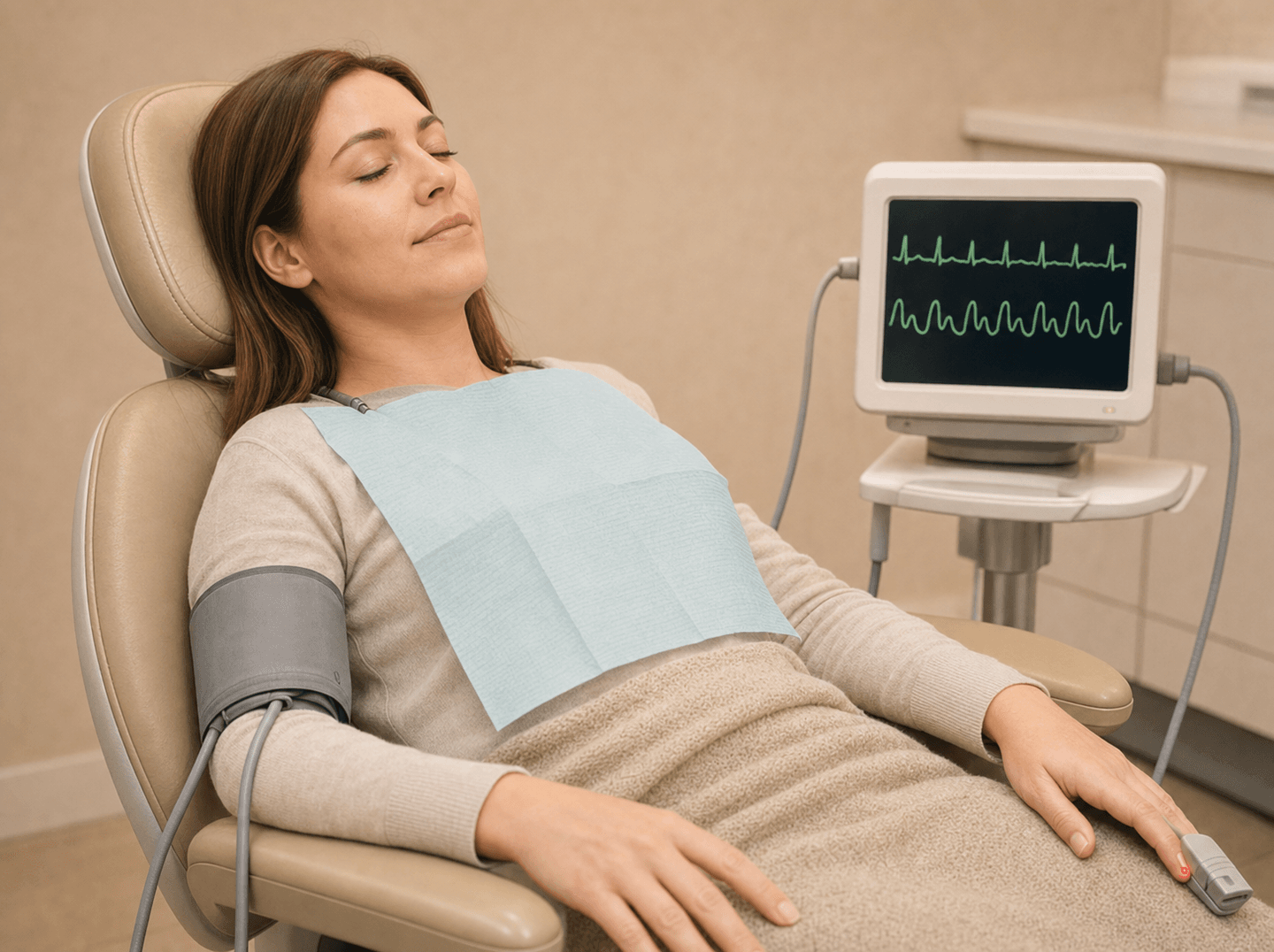
D9245 reports moderate sedation administered via an enteral route. Enteral means the drug is absorbed through the digestive tract, and the uncontested core of that is a short list: swallowed tablets, oral liquids, and rectal suppositories. Sublingual sits on the contested edge of it, and the published sources genuinely disagree about which side it falls on. That is worth knowing before you code one, because it is the only route on these codes where a confident answer is the wrong instinct. See the section below. In CDT 2026, the enteral route is coded as moderate sedation (D9245 rather than D9244) when either condition is met: more than one sedative drug is administered enterally, or a single enteral drug is given above the FDA maximum recommended dose (MRD) for unmonitored home use. Clinically, moderate sedation (also called conscious sedation) is a drug-induced depression of consciousness in which the patient responds purposefully to verbal commands, either alone or with light tactile stimulation, while maintaining protective reflexes and adequate spontaneous ventilation, and the descriptor still requires the provider to document that effect. What separates D9245 from D9244 is the drug protocol; what supports D9245 as a moderate sedation code is the recorded depth.
Nitrous oxide may be co-administered with the enteral drugs. When it is, the nitrous is part of D9245 and is not billed separately (D9230 is only for nitrous used as the sole agent), though its administration still has to be documented in the clinical notes.
The code includes drug administration, patient monitoring during the sedation period, and recovery observation before discharge. It is reported once per visit.
D9245 does not cover:
- Minimal sedation (anxiolysis) with a single enteral drug. Use D9244.
- Moderate sedation via non-intravenous parenteral routes: intramuscular, intranasal, submucosal, subcutaneous, or intraosseous. Use D9246 (first 15 minutes) or D9247 (each additional 15 minutes). Sublingual is the route the sources split on, so it is not on either list here as settled.
- IV moderate sedation. Use D9239 (first 15 minutes) or D9243 (each additional 15 minutes).
- Deep sedation or general anesthesia. Use D9222 (first 15 minutes) or D9223 (each additional 15 minutes).
- General anesthesia with advanced airway management. Use D9224 (first 15 minutes) or D9225 (each additional 15 minutes).
- Nitrous oxide alone. Use D9230.
- The dental procedure performed under sedation. That has its own code.
The code is specific to moderate sedation via enteral route. If the route is parenteral or IV, or the depth is minimal or deep, a different code applies.
The sublingual question is open, not settled
A tablet placed under the tongue is the one route where the published sources point in different directions, and each of them is the kind of source a biller would reasonably rely on.
- The ADA’s January 2026 sedation coding guide lists sublingual among the parenteral routes that D9246 and D9247 cover, and that listing survives into the guide’s May 4, 2026 revision.
- Pediatric anesthesia guidance from the AAPD and the AAP defines the enteral route as absorption through the gastrointestinal tract or the oral mucosa. Read that way, a sublingual dose is enteral and the visit stays on D9244 or D9245.
- A widely circulated coding-educator summary of the same 2026 ADA update lists the D9246 routes as intramuscular, intranasal, submucosal, subcutaneous, and intraosseous, without naming sublingual at all.
We are not going to tell you which of those is right, because settling it takes the licensed CDT manual and the sources above do not settle it between them. What that means operationally is narrower than it sounds, and it is still actionable.
When to bill D9245
Bill D9245 when:
- A patient received more than one enteral sedative drug, or a single enteral drug above its FDA maximum recommended dose, and every dose was given by an enteral route (swallowed or rectal).
- The intended and documented sedation level was moderate (conscious sedation).
- The patient responded purposefully to verbal commands throughout the procedure but had depressed consciousness beyond simple anxiolysis.
- The provider holds the appropriate state sedation permit for moderate sedation.
- The patient was monitored per the state board’s and ADA’s standards for moderate sedation (pulse oximetry, blood pressure, heart rate, respiratory rate at defined intervals).
Do not bill D9245 for:
- Cases where the patient remained fully alert and responsive with only mild relaxation. That is minimal sedation (D9244).
- Deep sedation where the patient could not be aroused by verbal commands alone. That is D9222/D9223.
- Any dose given by an unambiguously parenteral route (intramuscular, intranasal, submucosal, subcutaneous, intraosseous, or IV), even if the sedation level was moderate. D9245 requires that the sedation was achieved enterally.
- A sublingual dose is the exception to that bullet rather than an example of it. The route is disputed, so it does not automatically disqualify D9245 and it does not automatically qualify it either. Document it precisely and check the plan.
- Nitrous oxide used as the sole agent. Use D9230 regardless of the patient’s response level.
- A take-home prescription without in-office administration or supervised monitoring.
D9245 versus D9244 and other sedation codes
The 2026 sedation code restructuring split the older bundled codes into precise tiers by sedation depth, route of administration, and (for some) time increments. Here is how D9245 fits relative to the codes around it.
D9244 (minimal sedation, single drug, enteral): One sedative agent given at or below the FDA maximum recommended dose. Clinically the patient is awake and responds normally to verbal commands. Typical scenario: a single low-dose oral benzodiazepine for anxiety reduction.
D9245 (moderate sedation, enteral): More than one enteral drug, or a single enteral drug above the MRD. Monitoring requirements are more extensive than for minimal sedation. Typical scenario: a hydroxyzine-plus-midazolam oral protocol, or a single agent dosed above its MRD for a longer or more involved procedure.
D9246/D9247 (moderate sedation, non-IV parenteral): Same sedation depth as D9245, but the route is parenteral short of intravenous. The ADA’s January 2026 guide lists that route set as intramuscular, intranasal, submucosal, subcutaneous, sublingual, and intraosseous. Sublingual is the one entry other published sources place with the enteral codes instead, so treat it as unresolved rather than as belonging here. These are time-based (first 15 minutes, each additional 15 minutes), which is a second practical difference: D9245 is a single per-visit line, D9246/D9247 are billed by the clock.
D9239/D9243 (IV moderate sedation): Same sedation depth, but the route is intravenous. Time-based billing.
D9230 (nitrous oxide): Used only when nitrous oxide is the sole sedative agent. If the practice’s protocol combines nitrous with an oral sedative, the nitrous is part of D9245 (or D9244) and is not reported separately. Per the ADA’s 2026 guidance, D9230 and a sedation code are never billed together for the same visit. Document the nitrous in the clinical notes.
D9219 (evaluation for moderate sedation, deep sedation, or general anesthesia): A separate code for the pre-sedation evaluation. Per the ADA’s 2026 guidance it can be reported on the same date of service as D9245 to document the doctor’s safety check before sedation begins.
The drug protocol is what draws the line between the two codes. A single enteral drug at or below the MRD is D9244 even if the patient looks deeply relaxed; multiple enteral drugs, or a single drug above the MRD, is D9245. Code the boundary from the protocol, and still record the depth, because D9245 is a moderate sedation code and its descriptor asks for it.
New code, carrier lag
D9245 is effective January 1, 2026. As of mid-2026, not all carriers have loaded the new sedation codes into their adjudication systems. This is the same adoption-lag pattern that follows every CDT release, and it typically takes six to twelve months for full carrier adoption.
What this looks like in practice:
- Claim rejected as “code not recognized.” The carrier’s system doesn’t have D9245 in its code table yet. This is not a coverage denial. It is a system-update issue.
- Claim processed but with a $0 fee schedule. The carrier loaded the code but hasn’t assigned an allowable. This looks like a non-covered service on the EOB but is really a fee-schedule gap.
- Carrier asks you to resubmit under the old code. Some carriers will tell you to use D9248, the pre-2026 catch-all for non-IV conscious sedation, until they complete the transition. D9248 was deleted effective January 1, 2026 and is not valid coding on its own. Submit it only when the carrier has explicitly directed you to, record who gave the instruction and when, and switch to D9245 as soon as their system is updated. The correct first move is always to ask the carrier to load the code and reprocess.
Provider licensure and sedation permits
State dental boards regulate sedation permits independently of CDT codes and insurance billing. Most states require a separate permit for moderate sedation that is distinct from (and a tier above) the minimal sedation permit. The specific permit names and requirements vary by state.
Common requirements for a moderate sedation permit include:
- Completion of ADA-recognized training in moderate sedation (typically 60+ hours of didactic and clinical instruction, though state requirements vary).
- Current ACLS or PALS certification.
- Office inspection demonstrating appropriate monitoring equipment (pulse oximeter, blood pressure monitor, emergency drugs, supplemental oxygen, suction).
- A trained sedation assistant present during the procedure.
- Permit renewal on the state board’s cycle, usually every two to five years.
If the provider does not hold the required permit, the carrier may deny the claim. But the bigger problem is regulatory: performing moderate sedation without the proper state permit is a violation that carries consequences beyond a claim denial. Confirm the provider’s permit status before adding moderate sedation services to the practice.
Top reasons D9245 gets denied
Six issues account for most denials on this code in 2026:
- Code not recognized by the carrier. The carrier hasn’t loaded CDT 2026. Call, confirm, and push them to reprocess the D9245 claim as a system-update issue rather than a coverage decision. If the carrier explicitly directs you to the deleted D9248 in the meantime, document that instruction and switch back once they update.
- Plan doesn’t cover sedation. Many dental plans exclude sedation entirely or cover it only for specific populations (pediatric patients, special needs patients) or specific procedures (oral surgery). The denial reads “non-covered service.” The patient owes the full fee out of pocket.
- Medical necessity not documented. Plans that do cover sedation often require a narrative explaining why moderate sedation was clinically necessary. Without it, the claim pends or denies. Common justifications: severe dental anxiety unresponsive to behavioral management, strong gag reflex preventing standard treatment, extensive or lengthy procedure, special needs patient.
- Provider lacks the sedation permit. Some carriers verify the provider’s sedation permit against the state board’s records. If the permit isn’t on file or has lapsed, the claim denies.
- Wrong code for the sedation level or route. D9245 billed when the chart documents minimal sedation (should be D9244), or D9245 billed when a dose went by an injected or intranasal route (should be D9246/D9247). The chart documentation has to support the code either way. Sublingual dosing draws this denial more than any other route, and there it means something different: the route itself is disputed, so a denial is a definitional disagreement rather than evidence you miscoded. Ask the plan which family it maps sublingual to before rebilling.
- Bundling with the procedure. Some plans bundle sedation into the procedure allowable and won’t pay the sedation code separately. Appeal with documentation showing the sedation was a distinct service with its own monitoring, timing, and clinical notes.
Documentation that supports the claim
The claim submission needs:
- Date of service.
- D9245 as the sedation code.
- Procedure code(s) for the dental work performed under sedation.
- Medical necessity narrative (recommended on every sedation claim, required by many carriers).
For the patient record, document all of the following:
- Pre-sedation assessment: medical history review, current medications, ASA physical status classification, baseline vital signs, informed consent signed.
- Drug protocol: drug name(s), dosage(s), route of administration, and time of administration. Record the route dose by dose, not once for the appointment. D9245 requires that the sedation was achieved enterally, so the note has to name each route specifically. Write sublingual as sublingual rather than folding it into “oral,” because that is the route the published sources disagree about and a vague note hands the decision to whoever reads the claim.
- Monitoring during sedation: pulse oximetry, blood pressure, heart rate, and respiratory rate recorded at regular intervals (typically every five minutes, per state and ADA guidelines for moderate sedation). Note the patient’s responsiveness level at each check.
- Sedation start and end times.
- Patient’s level of consciousness throughout: responsive to verbal commands, any tactile stimulation required to elicit response.
- Recovery observation: vital signs returning to baseline, patient meeting discharge criteria (oriented, ambulatory with assistance, stable vitals).
- Discharge: time of discharge, confirmed responsible adult driver present, written post-sedation instructions provided.
- Provider’s sedation permit number if the state board requires it in the record.
A pre-printed sedation record template that the assistant fills in during the visit is the most reliable way to capture all of this without gaps.
Example case
A 42-year-old patient with severe dental anxiety and a strong gag reflex presents for extraction of a failing upper right first molar (#3) and bone grafting. The dentist treatment-plans the procedures under moderate oral sedation. The patient has a history of failed minimal sedation (single-drug oral protocol did not achieve adequate sedation for a prior procedure).
Treatment sequence:
- Pre-sedation assessment completed at check-in: medical history reviewed, ASA Class II (controlled hypertension), vital signs recorded, informed consent for moderate oral sedation signed.
- Oral triazolam 0.5mg administered at 8:00 AM. A second oral dose of 0.25mg administered at 8:20 AM per the practice’s incremental oral protocol, bringing the total to 0.75mg, above the 0.5mg maximum on the drug’s FDA label for unmonitored home use.
- Patient taken to the operatory at 8:45 AM. Responds to verbal commands but shows depressed consciousness consistent with moderate sedation. Baseline monitoring recorded: SpO2 98%, BP 128/82, HR 72, RR 14.
- Local anesthesia administered. Extraction of #3 (D7210) and bone graft (D7953) completed.
- Vital signs monitored every five minutes throughout the procedure. All readings within normal limits. Patient responded purposefully to verbal commands at each check.
- Procedure completed at 9:40 AM.
- Recovery monitoring. Patient meets discharge criteria at 10:15 AM: oriented, ambulatory with assistance, vital signs stable. Discharged with responsible adult driver. Written post-sedation instructions provided.
Two things make this a D9245 case rather than a D9244 case: the single drug exceeded its FDA maximum recommended dose, and both doses were swallowed, so the enteral route is not in question. Change the second detail and the clean answer goes away. Had the 8:20 AM dose been placed under the tongue instead of swallowed, the case would land on the one route the published sources do not agree about, and which code reports it would turn on the reading the plan applies rather than on anything in the chart. That is the case to document precisely and call the plan about before submitting, not the case to code confidently either way.
Billing steps:
- Verify benefits before treatment. Confirm that the plan covers moderate sedation and ask about any required pre-authorization. If sedation is not covered, quote the patient the full sedation fee as out of pocket.
- Submit on the date of service:
- D7210 (surgical extraction) on tooth #3.
- D7953 (bone graft) on site #3.
- D9245 for the moderate enteral sedation.
- Attach a medical necessity narrative: “Patient with documented severe dental anxiety and gag reflex, with prior failed minimal sedation attempt. Moderate enteral sedation administered to enable surgical extraction and bone grafting. Patient monitored throughout, procedure completed without complication.”
- If the carrier rejects D9245 as unrecognized, call to confirm CDT 2026 adoption status and ask them to reprocess. D9248 is deleted, so use it only if the carrier explicitly directs you to, note who said so and when, and go back to D9245 once their system is updated.
What to get right in your PMS
The specifics vary across Open Dental, Dentrix, Eaglesoft, Curve, and Carestream. The steps that matter are the same regardless of system:
- Add D9245 to your procedure code table. This is a new 2026 code. If your PMS received the CDT 2026 update, the code should be present. If it isn’t, add it manually with the correct fee and a default category. Confirm the update was installed.
- Set the fee on D9245. A missing fee means the code posts at $0, which cascades into incorrect patient estimates and incorrect claim amounts.
- Link the sedation record to the claim. Your sedation monitoring notes (vitals, times, drug protocol) should be attachable to the claim. Many systems store clinical notes at the patient level by default. Make sure the sedation documentation is linked to the specific claim, not just the chart.
- Flag carrier adoption status. Add a note or flag on each carrier record indicating whether they’ve loaded CDT 2026 sedation codes. This prevents your team from submitting D9245 to a carrier that will reject it, saving a round-trip.
- Use a sedation-specific clinical note template. A template that prompts for drug name, dose, route, administration time, vital signs at intervals, and discharge criteria prevents documentation gaps that lead to denials or audit issues later.
FAQs
- What's the difference between D9244 and D9245?
- Both report enteral sedation, and CDT 2026 draws the line between them by the drug protocol rather than by the observed depth. D9244 is a single drug given at or below the FDA maximum recommended dose (MRD) for unmonitored home use. D9245 is moderate sedation, reported when more than one enteral drug is given, or when a single enteral drug exceeds the MRD. The monitoring protocol and state permit requirements are also more demanding at the moderate level.
- My carrier rejected D9245 as an unrecognized code. What do I do?
- Call the carrier and ask whether they've loaded CDT 2026 codes. A rejection for an unrecognized code is a system-update problem on their side, not a coverage decision, so the first move is to ask them to reprocess the D9245 claim. The pre-2026 code that covered this was D9248 (non-IV conscious sedation), but D9248 was deleted effective January 1, 2026 and is no longer valid coding. Fall back to it only if the carrier explicitly instructs you to, and record the date, the representative's name, and the code you submitted. Once the carrier confirms the 2026 codes are active, switch to D9245 going forward.
- Does the dentist need a special permit to bill D9245?
- Yes. Most states require a moderate sedation permit (sometimes called a conscious sedation permit) issued by the state dental board. The permit requirement is separate from the billing question. If the provider does not hold the permit, the carrier may deny the claim, and performing moderate sedation without the permit is a regulatory violation regardless of billing.
- Is a sublingual dose enteral, so D9245, or parenteral, so D9246?
- The sources do not agree, so treat it as unsettled rather than obvious. The ADA's January 2026 sedation coding guide lists sublingual among the parenteral routes that D9246 and D9247 cover, and that listing survives into the May 4, 2026 revision. Pediatric anesthesia guidance from the AAPD and the AAP defines the enteral route as absorption through the gastrointestinal tract or the oral mucosa, which puts sublingual with D9244 and D9245 instead. At least one widely circulated coding-educator summary of the same 2026 update lists the D9246 routes without naming sublingual at all. Record the route as sublingual in the note rather than as oral, and if a sublingual case is denied as a route mismatch, ask the plan which family it maps sublingual to before rebilling.
- Is D9245 billed per visit or per hour?
- Per visit. D9245 is reported once per date of service, not per drug, per dose, or per time increment. This is different from IV sedation codes (D9239/D9243) and non-IV parenteral codes (D9246/D9247), which are time-based with a first-15-minutes code and an each-additional-15-minutes code.
- Can I bill D9245 alongside the dental procedure performed under sedation?
- Yes. D9245 is a separate line item on the same claim as the procedure it supported (extraction, restoration, surgery, etc.). Some plans bundle sedation into the procedure allowable and won't pay separately. Others pay the sedation code as an independent line item. Verify the plan's sedation coverage before treatment.
Related codes
Need help billing this code?
We handle D9245 claims daily.
If your team is spending time on denials, narratives, or carrier follow-up for this code, our outsourced dental insurance billing service can take it off your plate. We work inside your PMS and post payments the same week.
CDT codes are maintained by the American Dental Association. This page is an editorial billing guide, not the official ADA code descriptor. Verify current coverage policies with each carrier before submitting claims.