D9310 is the CDT code for a consultation where a dentist or physician gives an opinion on a specific problem at another practitioner's request.
- When to use: A specialist sees a patient on referral, or a dentist gives a second opinion, and reports back to the provider who asked.
- When not to use: The treating dentist's own exam is D0140, D0160, D0120, or D0150, and coordinating with a physician about medical history is D9311.
- Billing note: Many plans bundle D9310 with a same-day exam or count it against the exam frequency limit, so verify before billing both on one date.
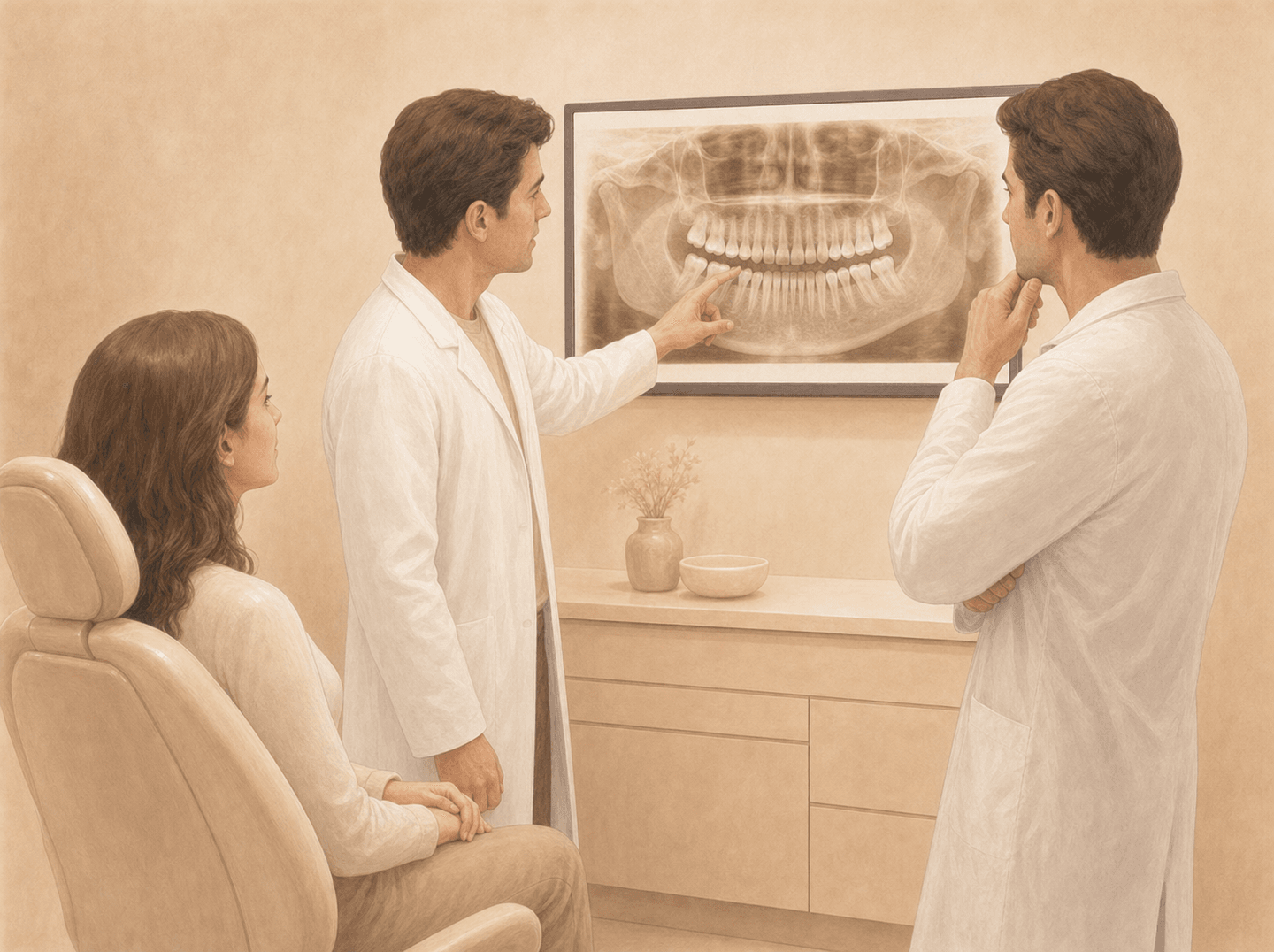
What D9310 covers
D9310 reports a consultation: a diagnostic encounter where a dentist or physician who is not the one requesting it gives an opinion or advice on a specific problem. A practitioner asks for the consult, the patient is seen by the consulting provider, and that provider weighs in on the evaluation or management of the problem. The consult includes looking at the patient, and the consulting provider typically sends a written opinion back to the dentist who asked for it.
Two clinical pictures fit. The first is a specialist seeing a patient on referral, an oral surgeon, periodontist, or endodontist giving an opinion before anyone decides on treatment. The second is a dentist providing a second opinion on a diagnosis or treatment plan another dentist proposed.
The defining feature is the provider, not the depth of the look. D9310 belongs to the consulting provider, the one brought in for an opinion. It is not the treating dentist’s routine or problem-focused exam.
The distinguishing axis: who provides it, not how detailed it is
This is the single thing to get right on D9310, and the thing most often gotten wrong.
The instinct is to choose between D9310 and the evaluation codes by how thorough the appointment felt: a quick look is D0140, a deep workup is D0160, an even more involved one must be D9310. That is the wrong axis. The deciding variable is who the provider is relative to the patient’s care.
- D0140 is a limited, problem-focused evaluation reported by the treating dentist for a specific complaint.
- D0160 is a detailed and extensive problem-focused evaluation, by report, also reported by the treating dentist, when the workup goes well beyond a limited look.
- D9310 is a consultation reported by the provider who was asked for the opinion, not the one who asked, brought in to give an opinion on a specific problem.
D0140 and D0160 differ from each other by depth. Both are the treating dentist evaluating their own patient. D9310 sits on a different axis entirely: it is the consulting provider, the second set of eyes asked for at another practitioner’s request. A patient who walks into their own dentist with a cracked molar is a D0140 (or D0160) visit. The same patient sent to an oral surgeon for an opinion on that molar is a D9310 visit for the surgeon. Same patient, same tooth, different provider, different code.
D9310 versus the codes it gets confused with
A few codes sit near D9310 and get mixed up with it. The axis that separates them is what the visit actually was.
Evaluations by the treating dentist (D0140, D0160, and the comprehensive/periodic exams D0120 and D0150). These are the treating dentist looking at the patient, whether routine, problem-focused, or comprehensive. D9310 is a different provider giving an opinion at someone’s request. The overlap that causes denials is that many plans treat a consultation and an evaluation as the same kind of service for frequency and bundling, so billing D9310 with an exam on the same visit often gets one denied.
D9311 (consultation with a medical health care professional). This is a newer code and a different situation. D9311 is the dentist consulting with a physician, nurse practitioner, or other medical professional about a patient whose medical status affects dental care. There is no patient consultation encounter at its center the way there is with D9310; it covers the provider-to-provider coordination. Don’t reach for D9311 when a specialist saw the patient for an opinion, and don’t reach for D9310 when the dentist phoned a physician about a medical history.
D9430 (office visit for observation, no other services performed). D9430 is a visit where the patient is seen but nothing is done, no evaluation, no treatment. A consultation is a diagnostic service with an opinion rendered, so it isn’t D9430. If a diagnostic evaluation happened, D9430 doesn’t fit by definition.
D9450 (case presentation, detailed and extensive treatment planning). D9450 is the treating dentist presenting a worked-up treatment plan to the patient. It is part of the treating dentist’s planning, not an outside opinion. D9310 is the consulting provider’s opinion at another practitioner’s request.
The rule underneath all of these: D9310 is the consulting provider being asked for an opinion. Everything the treating dentist does for their own patient lives under a different code.
Coverage reality: a consultation is often treated like an exam
How a plan handles D9310 is plan-dependent, but a few patterns show up often enough to plan around.
- It’s frequently limited. Many plans cap consultations, commonly once per provider per benefit year, and some fold that limit in with the oral evaluation frequency. A patient who already used their evaluation benefit may find the consultation denied as exceeding frequency.
- Same-visit bundling is common. A consultation billed alongside an oral evaluation (D0120, D0150, or D0140) on the same date often results in one being denied as included in the other. Plans don’t reliably pay both for one encounter.
- Some plans pay it only for specialist referrals. A consult by a referred-to specialist may be covered while a same-office second opinion is denied, depending on the plan’s definition.
- A written opinion is often expected. Because the descriptor centers on rendering an opinion, plans that pay D9310 frequently want the consulting provider’s written narrative back to the requesting dentist on file.
None of this is universal. The only reliable way to know is to verify the specific plan’s consultation benefit and its frequency rule before the visit.
When to bill D9310
Bill D9310 when a dentist or physician who is not the one requesting it provides a consultation, an opinion on a specific problem, at another practitioner’s request. Typical situations:
- A specialist (oral surgeon, periodontist, endodontist) sees a patient on referral and gives an opinion before treatment is decided.
- A dentist provides a documented second opinion on another dentist’s diagnosis or proposed treatment plan.
Do not bill D9310 for:
- A routine, problem-focused, or comprehensive exam by the patient’s own treating dentist. That’s an evaluation code (D0140, D0160, D0120, or D0150 by type and depth).
- A visit where nothing diagnostic happened. That’s D9430 (observation, no services).
- The treating dentist presenting their own treatment plan. That’s D9450 (case presentation).
- A dentist coordinating with a physician about a medical condition. That’s D9311.
Documentation that supports the claim
A consultation that gets reviewed turns on showing it really was a consultation by a different provider, not a relabeled exam. The record that supports D9310 generally includes:
- Who requested the consult. The referring or requesting practitioner, named, so it’s clear the reporting provider is not the one who asked for the opinion.
- The specific problem. The reason the opinion was requested, stated plainly.
- The opinion rendered. The consulting provider’s findings and recommendation, ideally as a written narrative sent back to the requesting dentist. Many plans expect this on file.
- That it was a consultation, not treatment. D9310 reports the opinion; if the consulting provider goes on to treat, that treatment is reported under its own codes.
For a same-office second opinion, the record should make the requesting-versus-reporting distinction explicit, since that is exactly what a reviewer will question.
What to get right in your PMS
The exact menus differ across Open Dental, Dentrix, Eaglesoft, Curve, and Carestream, but the setup that prevents problems is the same:
- Keep D9310 distinct from the evaluation codes in the code table. It should be a separate, clearly labeled line item, not something a biller picks because the exam ran long. Label it as the consultation by a non-treating provider so the choice is deliberate.
- Flag the same-visit bundling risk. A note on the code record or a claim edit that prompts the biller when D9310 is on a claim with D0120, D0150, or D0140 catches the most common denial before it goes out.
- Track the consultation frequency separately, but watch the overlap. Set the consultation benefit field for the plan’s limit (often once per provider per year), and remember some plans count it against the same frequency as an oral evaluation. If your system treats them as unrelated, the estimate will be wrong.
- Attach the written opinion to the claim, not just the chart. For plans that pay D9310, link the consulting provider’s narrative to the claim line so the clearinghouse sends it with the claim.
- Don’t confuse D9310 and D9311 in the menu. Keep the patient consultation (D9310) and the consultation with a medical professional (D9311) as separate, clearly labeled codes so the team picks the one that matches the encounter.
FAQs
- What is the dental code for a consultation?
- D9310. It reports a consultation, meaning a diagnostic encounter where a provider who is not the one asking for it gives an opinion on a specific problem. The classic case is a specialist seeing a patient on a referral, or a dentist providing a second opinion. The thing that defines the code is the provider: D9310 is reported by the consulting provider, not by the treating dentist doing a routine evaluation. If the treating dentist is the one looking at a problem, that's an evaluation code such as D0140, not D9310.
- What is the difference between D9310 and D0140?
- It's who performs the service, not how deep the look is. D0140 is a limited, problem-focused evaluation by the treating dentist, the dentist who is going to handle the patient. D9310 is a consultation by a different provider, brought in for an opinion at someone else's request, often a specialist or a second opinion. A patient walking into their own dentist with a toothache is a D0140 visit. The same patient sent to an oral surgeon for an opinion on that tooth is a D9310 visit for the surgeon. Same patient, different provider, different code.
- What is the difference between D9310 and D0160?
- Again, the provider, not the detail level. D0160 is a detailed and extensive problem-focused evaluation reported by the treating dentist, used when the workup goes well beyond a quick limited look (D0140) but is still focused on a problem. D9310 is a consultation given by a provider other than the one who asked for it. The error to avoid is picking between D9310 and D0160 based on how thorough the appointment was. The deciding question is whether the provider is the treating dentist (D0140 or D0160 by depth) or a consulting provider giving an opinion at another practitioner's request (D9310).
- Does insurance cover D9310?
- It depends on the plan. Many plans cover D9310 but limit it, commonly to once per provider per benefit year, and many treat it the same way they treat an oral evaluation for frequency purposes. That overlap is why a consultation often gets denied when an evaluation code was also billed on the same visit. Some plans pay it only for specialist referrals and deny it for a same-office second opinion. Verify the specific plan's consultation benefit and its frequency rule before the visit, and don't assume it pays on top of an exam.
- Can I bill D9310 and an exam on the same day?
- Often not, and this is the most common denial. Many plans bundle a consultation with an oral evaluation, so billing D9310 alongside D0120, D0150, or D0140 on the same date gets one of them denied as included in the other. The cleaner approach is to report the code that actually matches what happened: a consultation by a non-treating provider is D9310, a routine or problem-focused exam by the treating dentist is the evaluation code. Confirm the plan's bundling rule before putting both on one claim.
- Is D9310 a current CDT code for 2026?
- Yes. D9310 is active in CDT 2026. It reports a consultation given by a dentist or physician who is not the practitioner that asked for it. Note the related newer code D9311, consultation with a medical health care professional, which covers the dentist coordinating with a physician or other medical provider about a patient's care. D9311 is a different situation from D9310's patient consultation, so don't substitute one for the other.
Related codes
Need help billing this code?
We handle D9310 claims daily.
If your team is spending time on denials, narratives, or carrier follow-up for this code, our outsourced dental insurance billing service can take it off your plate. We submit the claims, post what comes back, and follow up on anything unpaid.
“Claims, posting, denials, all of it gets handled, and it costs far less than hiring another employee. My front desk got hours of their week back, and honestly I just don't think about billing anymore.”
CDT codes are maintained by the American Dental Association. This page is an editorial billing guide, not the official ADA code descriptor. Verify current coverage policies with each carrier before submitting claims.