D0150 is the CDT code for the full baseline workup of the entire mouth, billed at a new patient's first visit or when an existing patient returns after years away or with a dental picture that has changed significantly.
It's the second most-billed evaluation code after D0120. Two things drive most of its billing problems: the lookback window question (when does an established patient become eligible for D0150 again instead of D0120), and the frequency-limit reset that catches a lot of practices.
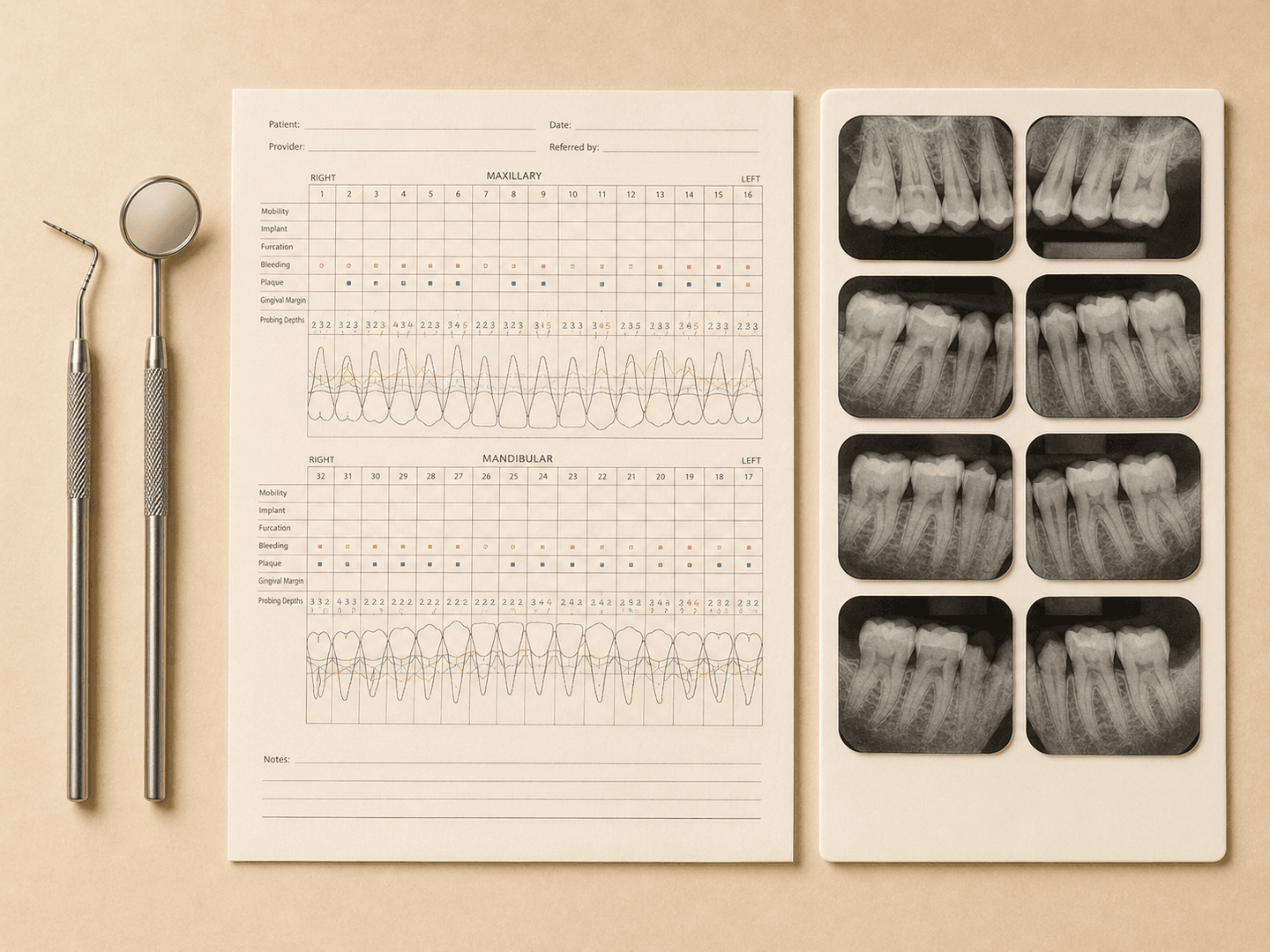
What D0150 covers
D0150 reports the full baseline workup, performed on a new patient or on an existing one who has not had a comprehensive evaluation within the carrier’s lookback window. The evaluation includes:
- Medical and dental history review.
- Intraoral examination of teeth, restorations, and prostheses.
- Extraoral examination of the head, neck, lymph nodes, TMJ.
- Oral cancer screening.
- Periodontal screening (probing, bleeding, mobility, recession).
- Review of any radiographs available.
- Treatment planning discussion with the patient.
- Risk assessment for caries, periodontal disease, and other conditions.
The evaluation is more thorough than a D0120 recall exam and produces a documented baseline that future recall visits compare against.
It does not cover:
- A periodic recall evaluation on an established patient inside the lookback window. Use D0120.
- A limited or problem-focused evaluation. Use D0140.
- A child under three years old. Use D0145.
- A periodontal-only evaluation. Use D0180.
- The radiographs taken at the visit. Those are separately billable (D0210, D0274, D0220, D0230, etc.).
- The prophylaxis if performed at the same visit. Use D1110, D1120, D4346, or D4910 depending on the periodontal status.
When to bill D0150
Bill D0150 when:
- A new patient comes to the practice for the first time.
- An established patient returns after a long absence (typically three or more years).
- An established patient’s clinical condition has changed substantially enough to warrant a re-comprehensive evaluation (significant new caries, periodontal status change, major restorative needs, treatment planning for prosthetics).
- The dentist performs the full scope of a comprehensive evaluation as documented above.
Do not bill D0150 for:
- An established patient’s routine recall visit. Use D0120.
- A patient presenting with a specific complaint (toothache, broken filling, swelling). Use D0140.
- A new patient under three years old. Use D0145.
- An exam limited to periodontal evaluation only. Use D0180.
The lookback window: how it works
Two layers govern D0150 on a returning patient. The ADA’s CDT descriptor sets when D0150 is coding-appropriate: a comprehensive evaluation is authorized for an established patient who has had a significant change in health conditions or other unusual circumstances (by report), or who has been absent from active treatment for three or more years. That three-year threshold and the significant-change pathway come from the ADA descriptor itself, not from any one carrier’s policy. Separately, the carrier’s lookback or frequency limit governs whether the plan pays the D0150 you’ve correctly coded.
Most carriers track when each patient last had a comprehensive evaluation and only pay D0150 again after their lookback window has expired.
Typical lookback patterns:
- Three years (most common). Delta Dental, most BlueCross plans, most employer-sponsored PPOs. The patient is eligible for D0150 again three years after the last D0150 on the claim history.
- Five years. Some employer-sponsored plans and individual marketplace plans.
- Lifetime once with this carrier. A small number of plans treat D0150 as a one-time benefit per patient. After the first D0150, every subsequent evaluation is D0120 regardless of how much time has passed.
D0150 frequency is most commonly tracked per patient per provider (per dentist or office), not across the carrier’s entire multi-provider claim history. So a genuinely new patient is normally eligible for D0150 at your office even if a prior, different office billed D0150 recently. Delta Dental and most major carriers apply the limit per provider, and ADA guidance is explicit that a patient who transfers offices is not a patient of record in the new office, so D0150 is appropriate for that first visit. A minority of plans aggregate evaluation history across providers, and referral combinations (a GP D0150 plus a specialist’s comprehensive or detailed eval, for example) can hit a shared frequency limit, so verifying benefits per plan is still prudent.
The best you can do during verification is ask the patient when they last had a comprehensive exam, and confirm eligibility for D0150 with the carrier. The eligibility rep can usually tell you whether D0150 is currently available for the patient based on the carrier’s records.
Top reasons D0150 gets denied
Four issues account for most denials:
- Frequency exceeded. The same provider or office already billed a D0150 for the patient within the lookback window. The carrier denies. Code as D0120 if the patient is otherwise within the established-patient parameters, but check the remaining evaluation allowance first, not just D0150-specific eligibility. Many plans apply a shared evaluation allowance (commonly two clinical oral evaluations per benefit period) that D0120, D0140, D0145, D0150, and D0180 all count against. If the patient already used that allotment (two D0120 recalls, or a D0120 plus a D0140 emergency visit), the D0120 re-code will also be denied. Note “benefit period,” not strictly “per year.” It may be calendar-year, plan-year, or rolling depending on the plan.
- Wrong eval code. D0150 billed on what was actually a periodic recall (should have been D0120) or a problem-focused visit (should have been D0140). The carrier may pay it at the lower allowable or deny for incorrect code.
- Plan limits D0150 to lifetime once. A small number of plans treat D0150 as a one-time benefit. The denial reads as “lifetime maximum reached” or “service previously rendered.” Code subsequent evaluations as D0120 even on patients who feel they deserve a comprehensive again after a long absence.
- Documentation insufficient. The clinical note doesn’t reflect the scope of a comprehensive evaluation. A “new patient seen, full exam, recommended cleaning” note doesn’t pass audit. The note needs to reflect medical history review, periodontal screening, oral cancer screening, occlusion, and documented treatment planning.
Documentation that supports the claim
The claim needs:
- Date of service.
- Indication that this is the patient’s first visit, or that the patient is an established patient eligible for D0150 under the carrier’s lookback rules.
For the patient record, document:
- Medical history reviewed and dated.
- Chief complaint and reason for the visit.
- Extraoral findings (lymph nodes, TMJ, muscles, occlusion).
- Intraoral findings (soft tissue, hard tissue, restoration status, missing teeth, prosthetics).
- Oral cancer screening (specific anatomic structures checked).
- Periodontal screening or full perio charting if indicated.
- Radiographs taken or reviewed.
- Diagnostic impressions and treatment plan.
- Patient education and recommendations.
A D0150 chart note should be visibly more thorough than a D0120 chart note. If the notes look identical, an audit will reclassify the visit as D0120 and demand the difference back.
D0150 vs D0120 on returning patients
This is where most coding mistakes happen. A patient comes back after 18 months. Two years. Five years. Is the visit D0150 or D0120?
The decision rule:
- If the carrier’s lookback window has elapsed since the last D0150 on the patient’s claim history, the visit can be D0150.
- If the lookback window has not elapsed, the visit is D0120 regardless of how the dentist conducted the exam.
The lookback measures from the last D0150, not from the last visit. A patient who has been coming in for D0120 recalls but hasn’t had a D0150 in over three years may be eligible for D0150 again if the carrier uses a three-year lookback.
This matters because patients who have been seen consistently sometimes accumulate enough time between comprehensive evaluations that a D0150 is appropriate. The dentist re-evaluates the full periodontal status, retakes baseline radiographs, and documents updated treatment planning. The visit is genuinely comprehensive, and the code should reflect that.
Same-day combinations
D0150 is routinely billed alongside other codes on a first visit or comprehensive re-evaluation:
- D0150 + D1110 (adult prophy): standard for an adult new patient with healthy gums.
- D0150 + D4346 or D4910 (periodontal cleaning): when the patient has perio rather than healthy gingiva.
- D0150 + D0210 (full mouth radiographs): standard for a new adult patient with no recent FMX.
- D0150 + D0274 (four bitewings): when an FMX isn’t indicated but bitewings are.
- D0150 + D0220 + D0230 (selected periapicals): when specific teeth need diagnostic films.
Each code reports separately on the claim and pays per the plan’s benefit category for that code.
Example case
A 34-year-old patient has not been to a dentist in five years. He’s relocating to the area and chooses your office. He presents for his first visit complaining of cold sensitivity on a posterior tooth and wanting a general check-up.
Billing steps:
- Verify the patient’s dental benefits. Confirm D0150 is currently eligible (carrier records show no D0150 in the last five years, well outside any lookback window).
- The dentist conducts a comprehensive evaluation: medical history, full exam, periodontal screening, oral cancer screening, occlusion assessment, treatment planning discussion. The cold-sensitive tooth is identified as a likely deep cavity and added to the treatment plan.
- The hygienist takes a full mouth series (D0210) and performs an adult prophylaxis (D1110). The gums are healthy enough for a standard prophy rather than perio therapy.
- Submit D0150, D0210, and D1110 on the date of service.
- The carrier pays each per the plan’s benefits. D0150 typically pays at 100% under preventive benefit. D0210 pays at preventive. D1110 pays at preventive.
The cold-sensitive tooth’s actual restorative treatment is scheduled for a separate visit and billed separately.
What to get right in your PMS
The specifics vary across Open Dental, Dentrix, Eaglesoft, Curve, and Carestream. The steps that matter:
- Verify D0150 eligibility during benefits verification, not at the chair. The eligibility rep can usually confirm whether D0150 is currently payable for the patient. Don’t rely on the patient’s self-reported history.
- Code by clinical and coding appropriateness; let the lookback window set your payment expectation. The ADA descriptor determines whether D0150 is the right code (new patient, three-plus-year absence, or a significant change in health conditions). The carrier’s lookback window determines whether the plan will pay it. A thorough recall exam on an established patient with no significant change and no qualifying absence is D0120, not D0150.
- Post the procedure on the date of service. Not the new patient’s appointment-booking date.
- Make the chart note reflect comprehensive scope. A D0150 visit with a D0120-sized chart note will get reclassified on audit.
- Don’t default D0150 for every new patient. Some new patients are children under three (D0145) or are presenting with a specific complaint and should be coded D0140.
If your office sees D0150 frequency denials more than occasionally, the cause is usually that benefits verification isn’t checking D0150 eligibility specifically for each new patient. Adding that one question to the verification call resolves most of these denials.
FAQs
- When should I bill D0150 versus D0120?
- D0150 is for a new patient's first visit, or for an established patient who has not had a comprehensive evaluation within the carrier's lookback window (typically three years). D0120 is for an established patient at a routine recall when a comprehensive evaluation is on file within the lookback window. The lookback window decides which code applies on an established patient's visit.
- How long is the typical lookback window before an established patient is eligible for D0150 again?
- Three years is the most common window across major carriers. Some plans extend to five years. The window is measured from the date of the last comprehensive evaluation, not from the patient's last visit. A patient who has been in for D0120 recalls but hasn't had a D0150 within the lookback can be eligible for D0150 again.
- Why did the carrier deny D0150 for frequency?
- The most common cause is that the same provider or office already billed a D0150 for this patient within the carrier's lookback window, since most carriers track D0150 frequency per patient per provider. A prior D0150 at a different office usually does not block a new patient's D0150, because the limit is normally applied per provider, though a minority of plans aggregate evaluation history across providers. Verify benefits per plan to confirm.
- Can D0150 be billed the same day as a prophy and X-rays?
- Yes. D0150, D1110 (prophy), and D0210 or D0274 (X-rays) are routinely billed together on a new patient's first visit. The codes report separately on the claim and each pays per the plan's benefit structure for that code category.
- Is D0150 only for new patients?
- No. D0150 is appropriate any time a comprehensive evaluation is performed, including for established patients who have not been seen in years (typically three or more) or for patients whose dental status has changed significantly enough to warrant a re-comprehensive evaluation. The code is defined by the depth of the evaluation performed, not by whether the patient is new to the practice.
Related codes
Need help billing this code?
We handle D0150 claims daily.
If your team is spending time on denials, narratives, or carrier follow-up for this code, our dental insurance verification service can take it off your plate. We work inside your PMS and post payments the same week.
CDT codes are maintained by the American Dental Association. This page is an editorial billing guide, not the official ADA code descriptor. Verify current coverage policies with each carrier before submitting claims.