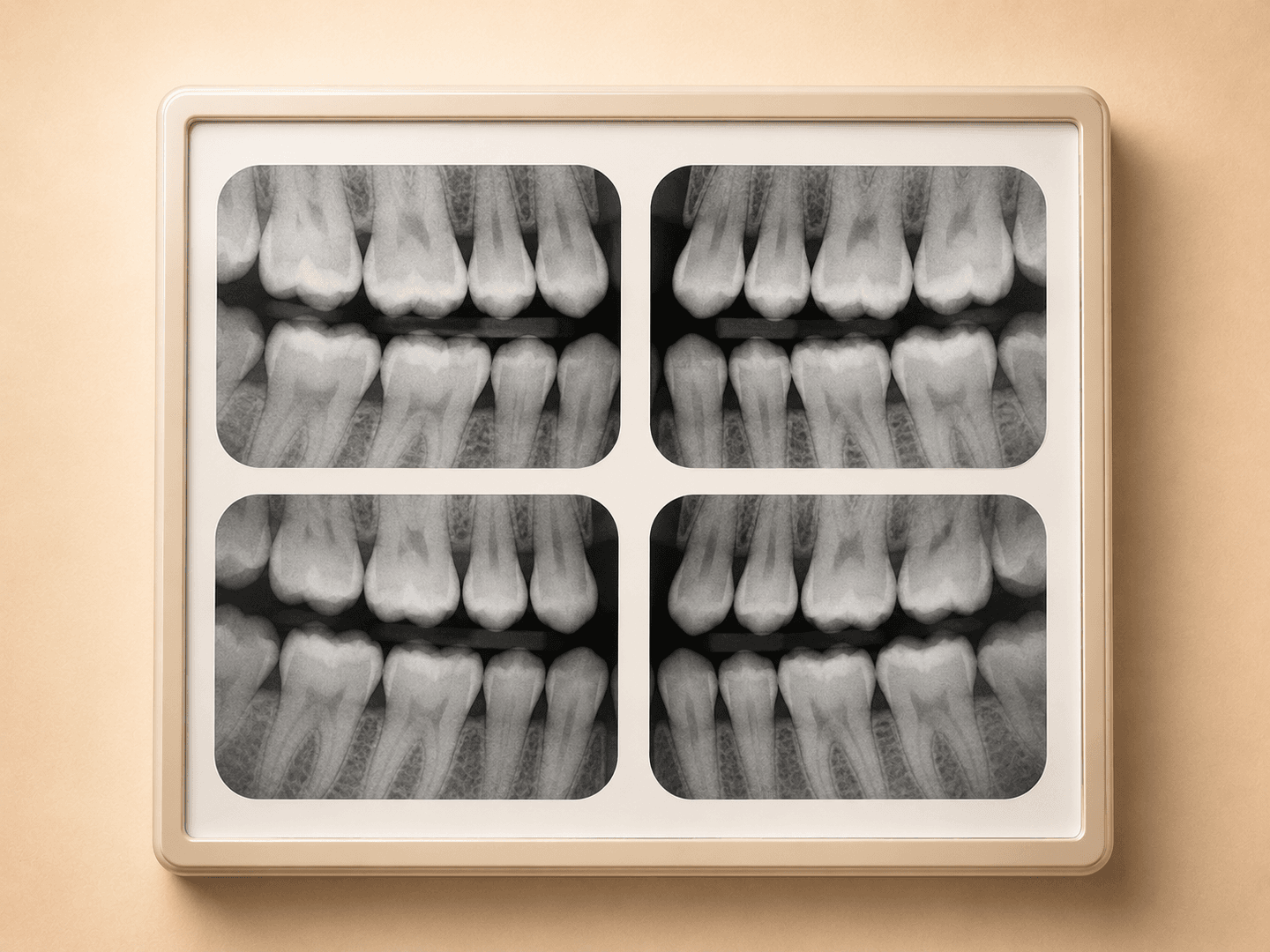
D0274 is the CDT code for a four-image bitewing set — the standard interproximal caries screening for adult patients, covering the premolars and molars on both sides.
What snags D0274 is almost always frequency limits (most plans pay once per benefit year), the bundling rule with FMX on the same date, or confusion with the smaller bitewing codes (D0270, D0272, D0273) when fewer films are taken.
What D0274 covers
D0274 reports a four-image bitewing set taken at one appointment. The films show the crowns of upper and lower posterior teeth in occlusion, designed to detect interproximal caries, evaluate marginal integrity of existing restorations, and assess bone level for periodontal screening. The standard adult bitewing series is four films covering the premolars and molars on both sides.
It does not cover:
- One bitewing. Use D0270.
- Two bitewings. Use D0272.
- Three bitewings. Use D0273.
- Periapical radiographs. Use D0220 and D0230.
- A full mouth series. Use D0210.
- Panoramic films. Use D0330.
The code reports the entire four-film series as one procedure. Quantity is 1, not 4.
When to bill D0274
Bill D0274 when:
- Four bitewing radiographs are taken at the same appointment.
- The films are diagnostic quality and document the interproximal surfaces of the upper and lower posterior teeth.
- The patient is at or beyond the plan’s bitewing frequency window since the last bitewing series.
Do not bill D0274 for:
- Fewer than four bitewings actually taken. Use D0270, D0272, or D0273 depending on the count.
- More than four bitewings (a vertical bitewing series of seven films is unusual but is billed differently in some practices).
- An FMX on the same date as D0274. The FMX’s full-mouth coverage already captures the interproximal surfaces.
When to use D0272 or D0273 instead
Bitewing codes are quantity-specific. The film count must match:
- D0270: one bitewing. Used rarely, typically for a follow-up film on a specific area.
- D0272: two bitewings. Often used on patients with limited posterior dentition, or on younger patients who only need posterior coverage of the molar areas.
- D0273: three bitewings. Less common. Sometimes used for patients with specific anatomical needs.
- D0274: four bitewings. Standard adult series.
Patients with full posterior dentition almost always get D0274. Patients missing posterior teeth, with implant prostheses, or with other reasons that limit needed coverage may get D0272 or D0273.
Submitting D0274 for a three-film series will get rejected or downgraded. Submitting D0273 for a four-film series underbills the procedure. The code on the claim should match the number of films actually taken.
The FMX bundling rule
D0210 (intraoral comprehensive series, FMX) is defined by full-mouth coverage (crowns, roots, periapical, interproximal, and alveolar-bone areas), not by a fixed set of films. (CDT 2023 removed the old “14–22 periapical and bitewing images” language; the dentist decides the type and number of images.) When a comprehensive series is taken, its interproximal coverage already captures what a four-bitewing set would show, so carriers expect D0210 to be the only radiograph code on that claim.
Billing D0274 alongside D0210 on the same date generates a bundling denial. The carrier either pays D0210 only and denies D0274, or denies both pending clarification.
The correct billing path when a full mouth series is taken:
- D0210 quantity 1. That’s it.
- Individual bitewings and PAs that make up the series are not separately billable on the same date.
If bitewings were taken separately from an FMX (different days, different clinical reasons), the codes report separately on their respective dates of service. Same-day billing of D0210 and D0274 is the bundling trigger.
Top reasons D0274 gets denied
Five issues account for most denials:
- Frequency exceeded. The patient had bitewings within the carrier’s frequency window. Most plans use 12 months. Some plans count 12 months exactly to the day. Others allow flexibility around the anniversary.
- Bundled with FMX. As described above. Same-day D0210 plus D0274 generates the bundling rule.
- Annual radiograph cap reached. The patient has consumed the plan’s annual radiograph maximum through other films. Additional bitewings exceed the cap.
- Wrong code quantity. D0274 is the four-film series code (quantity 1). Some practices accidentally bill D0274 quantity 4 (treating the code as per-film), which gets rejected.
- Wrong code for film count. D0274 was billed when fewer than four bitewings were actually taken. The carrier may reprocess at the lower-count code’s allowable.
Carrier frequency patterns
The frequency rule on bitewings varies by carrier:
- Delta Dental (most state plans): once per 12 months. Some Delta plans allow bitewings every six months on patients flagged as high caries risk.
- Aetna PPO: once per 12 months, with some plan-specific variation.
- Cigna: once per 12 months on most plans. Some employer plans allow every six months.
- MetLife: once per 12 months typical.
- United Concordia: once per 12 months. Military and federal plans (TDP/FEDVIP) sometimes have different rules.
- BlueCross BlueShield: varies widely by state and plan.
For new patients who had recent X-rays elsewhere, the frequency clock started at the previous appointment, not at the new patient’s first visit at your office. Verify the date of the most recent bitewings during eligibility.
Documentation that supports the claim
The claim needs:
- Date of service.
- Indication that four bitewings were taken.
For the patient record, document:
- Clinical reason for bitewings (routine caries screening, follow-up on suspected interproximal lesion, periodic assessment).
- Findings on the films (caries detected, restoration margins evaluated, bone levels normal or otherwise).
- Patient education and treatment planning based on findings.
Radiograph documentation is among the lowest-burden in dental charts, but a brief note on what was seen and what action was taken matters for audit and for continuity of care.
High caries risk patients
A subset of plans allow bitewings every six months instead of every twelve months on patients flagged as high caries risk. The risk classification typically requires:
- Active caries within the past 12 months.
- Multiple restored surfaces.
- Specific risk factors documented (xerostomia from medications or radiation therapy, frequent snacking, poor oral hygiene status, orthodontic appliances).
Documentation of high caries risk should be in the patient chart, ideally noted at the comprehensive evaluation. The chart note “patient is high caries risk” without supporting findings doesn’t usually pass carrier review. The documentation should specify what makes the patient high risk.
When billing bitewings on a high-risk patient at six months, attach a brief narrative to the claim noting the risk classification and the supporting clinical findings. Without it, the carrier defaults to the standard 12-month frequency rule.
Example case
A 42-year-old patient presents for her six-month recall. Her last bitewings were taken 12 months ago at the previous recall. She has a history of two interproximal caries detected and restored in the past three years and is flagged in the chart as moderate caries risk.
Billing steps:
- Verify the patient’s benefits and confirm she’s past the bitewing frequency window. Twelve months since the last bitewings clears most plan frequency rules.
- The hygienist takes four bitewings at the start of the recall visit.
- The dentist conducts the periodic evaluation (D0120), reviews the bitewings, and notes one suspicious interproximal area on tooth #14 for monitoring.
- The hygienist completes the adult prophy (D1110).
- Submit D0120, D0274, and D1110 on the date of service.
- The carrier pays each per the plan’s benefits. D0274 typically pays at preventive.
If the carrier denies D0274 for frequency, check the actual date of the last bitewings in the patient’s claim history. If the previous date was within the carrier’s lookback (sometimes calculated to the exact day rather than the recall anniversary), the patient owes for the films.
What to get right in your PMS
The specifics vary across Open Dental, Dentrix, Eaglesoft, Curve, and Carestream. The steps that matter:
- Match the code to the film count. Four films = D0274. Three films = D0273. Two films = D0272. One film = D0270.
- Quantity is always 1 on D0274. The code includes the four-film set. Billing quantity 4 will reject.
- Don’t itemize bitewings on an FMX claim. When a complete series was taken, bill D0210 only.
- Check the actual date of the patient’s last bitewings during verification. The carrier’s frequency clock is calendar-based, not recall-based.
- Add the high caries risk narrative when billing at six months. A six-month bitewing claim without supporting documentation will deny on most plans.
If your office sees D0274 frequency denials more often than expected, the cause is usually new patients whose previous bitewings were taken closer to their first visit than the chart suggests. Verification calls that ask the carrier directly for the last X-ray date on file resolve most of these.
FAQs
- What's the difference between D0272, D0273, and D0274?
- All three are bitewing series of different sizes. D0272 is two bitewings. D0273 is three bitewings. D0274 is four bitewings. The code that bills depends on how many films were actually taken. A four-film series billed as D0273 underbills the procedure. A three-film series billed as D0274 will be rejected for incorrect quantity.
- How often will the plan pay D0274?
- Most plans pay D0274 once per benefit year. Some plans allow two per year (one every six months) on patients flagged as high caries risk. A small number of plans limit bitewings to once every 18 or 24 months. Verify benefits before scheduling.
- Can I bill D0274 the same day as D0210 (FMX)?
- Usually no. D0210 is defined by full-mouth coverage (crowns, roots, periapical, interproximal, and alveolar-bone areas), so its interproximal coverage already captures what a four-bitewing set would show. Billing D0274 plus D0210 on the same date generates a bundling denial. If a full mouth series was taken, bill D0210 only.
- Why did the carrier deny D0274 when the patient was due?
- The most common cause is the lookback measured from the last bitewings. If the previous bitewings were billed within the carrier's frequency window (typically 12 months), the new claim denies. Always verify the actual date of the patient's last bitewings, especially for new patients who had X-rays at a previous office.
- Do bitewings count toward the annual radiograph maximum?
- Yes, on most plans. Plans that have a total radiograph dollar cap or film-count limit apply the cap across all radiograph types. Bitewings consume part of that cap. A patient who already had an FMX earlier in the benefit year may have exhausted the cap and additional bitewings deny.
Related codes
Need help billing this code?
We handle D0274 claims daily.
If your team is spending time on denials, narratives, or carrier follow-up for this code, our dental insurance verification service can take it off your plate. We work inside your PMS and post payments the same week.
CDT codes are maintained by the American Dental Association. This page is an editorial billing guide, not the official ADA code descriptor. Verify current coverage policies with each carrier before submitting claims.