D0270 is the CDT code for one bitewing X-ray — a single film showing the crowns and contact areas of the upper and lower back teeth, billed as one image rather than a set.
It is the code that gets misused most often in the bitewing family, usually by being billed when two or more images were actually taken.
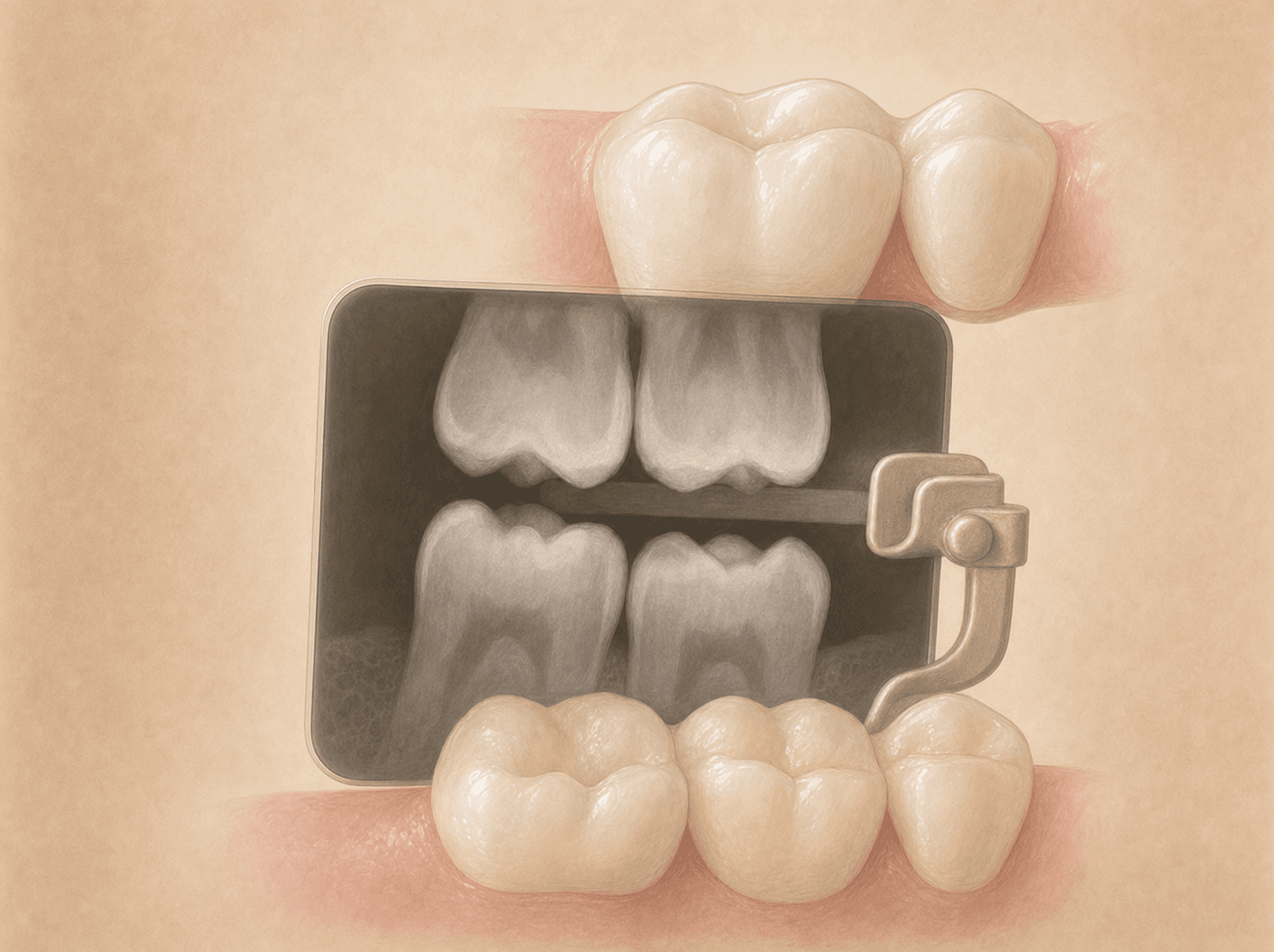
What D0270 covers
D0270 reports one bitewing X-ray, billed as a single image. A bitewing shows the crowns of the upper and lower teeth in one view, with the contact areas between adjacent teeth lined up so the dentist can read interproximal decay and check bone levels at the crest.
The defining fact about D0270 is the count: one image. The whole bitewing family is coded by how many images you take in the session, not by which teeth they show or why you took them.
It does not cover:
- Two bitewing images. That is D0272.
- Three bitewings (D0273) or four bitewings (D0274).
- A vertical bitewing set of seven to eight images. That is D0277, used for periodontal bone-level assessment.
- A periapical image, which shows the full length of the tooth down to the root apex. The first periapical is D0220 and each additional one is D0230.
- A full intraoral complete series. That is D0210.
When to bill D0270
Bill D0270 when the office captures exactly one bitewing image. That is the entire test. In practice a lone bitewing is most common for a focused recall on one quadrant, a follow-up on a single area of concern, or a child with a limited posterior contact to check.
If the session produces more than one bitewing, the single-image code is wrong. Move up the family to the code that matches the count.
How D0270 fits the rest of the bitewing family
The codes step up by image count, and that is the only axis that separates them:
- D0270 is one bitewing image.
- D0272 is two.
- D0273 is three.
- D0274 is four.
- D0277 is a vertical bitewing series of seven to eight images, used when the question is alveolar bone level rather than interproximal decay.
Read the count off the chart, then pick the one code that matches. There is no rule that says “use D0270 per image and let the carrier total them.” The set codes exist precisely so you bill one line for the set.
Bitewings versus periapicals versus the full series
This is where most diagnostic-imaging claims go sideways, so it is worth keeping straight:
- A bitewing (D0270 through D0277) is an interproximal view. It captures the crowns of the back teeth and the bone crest, not the root tips. Its job is finding decay between teeth and reading early bone loss.
- A periapical (D0220 first, D0230 each additional) captures the entire tooth, crown through root apex, plus the surrounding bone. Its job is the root and the area around it: abscess, fracture, retained root, pre-extraction assessment.
- A panoramic (D0330) is a single extraoral image of both arches, the jaws, and the sinuses.
- A complete series (D0210) is a comprehensive set of intraoral images, typically fourteen to twenty-two films combining periapicals and bitewings, meant to show the whole mouth.
A panoramic plus a handful of bitewings is not a complete series. Reporting that combination as D0210 is a known error and a clean reason for a carrier to adjust the claim.
Frequency limits carriers apply
Bitewings are one of the most frequency-restricted images in the book. Most plans allow bitewings on a set interval, commonly once or twice per benefit year, and the allowance almost always pools the whole bitewing family rather than tracking D0270 on its own. A single bitewing taken inside that window pays; one taken outside it denies on frequency.
The interval, whether it resets on a calendar year or a rolling twelve months, and whether children get a different allowance are all set by the individual plan. Treat any specific number as plan-dependent and confirm it during verification, not at the chair.
Documentation that supports the claim
A routine single bitewing rarely needs a narrative. When it does, the supporting facts are simple:
- The tooth or quadrant imaged and the clinical reason (recall, focused follow-up, decay check).
- The date of the prior bitewings, so a frequency question can be answered without a second request.
- The image itself, attached when the carrier asks for it or when the visit is outside the normal recall pattern.
Store the prior-image dates somewhere the billing team can see them. Most bitewing denials are frequency denials, and a frequency denial is answerable in seconds if the history is in front of you.
What to get right in your PMS
- Bill by image count, not by guesswork. One image is D0270, two is D0272, four is D0274. Match the code to what the assistant actually captured.
- Never bill D0270 in multiples for a set. Two units of D0270 is the single most common reason this code gets adjusted.
- Track the bitewing frequency per patient. The limit pools the whole family, so keep the last-taken date visible to whoever submits the claim.
- Keep bitewings, periapicals, and the complete series in separate lanes. D0270 is interproximal, D0220/D0230 are full-tooth, D0210 is the whole-mouth set. Mixing them is how clean claims turn into adjustments.
FAQs
- How is D0270 different from D0272?
- Count of images. D0270 is one bitewing image. D0272 is two. The bitewing codes are billed by how many images were captured in the session, so if the assistant took two films, the claim is D0272, not two units of D0270. Billing D0270 twice for a two-image set is a common error carriers catch.
- Can I bill D0270 and a periapical on the same visit?
- Usually yes, when both are clinically warranted, but it is plan-dependent. A bitewing (D0270) shows the crowns and contact areas of the back teeth; a periapical (D0220 for the first, D0230 for each additional) shows the whole tooth including the root tip. Some plans bundle same-day images into a series allowance, so check the EOB.
- How often will a carrier pay for bitewings?
- Most plans set a bitewing frequency, often once or twice per benefit year, and the limit usually pools all bitewing codes together rather than tracking D0270 separately. A single bitewing taken outside that window will deny on frequency. The exact interval is set by the plan, so verify it before the visit.
- If I take four bitewings, do I bill D0270 four times?
- No. Four bitewings is D0274, a single code for the four-image set. The family codes by image count: D0270 one, D0272 two, D0273 three, D0274 four, D0277 for a vertical set of seven to eight. Pick the one code that matches the number of images taken.
Related codes
Need help billing this code?
We handle D0270 claims daily.
If your team is spending time on denials, narratives, or carrier follow-up for this code, our dental insurance verification service can take it off your plate. We work inside your PMS and post payments the same week.
CDT codes are maintained by the American Dental Association. This page is an editorial billing guide, not the official ADA code descriptor. Verify current coverage policies with each carrier before submitting claims.