D0364 is the CDT code for a cone beam CT scan of a limited area, less than one whole jaw, where the same provider both captures and interprets the image, bundling the 3D scan and its diagnostic read into one line.
Miscoding comes down to two things. Field of view: D0364 is the smallest scan in the CBCT family, and using it for a full-arch or both-jaw scan undercodes the work. And the capture-plus-interpretation bundle: D0364 already includes the read, so pairing it with a capture-only code (D0380) or an interpretation-only code (D0391) for the same scan is duplicate billing that carriers will strip.
What D0364 covers
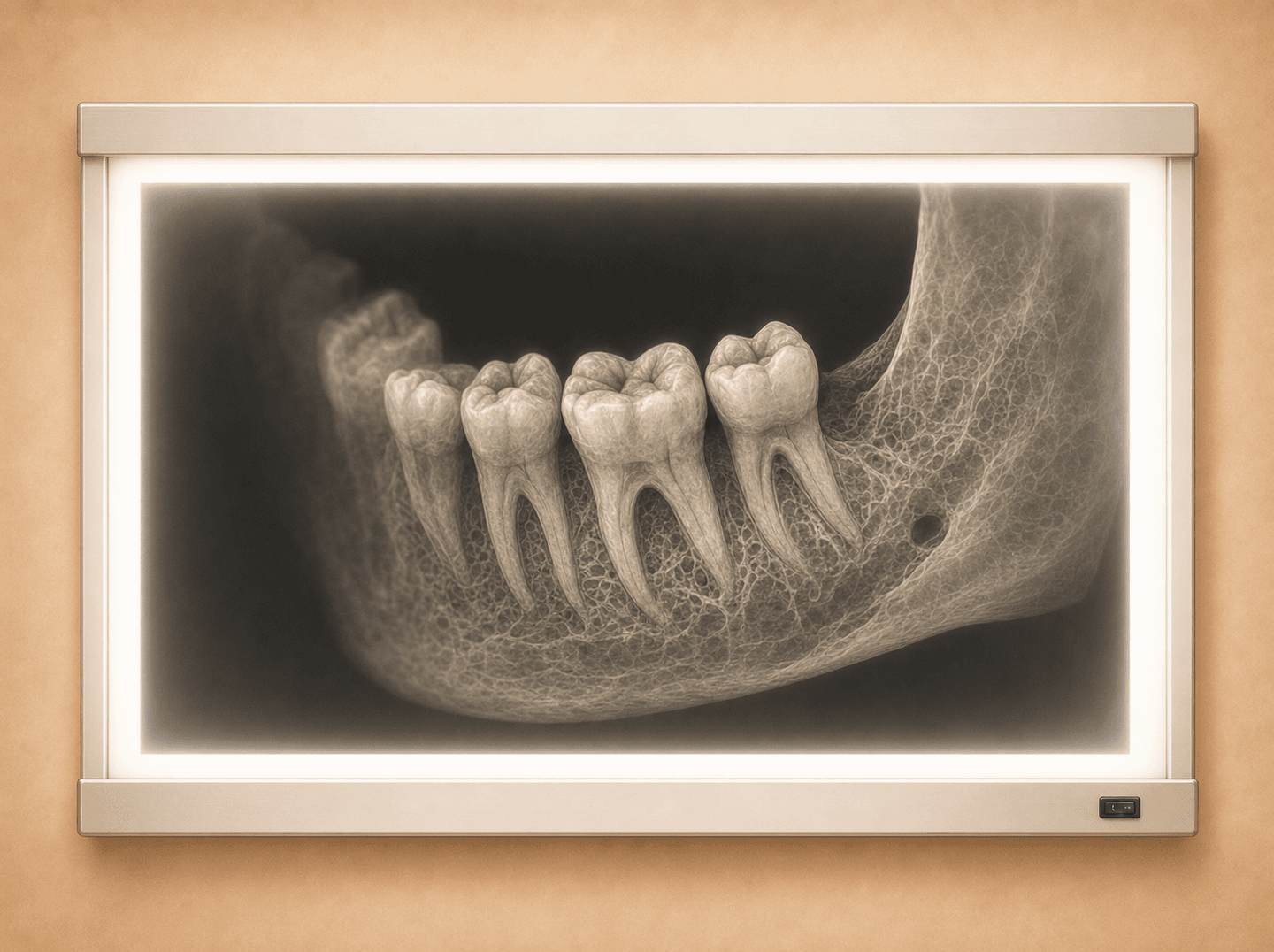
D0364 reports a cone beam CT scan of a limited area, less than one whole jaw, where the provider both captures the image and interprets it. The code bundles two pieces of work into one line: the 3D scan itself and the diagnostic read of that scan, with a written interpretation in the record.
The defining features are the field of view and the bundle. The field of view is limited, a focused volume around a specific site rather than a full arch. The bundle is capture plus interpretation, meaning the same provider who took the scan also read it. Both of those facts have to be true for D0364 to be the right code.
Common clinical situations for a limited CBCT:
- Locating a single impacted or ectopic tooth and its relationship to adjacent roots and nerves.
- Planning an implant at one site, where the bone volume and proximity to the sinus or the inferior alveolar canal matter.
- Evaluating a localized lesion, a suspected root fracture, or a focused endodontic problem that 2D films can’t resolve.
What D0364 is not
- A larger field-of-view scan. A full-arch or both-jaw scan is a different code. Use D0365 (full arch, mandible), D0366 (full arch, maxilla), or D0367 (both jaws, with or without cranium). D0364 is specifically the limited, less-than-one-jaw volume.
- Capture only. If the scan is taken by one provider and read by another, the capture is reported on its own. The capture-only twin of D0364 is D0380 (limited field of view, capture only). D0364 is not a capture-only code.
- Interpretation only. A read performed by a provider who did not take the scan is D0391. D0364 includes the interpretation, so it isn’t the code for a standalone read.
- A 2D radiograph. Panoramic and intraoral films are not CBCT. A panoramic image is D0330. A full-mouth intraoral series is D0210. D0364 is 3D cone beam imaging.
The first three of those turn on the two variables that pick every cone beam code, which the CBCT billing guide works through alongside the full code family.
D0364 versus the capture-only and interpretation-only codes
This is the distinction that separates D0364 from the codes it’s most often confused with. D0380, D0391, and D0364 can all touch the same limited scan, but they describe different scopes of work and rarely belong on the same claim.
D0364 (capture and interpretation) is the single-provider path. Your office owns the machine, takes the limited scan, and your provider reads it and writes the interpretation. One code covers the whole episode.
D0380 (capture only) is for the office that takes the scan but sends it out to be read. It reports the imaging without the interpretation, because the interpretation is coming from someone else.
D0391 (interpretation only) is for the reading provider, an oral and maxillofacial radiologist, for example, who receives a scan they did not capture and produces a diagnostic report. It reports the read without the capture.
Why D0364 gets denied
Two patterns account for most of it on a limited scan.
The first is the duplicate line. D0364 submitted alongside D0380 or D0391 for the same scan reports the capture or the read twice, and carriers strip it. Delta Dental’s processing policy treats the D0391 fee as included in the capture-and-interpretation codes and reprocesses a same-office pair back to the combined code.
The second is necessity on a focused question. Carriers pay cone beam as adjunctive imaging when a 2D film could not answer the clinical question, and a limited volume invites the reviewer to ask why a periapical did not settle it. Name the anatomy in the narrative: nerve or sinus proximity at a specific site, a suspected root fracture, a localized lesion that a flat image could not resolve.
The necessity standards, the frequency windows, and plans that carry no cone beam benefit at all are in the guide’s coverage, necessity, and frequency section.
Documentation that supports the claim
Two documentation facts are specific to D0364. The chart has to record that the captured volume was limited, less than one whole jaw, and name the imaged site, because that is what separates D0364 from D0365 and D0366 above it. And because D0364 bundles the read, a written interpretation report has to exist in the record; a combined code with no report behind it is the easiest audit finding there is.
The rest of what a cone beam claim needs is in the guide’s documentation that supports a cone beam claim section.
What to get right in your PMS
The setup item specific to D0364 is keeping it distinct from D0380, the capture-only code at the same field of view, with labels that name the difference. One fuzzy “CBCT” entry is how a single-office scan ends up billed as both a capture and a separate read. The rest of the cone beam setup is in setting up cone beam codes in your PMS.
FAQs
- What is the dental code for a CBCT scan?
- There isn't one CBCT code. There's a family, and the right one depends on two questions. First, how big is the scanned area (the field of view)? Second, did the same provider both take the scan and read it, or were those split between two providers? D0364 is the code for a limited field of view, less than one whole jaw, captured and interpreted by the same provider. Larger scans use D0365 (full arch, mandible), D0366 (full arch, maxilla), or D0367 (both jaws). If the scan is captured by one provider and read by another, the capture and interpretation get split into separate codes. Match the code to the actual field of view and to who did what.
- What's the difference between D0364 and D0380?
- Both cover a limited field of view, less than one whole jaw. The difference is interpretation. D0364 is capture and interpretation together: the provider takes the scan and reads it. D0380 is capture only: it reports taking the scan when someone else will interpret it, typically an oral radiologist who then bills the read separately under D0391. Use D0364 when your office both scans and interprets. Use D0380 only when the interpretation is genuinely being done by a separate provider. Billing D0364 and D0380 for the same scan is duplicate billing for the capture.
- Can I bill D0364 and D0391 together?
- Not for the same scan. D0364 already includes the interpretation. D0391 reports interpretation done by a provider who did not capture the image. They describe the same read from two different billing positions, so reporting both for one scan double-bills the interpretation. D0391 belongs with a capture-only code (D0380 for a limited field of view), used when the office that took the scan and the provider who reads it are different. If your office captures and reads its own limited CBCT, that's D0364 alone.
- How is the field of view defined for D0364?
- D0364 is for a limited field of view, less than one whole jaw, a focused volume rather than a full arch. If the scan captures a complete arch, it moves up to D0365 (mandible) or D0366 (maxilla). If it captures both jaws, with or without the cranium, it's D0367. The field of view is a scan setting, not a judgment call you make at billing, so the code should match what the machine actually captured. Document the imaged area in the chart so the code and the scan agree.
- Does insurance cover D0364?
- It depends on the plan, and CBCT coverage is more restrictive than routine radiographs. Many plans cover advanced 3D imaging only with documented clinical necessity, often tied to implant planning, surgical evaluation, or pathology, and many apply a frequency limit, which varies by plan and can run 12 months or longer. Some plans don't cover CBCT at all. Verify the specific plan's medical-necessity and frequency rules before the scan, and submit the interpretation report and clinical indication with the claim. Don't assume a routine-radiograph benefit extends to CBCT.
- Is D0364 a current CDT code?
- Yes. D0364 is an active code in CDT 2026, part of the cone beam CT capture-and-interpretation series (D0364 through D0368) that runs alongside the capture-only series (D0380 through D0384) and the standalone interpretation code D0391. It reports the smallest field of view in the capture-and-interpretation group: limited, less than one whole jaw.
Related codes
Need help billing this code?
We handle D0364 claims daily.
If your team is spending time on denials, narratives, or carrier follow-up for this code, our dental insurance verification service can take it off your plate. We work inside your PMS and post payments the same week.
CDT codes are maintained by the American Dental Association. This page is an editorial billing guide, not the official ADA code descriptor. Verify current coverage policies with each carrier before submitting claims.