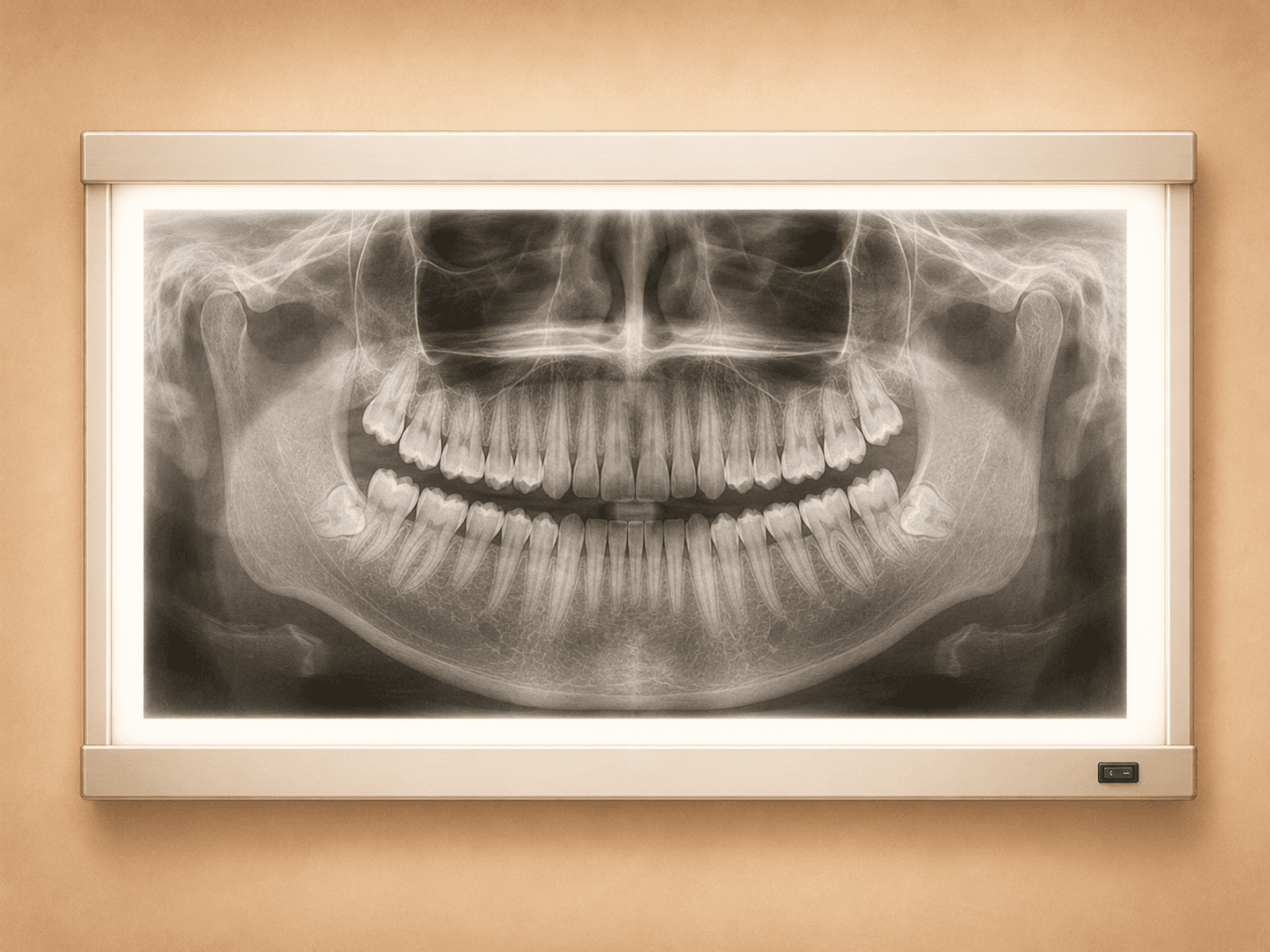
D0330 is the CDT code for one panoramic X-ray, a single curved exposure taken from outside the mouth that captures both arches, the condyles, and the sinuses, commonly shortened to a pano.
Most billing problems on it come from frequency overlap with D0210: many plans treat pano and FMX as alternates and count one against the other, so a recent FMX blocks a pano claim and the other way around.
What D0330 covers
D0330 reports a single panoramic radiographic image: one exposure capturing both arches, the condyles, the sinuses, and the surrounding bone in one curved film. It is the standard pano. The fee covers the image, the capture, and storage. It does not include interpretation as a separate billable service, the report, or any follow-up imaging like periapicals or CBCT.
It does not cover:
- A complete intraoral series. That’s D0210.
- Individual periapicals. Those are D0220 (first image) and D0230 (each additional).
- A bitewing series. Those are D0270, D0272, D0273, or D0274.
- Cone beam CT scans. Those are D0364 through D0368 (capture and interpretation) or D0380 through D0384 (image capture only), selected by field of view.
- A cephalometric film. That’s D0340.
- A digital pano analyzed for caries detection by software. The pano itself is still D0330. Software analysis is generally not separately billable.
When to bill D0330
Bill D0330 when:
- A single jaw-wide image is taken, typically for new-patient screening, third-molar evaluation, TMJ assessment, or pre-prosthetic planning.
- The clinical question is broad: condyle anatomy, sinus position, eruption sequence in mixed dentition, or the location of impacted teeth.
- The image is taken as a standalone and not as part of an FMX.
Do not bill D0330 for:
- A full-mouth series. Use D0210.
- A pano plus a few periapicals coded as one bundled service. Bill D0330 plus the appropriate periapical codes (D0220 for the first, D0230 for each additional).
- A CBCT. Those are in the D0364–D0368 (capture and interpretation) or D0380–D0384 (image capture only) ranges, selected by field of view.
- A small dental cone beam image labeled as a pano. Carriers cross-check the imaging type.
Top reasons D0330 gets denied
- Frequency overlap with D0210. Most plans treat the two as alternates: a recent FMX blocks a new pano and vice versa, usually inside a three to five year window.
- Recent pano on file. Plans typically pay one D0330 every three to five years on the same patient.
- Carrier wants the image. Pends or partial denials when the carrier needs to see the pano to adjudicate a downstream surgical or implant claim. Attaching the image at submission prevents this.
- Coded for the wrong image type. A CBCT billed as D0330 gets denied because the imaging types don’t match. The reverse happens too: a 2D pano billed as a CBCT pays at the CBCT rate but flags the account on audit.
- Submitted without the comprehensive exam. When a pano is taken at a new-patient visit, some carriers expect to see it paired with D0150. The pano alone, with no exam, can pend for clarification.
D0330 versus D0210
The two films answer different diagnostic questions. D0210 captures every tooth with full periapical detail of the roots and surrounding bone, plus interproximal coverage from the bitewings. D0330 captures the entire upper and lower arch in a single image, including the condyles and sinuses, at the cost of detail at any individual tooth.
Clinically:
- D0210 fits cases that need detailed assessment of individual teeth, root anatomy, periapical pathology, or restoration margins.
- D0330 fits cases that need a broad survey of the jaw: mixed dentition in pediatric patients, third-molar evaluation, TMJ structures, or post-trauma screening.
For billing, most plans treat them as alternates for frequency, not as additive procedures. A patient with a recent D0210 will typically hit the cap when D0330 is billed, and the other way around. A pano paired with a few periapicals on the same date is generally not D0210. Code D0330 plus the periapicals individually.
If the clinical case genuinely needs both on the same date, expect the carrier to pay one and deny or downgrade the other. A narrative explaining the clinical reason helps but does not override plan design.
Documentation that supports the claim
The claim needs:
- Date of service matching the date the image was captured.
- The image stored in the patient record, attached to the claim when supporting a downstream procedure.
- A short narrative if the pano is taken outside the normal frequency window (recent trauma, new clinical finding, surgical consult).
For the patient record, document:
- The clinical question that prompted the pano (third-molar evaluation, TMJ symptoms, edentulous planning).
- Findings reviewed on the image.
- Any treatment planning that depended on the imaging.
A chart entry of “pano taken” without a clinical rationale is thin. The chart should reflect that the image was read, not just exposed.
Example case
A 32-year-old new patient transfers to the practice and brings no prior imaging. The dentist orders a pano at the first visit to evaluate the third molars and establish a baseline of jaw and sinus anatomy. The hygienist also takes four bitewings for caries detection.
Billing steps:
- Verify the plan has not paid a D0210 or D0330 inside the frequency window.
- Code D0330 on the same claim as D0150 (comprehensive exam) and D0274 (four bitewings).
- Attach the pano if a third-molar extraction claim is likely in the next 90 days, or note in the record for later attachment.
- Expect the EOB to show D0150 and D0274 paid normally and D0330 paid if no recent pano or FMX is on file.
What to get right in your PMS
- Check the patient’s claim history for both D0210 and D0330 before scheduling either. The carrier’s frequency cap counts both against the same lookback window on most plans.
- Attach the pano image to the procedure claim, not just the patient record. Many systems store images at the patient level by default. The clearinghouse needs them linked to the specific claim line for surgical or implant claims.
- Don’t code a CBCT as D0330. Use D0364 through D0368 (capture and interpretation) or, when only the image is captured, D0380 through D0384, selected by field of view. Don’t reach into D0385–D0386, which are maxillofacial MRI and ultrasound, not CBCT. Cross-coding flags the account on audit.
- Submit D0330 with the comprehensive exam when it’s a new-patient visit. A standalone pano with no exam can pend for clarification.
- Note the clinical reason for the pano in the chart at the time of exposure. A narrative written from memory weeks later tends to be vague.
FAQs
- What is the dental code for a panoramic x-ray?
- D0330. It reports a single panoramic radiographic image covering both arches, the condyles, and the sinuses. Most plans pay one pano every three to five years and treat it as an alternate for the full-mouth series (D0210), so a recent FMX inside the frequency window will block a new pano claim and the other way around.
- Why does D0330 keep getting denied for frequency when the patient hasn't had a pano in years?
- The carrier is counting a prior D0210 (FMX) against the pano frequency. Most plans treat the two as alternates: a pano taken inside three to five years of an FMX bills as if the patient already had pano-level imaging. Verify the patient's last D0210 and D0330 date before scheduling either.
- Can I bill D0330 and D0210 on the same date?
- Usually one will deny. Carriers treat the two as alternates for frequency, not as additive procedures. If the clinical case genuinely needs both (a surgical consult that needs jaw-wide context plus periapical detail), expect the carrier to pay one and deny or downgrade the other. A narrative explaining the clinical reason helps but does not override the plan's frequency design.
- Does D0330 cover a cone beam CT?
- No. D0330 is a single two-dimensional panoramic image. Cone beam CT scans are coded in the D0364 through D0368 range (capture and interpretation, selected by field of view) or D0380 through D0384 (image capture only) depending on the field of view and reporting. Submitting D0330 for a CBCT is a coding error that gets denied and may flag the account.
- Do I need to attach the image when billing D0330?
- Many carriers don't require the image on the initial claim but will request it during adjudication, especially when the pano supports a downstream procedure (third-molar extractions, implant planning, TMJ workup). Attaching the image at submission shortens the cycle and prevents pends.
Related codes
Need help billing this code?
We handle D0330 claims daily.
If your team is spending time on denials, narratives, or carrier follow-up for this code, our dental insurance verification service can take it off your plate. We work inside your PMS and post payments the same week.
CDT codes are maintained by the American Dental Association. This page is an editorial billing guide, not the official ADA code descriptor. Verify current coverage policies with each carrier before submitting claims.