D0367 is the CDT code for a cone beam CT covering both jaws, where the same provider both captures and interprets the scan, with or without the cranium in the field of view.
The CBCT codes turn on two facts: how much anatomy the scan covers, and whether the provider who took the scan also read it. Get the field of view wrong and you've billed the wrong code even though the machine and the workflow are identical. D0367 bundles the capture and the read, so when one office takes the scan and a radiologist reads it, the work splits into two codes.
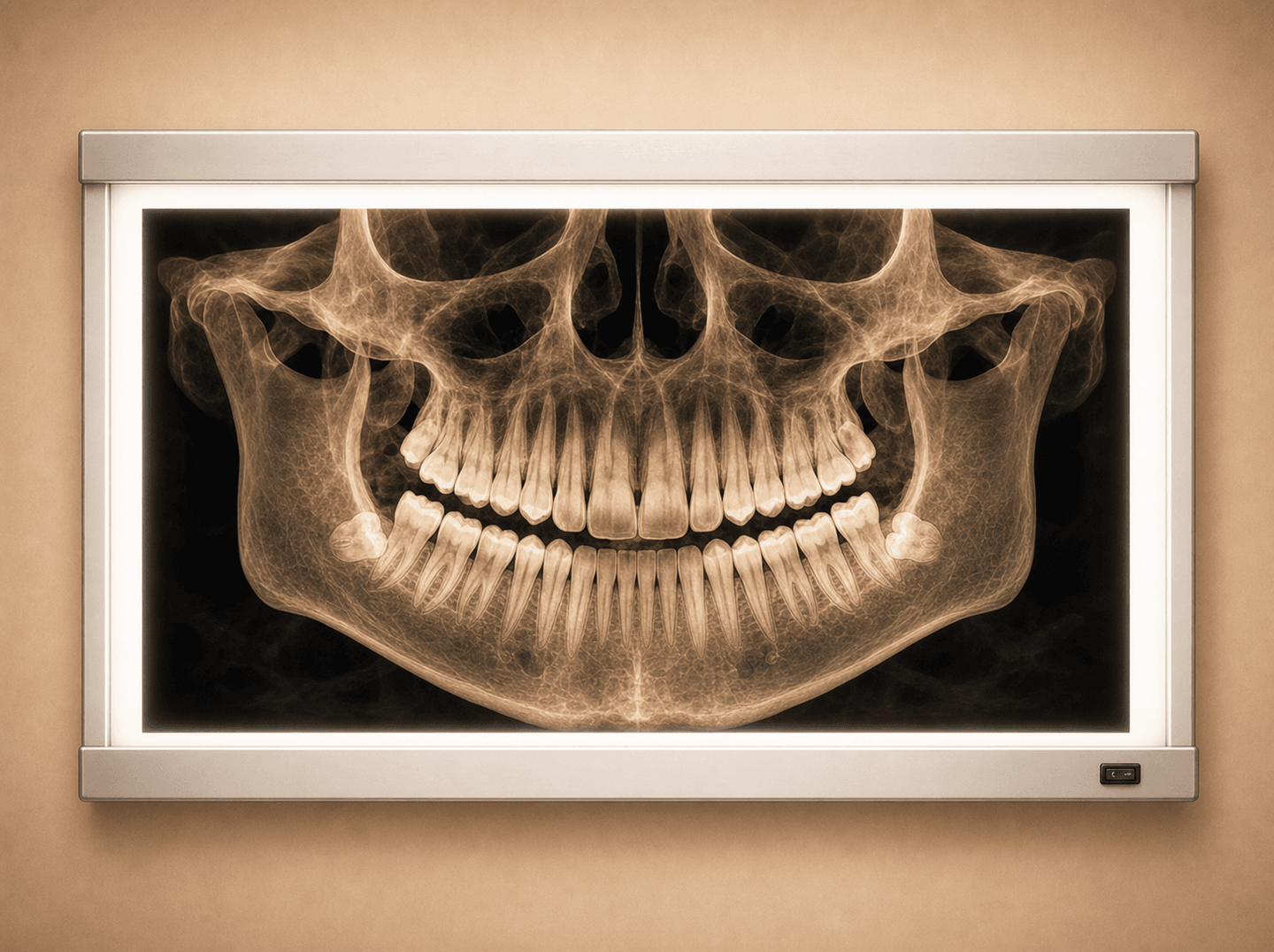
What D0367 covers
D0367 reports a cone beam CT scan whose field of view takes in both the upper and lower jaws, with or without the cranium, where the same provider captures the scan and interprets it. It covers the 3D acquisition, the reconstruction of the volume, the radiologic interpretation, and the report. One code, both halves of the work.
The defining feature is the field of view. CBCT codes are not separated by the machine, the reason for the scan, or the anatomy of interest. They’re separated by how much of the patient the scan volume covers. D0367 is the largest of the dental-arch field-of-view codes: both jaws in one volume.
The “with or without cranium” language matters less than it sounds. Whether the scan captures cranial structures doesn’t change the code. Jaw coverage changes the code. If the volume includes both arches, it’s D0367 regardless of how much skull came along with it.
Where D0367 gets upcoded
D0367 sits at the top of the field-of-view ladder, which makes it the highest-fee code in the capture-and-interpretation series and the one carriers look at hardest. The error they are looking for is upcoding into it. A focused block of bone around a few teeth is D0364. A volume that stops at one arch is D0365 or D0366. Only a volume that actually captured the second dental arch is D0367, and a reviewer opening the reconstruction can count the arches. The full cone beam code family, including the TMJ codes that sit outside the field-of-view ladder, is laid out in the CBCT billing guide, along with how to choose the field of view.
Capture and interpretation: when D0367 splits
D0367 bundles the capture and the read, and that bundle holds when one provider does both. When the office takes the scan and an unassociated practitioner reads it, the capturing office bills D0383, the capture-only twin at the both-jaws field of view, and the reading practitioner bills D0391. The test for whether the work has actually split is professional association rather than distance, and the guide works it through in when capture and interpretation split.
Coverage reality: verify, and consider medical
The coverage problem specific to D0367 is size. A both-jaws volume draws more scrutiny than a limited scan, on the theory that a smaller field should have settled a focused question, and it carries the highest fee in the family when it denies. Some plans hold the large-volume codes to a longer frequency cycle than the limited ones, and some carry no cone beam benefit at all. The general rules on necessity, frequency, and what a carrier will and won’t recognize are in coverage, necessity, and frequency.
The high fee on a both-jaws scan is the reason medical crossover comes up on D0367 more than on the smaller fields of view. Surgical planning, pathology, trauma, and TMJ evaluation are the indications that tend to carry a scan to the medical plan, and the medical allowable for 3D maxillofacial imaging sometimes beats what a limited dental imaging benefit pays. Which CPT code to use, which indications medical plans commonly exclude, and what the workflow demands are covered in billing cone beam to medical.
Documentation that supports the claim
The one documentation fact specific to D0367 is that the record has to show the volume covered both arches, because that is what supports D0367 over the single-arch and limited codes. Record the protocol or preset name and the volume dimensions from the scan log on the date of service. The rest of what a cone beam claim needs is in documentation that supports a cone beam claim.
When to bill D0367
Bill D0367 when your office captures a cone beam CT covering both jaws and the same provider interprets it. Common situations:
- Implant planning across both arches, or where the scan field naturally takes in both.
- Evaluation of pathology, impacted teeth, or anatomy where a both-jaws volume is clinically indicated.
- Surgical or orthodontic assessment requiring a full both-arches 3D dataset.
Do not bill D0367 for:
- A scan limited to one arch (use D0365 for mandible, D0366 for maxilla) or a sub-arch region (D0364).
- A scan your office captured but a separate radiologist interpreted. Use D0383 for the capture, and the radiologist bills D0391.
- A 2D panoramic (D0330) or intraoral series (D0210). Those are different procedures and different imaging entirely. A panoramic view reconstructed out of the same cone beam acquisition is a separate question, covered in the same-acquisition panoramic.
What to get right in your PMS
The one setup item specific to D0367 is keeping it distinct from D0383, the capture-only code at the same field of view, so a scan your office sent out to be read doesn’t post as a one-provider service by default. The rest of the setup, including how to label the field-of-view codes and where to flag cone beam for verification, is in setting up cone beam codes in your PMS.
FAQs
- What is the dental code for a cone beam CT of both jaws?
- D0367, when the same provider both captures and interprets the scan. The CBCT codes are split by field of view, not by the machine or the reason for the scan. D0364 is a limited view of less than one whole jaw. D0365 is one full arch of the mandible (lower). D0366 is one full arch of the maxilla (upper). D0367 is both jaws, with or without the cranium. One code in the series sits outside that ladder: D0368 is a TMJ series of two or more exposures, chosen by what was imaged rather than by arch coverage. For the rest, pick the code that matches how much anatomy the scan actually covers.
- What's the difference between D0367 and D0383?
- Both describe a CBCT of both jaws, but they report different work. D0367 is capture and interpretation together, billed when one provider does both. D0383 is image capture only, billed when the office takes the scan but a different practitioner reads it. When the capture and the interpretation are split between two providers, the capturing office bills D0383 and the reading radiologist bills D0391 (interpretation and report by a practitioner not associated with the capture). You don't bill D0367 and D0383 for the same scan. One or the other applies depending on who interprets.
- Can I bill D0330 (panoramic) and D0367 on the same day?
- It depends on how the panoramic image was produced. If you take a separate 2D panoramic with the pan machine, that's a distinct procedure. But many CBCT units generate a panoramic projection from the same scan data, and when the pan comes out of the 3D acquisition rather than a separate exposure, billing both for the same exposure is generally not supported. If the panoramic was a genuinely separate image, document it as such. Carrier edits in this area are strict, so check the plan's bundling rules before submitting both.
- Does dental insurance cover D0367?
- It varies widely by plan. CBCT is more likely to be covered when it's tied to a specific clinical need the carrier recognizes, such as implant planning, evaluation of impacted teeth, or assessment of pathology, and many plans want a narrative establishing why 3D imaging was necessary over conventional radiographs. Frequency limits and field-of-view restrictions are common. Some plans don't cover CBCT under the dental benefit at all, which is one reason these scans often go to medical. Verify the specific plan and run a predetermination on elective cases before scanning.
- Should D0367 go on the dental claim or the medical claim?
- Often medical, depending on the indication and the patient's coverage. CBCT performed for surgical planning, pathology, trauma, or TMJ evaluation frequently meets a medical plan's criteria and may pay better there than under a limited dental imaging benefit. Medical billing uses a CPT code and an ICD-10 diagnosis rather than the CDT code, plus documentation of medical necessity. Practices with implant or surgical volume often build the medical workflow for exactly this reason. Offices that bill dental only should still verify whether the dental plan covers CBCT before assuming it's a write-off.
Related codes
Need help billing this code?
We handle D0367 claims daily.
If your team is spending time on denials, narratives, or carrier follow-up for this code, our dental insurance verification service can take it off your plate. We work inside your PMS and post payments the same week.
CDT codes are maintained by the American Dental Association. This page is an editorial billing guide, not the official ADA code descriptor. Verify current coverage policies with each carrier before submitting claims.