D2150 is the CDT code for a two-surface amalgam filling on a primary or permanent tooth, placed as one connected preparation.
- When to use: One connected amalgam preparation covers exactly two surfaces, such as mesial-occlusal or occlusal-buccal.
- When not to use: One surface is D2140, three surfaces is D2160, and a two-surface posterior composite is D2392.
- Billing note: Carriers pay D2150 at the D2140 rate when the record supports only one surface, so name both surfaces in the operative note and attach the pre-op film.
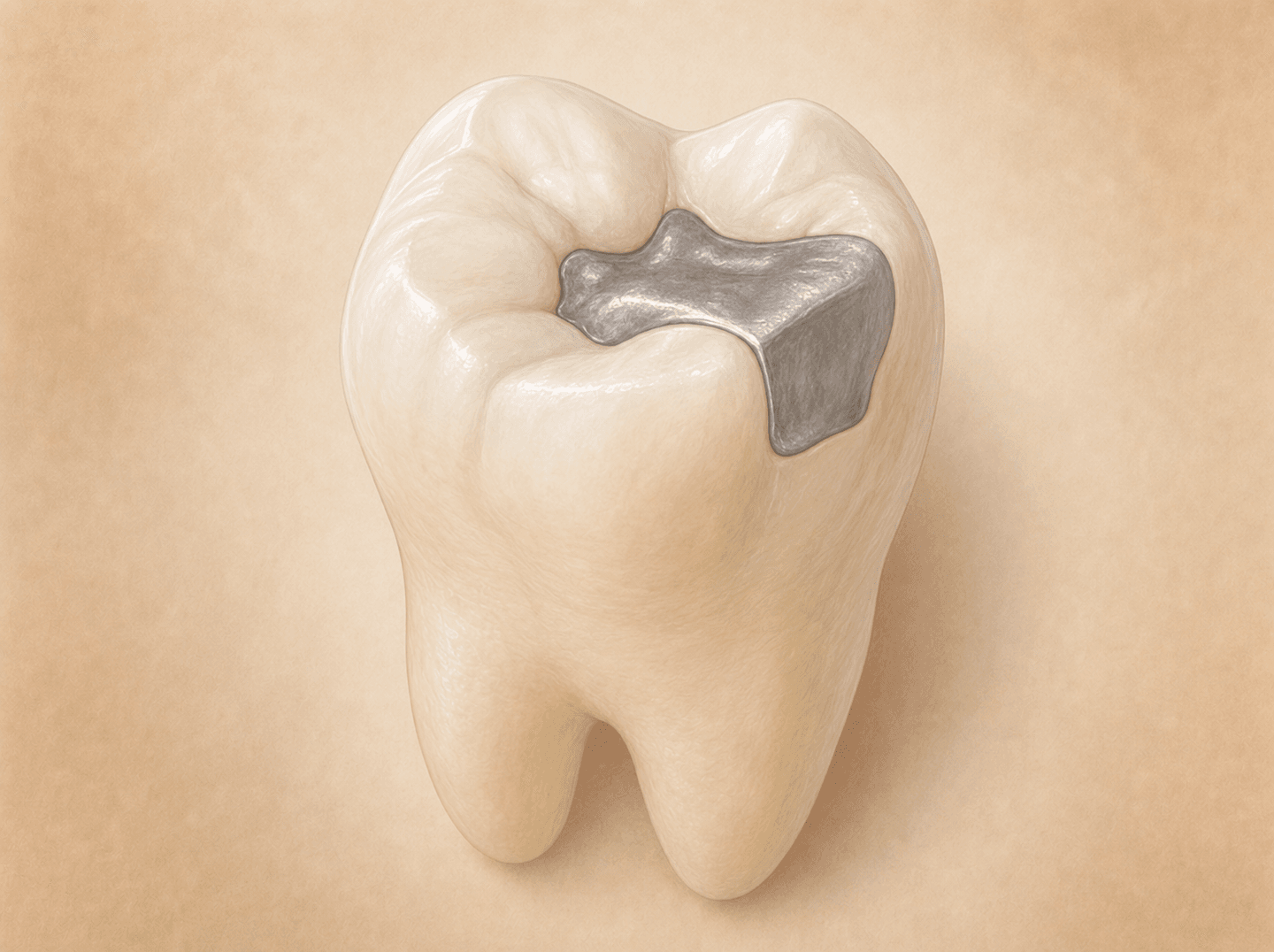
What D2150 covers
D2150 reports an amalgam restoration that involves two surfaces of a primary or permanent tooth in one connected preparation. Amalgam is the silver-colored material. Tooth-colored composite has its own series.
The five surfaces are mesial, distal, occlusal (incisal on front teeth), buccal (facial), and lingual. A filling that wraps from the top of a molar down one side is occlusal-buccal. A filling between two teeth that also involves the chewing surface is mesial-occlusal. Both are two surfaces.
It does not cover:
- A one-surface amalgam. That is D2140.
- A three-surface amalgam. That is D2160.
- A four-or-more-surface amalgam. That is D2161.
- A composite (tooth-colored) filling. Posterior composites are the D2391 through D2394 series; anterior composites are D2330 through D2335.
- A core buildup staged toward a crown. That is D2950.
The amalgam family is built on surface count
The D2140-to-D2161 series describes one procedure, an amalgam filling, separated only by how many surfaces the restoration involves. The tooth, the dentition, and the material grade never change the code.
- D2140 is one surface.
- D2150 is two surfaces.
- D2160 is three surfaces.
- D2161 is four or more surfaces.
Because the code is the surface count, the surface count is what carriers audit.
When to bill D2150
Bill D2150 when you place an amalgam filling and the connected preparation involves exactly two surfaces. Common two-surface preparations are occlusal-buccal, occlusal-lingual, mesial-occlusal, distal-occlusal, and mesial-buccal.
Two separate fillings on the same tooth that are not connected are reported by the surfaces each restoration covers. Splitting one connected restoration into separate claims is unbundling and an audit risk.
Top billing problems with D2150
Most trouble here is not a flat denial. It is the carrier paying less than the code you submitted.
- Surface-count downgrade. The carrier concludes only one surface was truly involved and pays the D2140 benefit. This is the most common D2150 adjustment. It is plan-dependent and turns on the documentation.
- Composite-to-amalgam downgrade. On plans with a least-expensive-alternative-treatment (LEAT) clause, a two-surface posterior composite is paid at the D2150 amalgam benefit. Here D2150 is the benchmark, not the submitted code. See the composite section below.
- Frequency limitation. Many plans limit how often they pay for a restoration on the same surface of the same tooth. A repeat filling within the plan’s window is the patient’s expense.
- Unbundling flag. Splitting one connected two-surface restoration into two single-surface claims is recoverable on audit.
Surface counting that holds up
- Count only the surfaces the restoration involves in one connected preparation.
- The occlusal counts once even when the filling crosses it into two proximal boxes. A mesial-occlusal-distal restoration is three surfaces (D2160) because mesial, occlusal, and distal are three distinct surfaces.
- Wrapping a cusp does not add a surface. The surface is named by the anatomical face involved, not by the contour of the prep.
A mesial-occlusal filling is two surfaces (D2150); an occlusal-only filling is one (D2140). If the operative note says “occlusal” and the claim says D2150, the carrier downgrades to D2140 and is correct to do so.
Documentation that supports the count
- An operative note naming each surface restored, for example “MO amalgam, #19.”
- A pre-op radiograph showing the extent of decay across the surfaces involved, especially for proximal (mesial or distal) involvement.
- The material recorded as amalgam, so the code matches the restoration.
The patient record should also give the tooth number and the reason for the restoration. A note that reads “filling, #19” does not support a two-surface code if the carrier asks for review.
D2150 versus the composite codes
Amalgam and composite are different materials with different codes:
- Amalgam, two surfaces: D2150.
- Posterior composite, two surfaces: D2392.
- Anterior composite, two surfaces: D2331.
When a plan has an LEAT clause and you place a posterior composite, the carrier may reimburse at the amalgam rate (D2150 for two surfaces) and apply the difference to the patient. Submit the composite code you actually performed; only the carrier’s benefit calculation drops to the amalgam level. Submitting the amalgam code for a composite is a misrepresentation, not a workaround for the downgrade.
Read the plan’s posterior-composite language before quoting a composite patient, so they hear about the difference before treatment rather than on the EOB.
Example case
An established adult patient has decay on the mesial surface of tooth #30 that extends onto the occlusal. After caries removal, the dentist places one connected amalgam restoration covering the mesial and occlusal surfaces.
Billing steps:
- Confirm one connected preparation across two surfaces: mesial and occlusal.
- Code D2150 with an operative note reading “MO amalgam, #30.”
- Attach the pre-op radiograph showing the mesial decay if the plan requires films on restorations.
- Read the EOB. If the plan pays D2150 as billed, post it. If it downgrades to D2140, check the operative note against the count before appealing.
FAQs
- What counts as a surface for D2150?
- Any two of the five surfaces: mesial, distal, occlusal (or incisal on anterior teeth), buccal (facial), and lingual. Common examples are occlusal-buccal and mesial-occlusal. The count is the surfaces actually restored, not the number of separate fillings placed.
- Why did the carrier pay D2150 as a one-surface filling?
- The plan reviewed the radiograph or narrative, concluded only one surface met its definition of involvement, and paid the D2140 benefit. This surface-count downgrade is plan-dependent. A clear pre-op film and an operative note naming each surface restored are the documentation most likely to hold the two-surface count.
- Can I bill two separate one-surface fillings instead of D2150?
- No, not when they are one connected preparation. A single restoration spanning two surfaces is D2150. Splitting it into two D2140 claims to increase the benefit is unbundling, which carriers catch and recover on audit.
- Does D2150 get downgraded when I place a composite instead?
- It works the other way: D2150 is the amalgam benchmark some plans downgrade composites to. If you place a posterior composite (D2391 for one surface, D2392 for two) and the plan has a least-expensive-alternative-treatment clause, the carrier may pay only the amalgam benefit and the patient owes the difference. Check the plan's posterior-composite language before quoting the patient.
- Is D2150 used on both baby teeth and adult teeth?
- Yes. The amalgam codes D2140 through D2161 apply to primary and permanent teeth and are selected by surface count, not dentition. There is no separate primary-tooth amalgam code in this series.
Related codes
Need help billing this code?
We handle D2150 claims daily.
If your team is spending time on denials, narratives, or carrier follow-up for this code, our outsourced dental insurance billing service can take it off your plate. We submit the claims, post what comes back, and follow up on anything unpaid.
“Claims, posting, denials, all of it gets handled, and it costs far less than hiring another employee. My front desk got hours of their week back, and honestly I just don't think about billing anymore.”
CDT codes are maintained by the American Dental Association. This page is an editorial billing guide, not the official ADA code descriptor. Verify current coverage policies with each carrier before submitting claims.