D2750 is the CDT code for a single-unit, full-coverage porcelain-fused-to-metal crown on a natural tooth where the metal coping is high noble alloy — more than 60% noble metal, with at least 40% of that being gold.
The trouble is almost always one of three things — metal content mismatched to the alloy actually used, alternate-benefit downgrades from carriers who pay only the base-metal allowable on posterior teeth, or confusion between D2750, D2751, and D2752.
On this page
- What D2750 covers
- When to bill D2750
- The metal-content rule that decides the code
- Top reasons D2750 gets denied or downgraded
- Alternate benefit downgrades
- D2750 vs D2740: when to choose which
- Documentation that supports the claim
- Waiting periods and major restorative classification
- Example case
- What to get right in your PMS
- FAQs
What D2750 covers
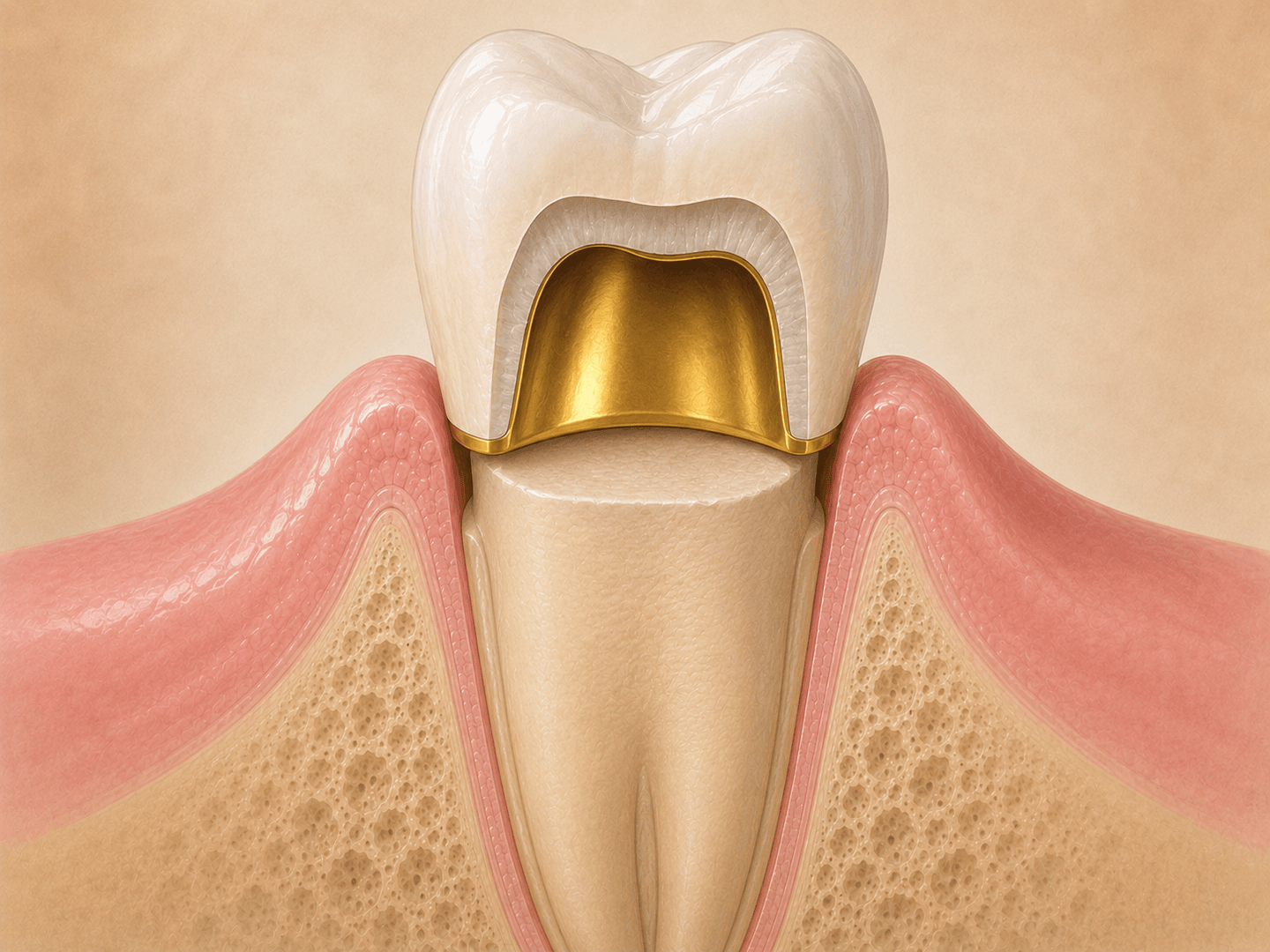
D2750 reports a single-unit, full-coverage porcelain-fused-to-metal crown on a natural tooth. The metal substructure is high noble alloy, defined by the ADA as containing more than 60% noble metal content (gold, platinum, palladium, iridium, osmium, rhodium, ruthenium) with at least 40% gold. The porcelain is layered over the metal coping for the visible portion of the crown. The code applies to permanent teeth only.
It does not cover:
- An all-ceramic or all-porcelain crown. Use D2740.
- A PFM crown with a predominantly base metal substructure. Use D2751.
- A PFM crown with a noble (not high noble) metal substructure. Use D2752.
- A full cast crown with no porcelain. Use D2790 for high noble, D2791 for predominantly base metal, D2792 for noble.
- A PFM crown on an implant abutment. Use the D6060 series.
- A PFM bridge retainer crown. Use D6750.
- A porcelain veneer. Use D2961 or D2962.
The metal class is what distinguishes D2750 from D2751 and D2752. Coding the wrong metal class is the most common avoidable denial on this code.
When to bill D2750
Bill D2750 when:
- A full-coverage PFM crown is fabricated and seated on a prepared natural tooth.
- The lab slip confirms the metal substructure is high noble alloy.
- The crown replaces a failing existing restoration on a tooth that cannot support a direct restoration.
- The tooth has had root canal therapy and needs full coverage to prevent fracture.
- A fractured cusp or cracked tooth requires full coverage.
Do not bill D2750 for:
- A crown with a base metal or noble metal substructure. Use the correct code by metal class.
- Provisional crowns. Use D2799.
- Crowns on implants. Use D6060 series.
- Crowns serving as bridge retainers. Use D6750.
The metal-content rule that decides the code
The ADA defines three metal classes for PFM crowns:
- High noble (D2750): more than 60% noble metal, at least 40% gold.
- Noble (D2752): at least 25% noble metal, below the high noble threshold.
- Predominantly base metal (D2751): less than 25% noble metal.
The lab slip tells you which one. Most labs print the alloy composition on the slip itself. If the slip only names the alloy by trade name, look up the composition. Common high noble alloys include Olympia, IPS d.SIGN 91, and various proprietary high-gold mixes that clear both the 60%-noble and 40%-gold thresholds. Common base metal alloys include nickel-chromium and cobalt-chromium.
The dentist usually selects the alloy when sending the case. If the lab substitutes a different alloy without notification (which sometimes happens with rush cases), the code on the claim should reflect what was actually used, not what was originally ordered. Submitting D2750 on a crown that was actually fabricated in base metal is incorrect coding and can trigger audit problems if the carrier requests the slip.
Top reasons D2750 gets denied or downgraded
Five issues account for most problems on this code:
- Alternate-benefit downgrade to D2751. The most common scenario. Many plans pay any PFM crown on a posterior tooth at the D2751 (base metal) allowable. This is a benefit limitation written into the plan. The carrier isn’t disputing that the high noble crown was placed. They’re saying the plan only pays the base-metal rate on that tooth.
- Wrong metal class submitted. Practice submits D2750 when the actual alloy was base metal (should have been D2751). The carrier may pay it without question or may request the lab slip. If the slip shows base metal, the claim gets reprocessed at the D2751 allowable and the practice owes the carrier the difference.
- No pre-op radiograph on file. Most carriers require a pre-op X-ray showing the tooth’s condition. Submit one with the initial claim instead of waiting for the request.
- Frequency limit on a replacement crown. Most plans allow one crown per tooth every 5 to 10 years. A replacement crown inside the window will pend or deny without strong narrative and documentation of the clinical failure on the previous crown.
- Anterior tooth on a plan with cosmetic exclusions. A small number of plans treat D2750 on anterior teeth as cosmetic and exclude it. Most do not, but a few employer-sponsored plans carry this exclusion explicitly. Verification should catch this before treatment.
Alternate benefit downgrades
The most common billing issue with D2750 is identical to D2740: the alternate-benefit downgrade. The pattern:
- You submit D2750 at office fee.
- The carrier processes the claim and applies the alternate-benefit clause.
- They pay D2750 at the D2751 (base metal) allowable.
- The difference becomes patient responsibility.
The downgrade isn’t questioning your clinical choice. It’s stating that the plan’s benefit on that tooth tops out at the base-metal allowable. The patient owes the difference between your office fee and the downgraded allowable, minus whatever portion the plan paid.
D2750 vs D2740: when to choose which
A practice typically decides between D2750 and D2740 at the treatment-planning step, not at the billing step. The factors:
- Posterior molars under heavy occlusion: PFM (D2750) holds up better long term. All-ceramic on a heavy bruxer can chip.
- Visible anterior teeth: D2740 (all-ceramic) gives better esthetics. The metal substructure of D2750 can show through at the gum line over time as the tissue recedes.
- Patient with a metal sensitivity: D2740 avoids the metal entirely.
- Patient with a tight budget on a noble-metal alloy: D2751 is more cost-controllable than D2750. Discuss before the lab case goes out.
From a billing standpoint, D2740 and D2750 have similar allowables on most plans. The downgrade pattern on posterior teeth applies equally to both. The choice is clinical, not financial.
Documentation that supports the claim
The claim needs:
- Pre-operative radiograph showing the tooth’s condition (caries, fracture, failing restoration, or post-RCT status).
- Date of service matching the seat date, not the prep date.
- Correct tooth number. Double-check before submission.
- Narrative for any case with unusual circumstances (replacement crown, recent extraction history, minor patient, large structural loss).
For the patient record, document:
- Why a direct restoration isn’t viable.
- Material selected and shade.
- The lab slip with alloy composition. Keep this in the patient record even though it isn’t sent with the claim.
- Occlusal contacts verified.
- Margins evaluated post-cementation.
Replacement crowns
If this replaces an existing crown:
- Note the date the original crown was placed.
- Note the reason for replacement (fracture, recurrent decay, margin failure, patient request for upgrade).
- Include a pre-op radiograph showing the failure on the previous crown.
Without these, the claim will pend for frequency limit. A “patient wanted a new crown” reason will not pass an audit. The replacement needs a clinical justification.
Waiting periods and major restorative classification
D2750 is typically classified as major (Class III) restorative on most plans. Common waiting periods on new policies:
- 6 months on most employer-sponsored plans.
- 12 months on some individual and marketplace plans.
- 24 months on a small number of group plans.
- None on union plans and some government plans.
Verify the waiting period before treatment. A claim submitted during the waiting period will deny, and the practice owes the patient a refund if it collected based on estimated coverage.
Example case
A 52-year-old patient presents with a fractured upper-right first molar (tooth #3). The tooth has a large failing amalgam restoration and recurrent decay. The dentist preps the tooth, sends the case to the lab specifying a high noble alloy (Olympia or equivalent), and seats the PFM crown two weeks later.
Billing steps:
- Verify the patient’s plan has no remaining frequency limit on tooth #3 (no prior crown on file).
- Confirm the patient has cleared any major-restorative waiting period.
- Confirm with the lab that the alloy used was actually high noble. If the lab substituted noble (not high noble), the correct code is D2752.
- Submit D2750 at office fee. Attach the pre-op radiograph and a one-line narrative noting the fracture and failing restoration.
- Watch the EOB for an alternate-benefit downgrade to D2751. If the plan downgrades, post the carrier’s payment at the downgraded amount and bill the patient the difference. Most molars downgrade on most plans.
- If the claim denies outright, pull the EOB, read the denial reason, and either correct and resubmit or appeal with additional documentation.
What to get right in your PMS
The specifics vary across Open Dental, Dentrix, Eaglesoft, Curve, and Carestream. The steps that matter:
- Code the procedure as D2750 only when the lab slip confirms high noble alloy. If you’re not sure, check the slip before posting. Submitting the wrong metal class is one of the most common audit issues on PFM crowns.
- Post on the seat date, not the prep date. This drives the date of service the carrier reads. Patients who switch insurance between prep and seat can lose coverage on the claim if the prep date is used.
- Attach the pre-op radiograph to the claim itself. Many systems store images at the patient level. The clearinghouse needs the image linked to the specific claim.
- Add a narrative before submission when the case has anything unusual. A replacement crown inside a frequency window, a minor patient on a noble-alloy crown, or a crown placed after recent extraction work all benefit from a one-line note up front.
- Confirm the fee comes from your office fee schedule, not the carrier’s allowable. Submitting at the allowable corrupts dual-coverage math and prevents proper write-off accounting on alternate-benefit downgrades.
If your office is seeing repeated downgrades to D2751 and the patient ledger isn’t being adjusted correctly, the root cause is usually that the practice is treating the downgrade as a denial instead of as a benefit limitation. The fix is on the posting workflow, not the claim itself.
FAQs
- What's the difference between D2750, D2751, and D2752?
- All three are porcelain fused to metal crowns. The difference is the metal substructure. D2750 is high noble (more than 60% noble metal, at least 40% gold). D2751 is predominantly base metal (less than 25% noble metal). D2752 is noble metal (at least 25% noble, but less than the D2750 threshold). The lab slip should tell you which alloy was used. Coding the wrong metal class is one of the most common D2750 errors.
- Why did Aetna pay D2740 at the D2751 allowable?
- Many plans apply an alternate-benefit clause on posterior teeth. The plan considers a base-metal PFM (D2751) functionally adequate for a molar, so they pay any higher-grade crown (D2740, D2750, D2752) at the D2751 allowable. This is a plan limitation, not a denial. The patient owes the difference unless the office writes it off.
- Can I bill D2750 for a crown with a gold alloy substructure?
- Yes, when the alloy is high noble (above the noble and gold thresholds). If it's pure gold or a high-gold alloy and you don't layer porcelain over the entire surface, you may be looking at D2790 (full cast high noble) instead. Check the lab slip and confirm the design with the dentist before submitting.
- Do I need to send the lab slip to the carrier with the claim?
- Usually no. Carriers don't require lab slips with the initial claim. They may request the slip if they're auditing the metal class. Keep the slip in the patient record. If the claim pends for metal documentation, you have it ready.
- When should I use D2750 versus D6750?
- D2750 is a single-unit crown on a natural tooth. D6750 is a retainer crown that supports a bridge pontic. Coding a bridge retainer as D2750 is a common preventable denial because the code doesn't signal that the crown is part of a fixed partial denture.
Related codes
Need help billing this code?
We handle D2750 claims daily.
If your team is spending time on denials, narratives, or carrier follow-up for this code, our outsourced dental insurance billing service can take it off your plate. We work inside your PMS and post payments the same week.
CDT codes are maintained by the American Dental Association. This page is an editorial billing guide, not the official ADA code descriptor. Verify current coverage policies with each carrier before submitting claims.