D2783 is the CDT code for a three-quarter crown made of porcelain or ceramic, covering most of the tooth while leaving one wall natural.
- When to use: A ceramic restoration covers the biting surface and most axial walls but spares one intact wall, so it is neither a full crown nor an onlay.
- When not to use: A full ceramic crown is D2740, a cast-metal three-quarter crown is D2780 to D2782, and a facial porcelain veneer is D2962.
- Billing note: Reviewers may reclassify D2783 as an onlay or a veneer, so send a narrative and image showing which walls the preparation covers.
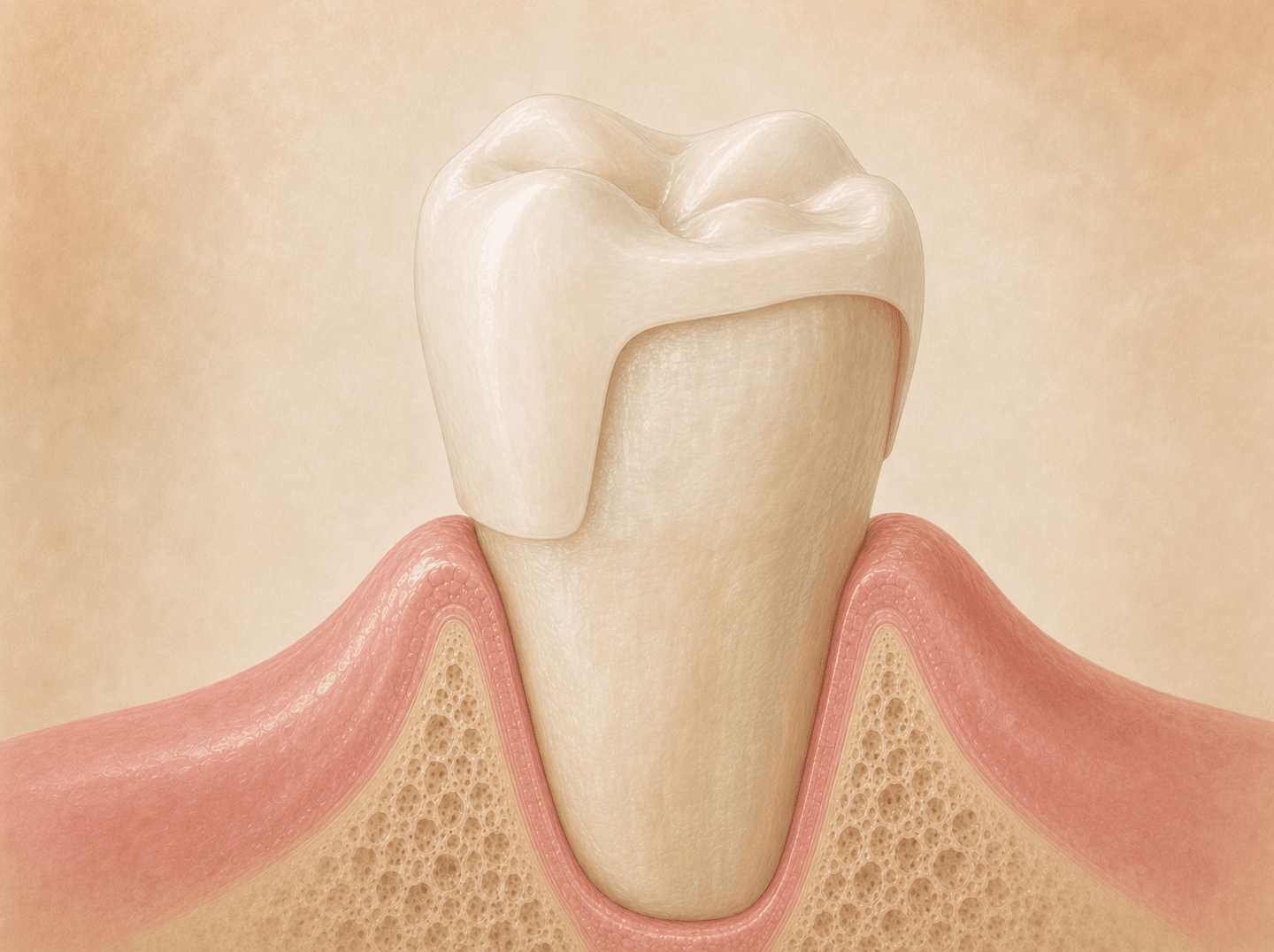
Where D2783 sits on the coverage ladder
Ceramic indirect restorations are coded by how much of the tooth they cover:
- Onlay: caps one or more cusps and rebuilds the biting surface. Ceramic onlays code by surface count, up to D2644 for four or more surfaces.
- Three-quarter crown (D2783): a crown preparation that reduces the occlusal surface and extends down most of the axial walls, sparing one wall in natural tooth.
- Full crown: every wall covered. In ceramic that is D2740.
A veneer, D2962, sits outside this ladder because it covers the facial surface only.
The line a reviewer tests is between steps 1 and 2. An onlay can involve four or five surfaces, so surface count alone does not prove a three-quarter crown. What proves it is axial reduction down the walls, the same preparation a crown gets, stopping short of one face.
The three-quarter material ladder
Natural-tooth three-quarter crowns split by material, in this order:
| Code | Material |
|---|---|
| D2780 | High noble metal |
| D2781 | Predominantly base metal |
| D2782 | Noble metal |
| D2783 | Porcelain/ceramic |
Two traps in that grid. Base metal (D2781) comes before noble (D2782), the same order as the full-cast crowns. And there is no titanium three-quarter crown, even though the full-cast family has one.
Payer treatment varies by material
Plans do not treat the four three-quarter codes alike. California’s Medi-Cal 2026 criteria are a clear example: D2781 and D2783 are covered with prior authorization, arch and periapical radiographs, and a once-in-five-years limit for patients 13 and older, while D2780 and D2782 are not a benefit at all.
Commercial plans vary just as much. Some exclude three-quarter crowns, and some apply an alternate benefit and pay at the rate of a different restoration. A predetermination shows which applies before the case goes to the lab.
Denial scenario: the lab slip says one thing, the note another
The dentist preps tooth #12, an upper premolar with failing interproximal composites and a sound buccal wall. The lab prescription reads “lithium disilicate 3/4 crown,” but the clinical note, written from a template, reads “ceramic onlay MODL.” The office bills D2783.
The carrier’s reviewer sees the note, reprocesses the claim as a four-surface ceramic onlay, and pays the D2644 rate.
The appeal needs what the note left out: a narrative stating that the preparation reduced the mesial, distal, and lingual walls and the occlusal surface while leaving the buccal wall intact, plus the pre-op radiograph and an intraoral photo of the prep. The fix for next time is in the note template: name the spared wall and describe the axial reduction on every three-quarter crown.
FAQs
- Is D2783 a veneer code?
- No. A porcelain veneer bonded to the front of a tooth is D2962, even when it wraps onto the proximal surfaces or incisal edge. D2783 needs a crown preparation that reduces the biting surface and most of the tooth's axial walls.
- Does it matter which wall is left uncovered?
- The code's nomenclature names the material, not which wall stays natural. A classic three-quarter crown spares the facial wall and a reverse design spares the lingual, and the descriptor draws no line between them. The chart should still name the spared wall, because that is what shows the reviewer it is a three-quarter preparation.
- What is the bridge version of D2783?
- D6783. When a three-quarter ceramic crown serves as a retainer that supports a pontic, it reports under the fixed prosthodontic retainer code, not D2783. Billing a bridge abutment as a single-tooth crown invites a code-mismatch denial.
- Does zirconia count as ceramic for D2783?
- Yes. Zirconia and lithium disilicate are both ceramics, so a three-quarter crown in either material is D2783. If the restoration is composite resin instead, the indirect resin three-quarter crown code is D2712.
Related codes
Need help billing this code?
We handle D2783 claims daily.
If your team is spending time on denials, narratives, or carrier follow-up for this code, our outsourced dental insurance billing service can take it off your plate. We submit the claims, post what comes back, and follow up on anything unpaid.
“Claims, posting, denials, all of it gets handled, and it costs far less than hiring another employee. My front desk got hours of their week back, and honestly I just don't think about billing anymore.”
CDT codes are maintained by the American Dental Association. This page is an editorial billing guide, not the official ADA code descriptor. Verify current coverage policies with each carrier before submitting claims.