D2953 is the CDT code for each additional custom-cast post placed in the same tooth as a D2952 cast post and core.
- When to use: A multi-rooted tooth gets its cast post and core on D2952, and the lab makes a second post for another canal in the same tooth.
- When not to use: The first cast post is D2952, an extra stock post alongside D2954 is D2957, and a loose post and core is recemented on D2915.
- Billing note: Many plans pay nothing extra for D2953 beyond the D2952, so check the plan before quoting the patient for the second post.
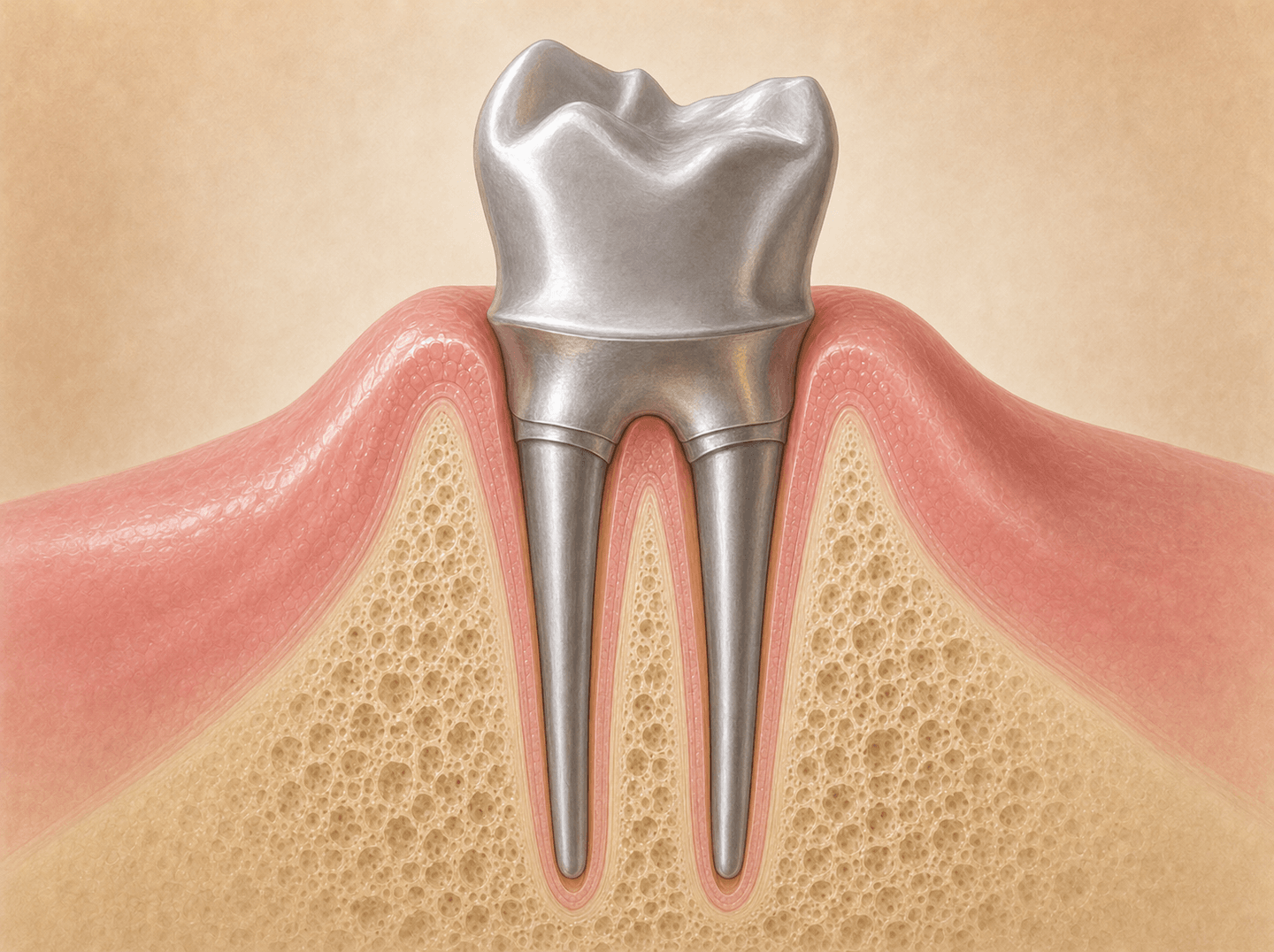
One core, more than one post
D2952 already includes a post and the core built on it, cast as a custom unit, usually by a lab. D2953 adds only the post. It is reported once for each extra custom post the tooth receives, never for the core.
The typical case is a molar or two-rooted premolar where a single post cannot give the core enough retention. The lab fabricates a post for a second canal, sometimes as a sectional casting that keys into the main post and core. Each post beyond the first is one unit of D2953.
Count posts, not canals treated. A molar with three obturated canals and two cast posts bills D2952 once and D2953 once.
Match the add-on to the first post
The additional-post codes are split by fabrication method, the same axis that separates the primary post and core codes.
| First post and core | Each additional post on the same tooth |
|---|---|
| D2952, cast (indirectly fabricated) | D2953 |
| D2954, prefabricated | D2957 |
Crossing them is a common miscode, and carriers can check the add-on against the primary post code on the same tooth. When every post is prefabricated, the claim is D2954 plus D2957, and D2953 does not appear. The note should say how each post was made.
A core buildup with no post in the canal is D2950, so D2953 never rides with it.
Codes that should not share the claim
D3950. Canal preparation and fitting of a preformed dowel or post is D3950. Its CDT descriptor rules it out alongside the post and core codes when the same practitioner places the post, because preparing the canal is part of placing it. PEHP’s 2026 guide, for one, treats D3950 as bundled into the related procedure.
Recementing. If a cast post and core comes out intact and is recemented, that is D2915. A recement never generates a new D2952 or D2953.
Removing an old post. Taking out an existing post before placing a new one is D2955, a separate procedure from placing the new posts.
How carriers treat the extra post
Payment on D2953 is thin. PEHP’s 2026 CDT code guide lists D2953 and D2957 as not covered, while D2952 is covered once per permanent tooth in five years after root canal therapy. Medi-Cal Dental’s fee schedule pays D2952 but marks D2953 and D2957 as global, meaning included in another procedure and not paid separately.
Not covered and bundled are different outcomes for the patient balance. A service the plan excludes may be billable to the patient; a service the plan treats as included in another payment often is not, for a contracted provider. Read the EOB remark and the provider agreement before posting a patient charge.
Example: a lower first molar with two cast posts
Tooth #30 has had root canal therapy and lost most of its coronal structure. The dentist preps post space in the distal canal and the mesiobuccal canal and takes an impression for a two-piece casting.
At the seat visit the claim reads D2952 for the post and core on #30, and D2953 once for the second post, same tooth, same date. The note names both canals, states the posts were custom cast, and attaches the post-op radiograph showing both posts. The crown goes on a later claim.
Under a plan like PEHP, the D2952 line pays and the D2953 line comes back not covered. Under a plan that bundles it, the D2953 line shows as included in the D2952 allowance.
FAQs
- Can D2953 be billed without D2952?
- No. D2953 is an add-on that only makes sense on the same tooth and date as a D2952 cast post and core. On its own line, a carrier has no primary procedure to attach it to and is likely to reject or deny it. If the first post was prefabricated, the add-on is D2957, not D2953.
- What is the difference between D2953 and D2957?
- How the extra post is made. D2953 is an additional indirectly fabricated (custom-cast) post and pairs with D2952. D2957 is an additional prefabricated (stock) post and pairs with D2954. The add-on has to match the fabrication method of the post and core it accompanies.
- Does insurance pay for D2953?
- Often not as a separate line. PEHP's 2026 code guide lists D2953 as not covered, and Medi-Cal Dental marks it global, meaning it is treated as part of another procedure and not paid on its own. Commercial plans vary, so verify the plan's rule and whether a disallowed add-on can be billed to the patient under your contract.
Related codes
Need help billing this code?
We handle D2953 claims daily.
If your team is spending time on denials, narratives, or carrier follow-up for this code, our outsourced dental insurance billing service can take it off your plate. We submit the claims, post what comes back, and follow up on anything unpaid.
“Claims, posting, denials, all of it gets handled, and it costs far less than hiring another employee. My front desk got hours of their week back, and honestly I just don't think about billing anymore.”
CDT codes are maintained by the American Dental Association. This page is an editorial billing guide, not the official ADA code descriptor. Verify current coverage policies with each carrier before submitting claims.