D2954 is the CDT code for a stock prefabricated post cemented into a root canal treated tooth, with the core built up around it.
- When to use: A root canal treated tooth lacks the structure to hold a crown, and a stock metal or fiber post is cemented chairside.
- When not to use: A custom lab-made post and core is D2952, a buildup with no post is D2950, and each extra prefabricated post on the tooth is D2957.
- Billing note: Many plans bundle the post and core into the crown or deny it without pre-op and post-op x-rays, so verify the plan and attach both films.
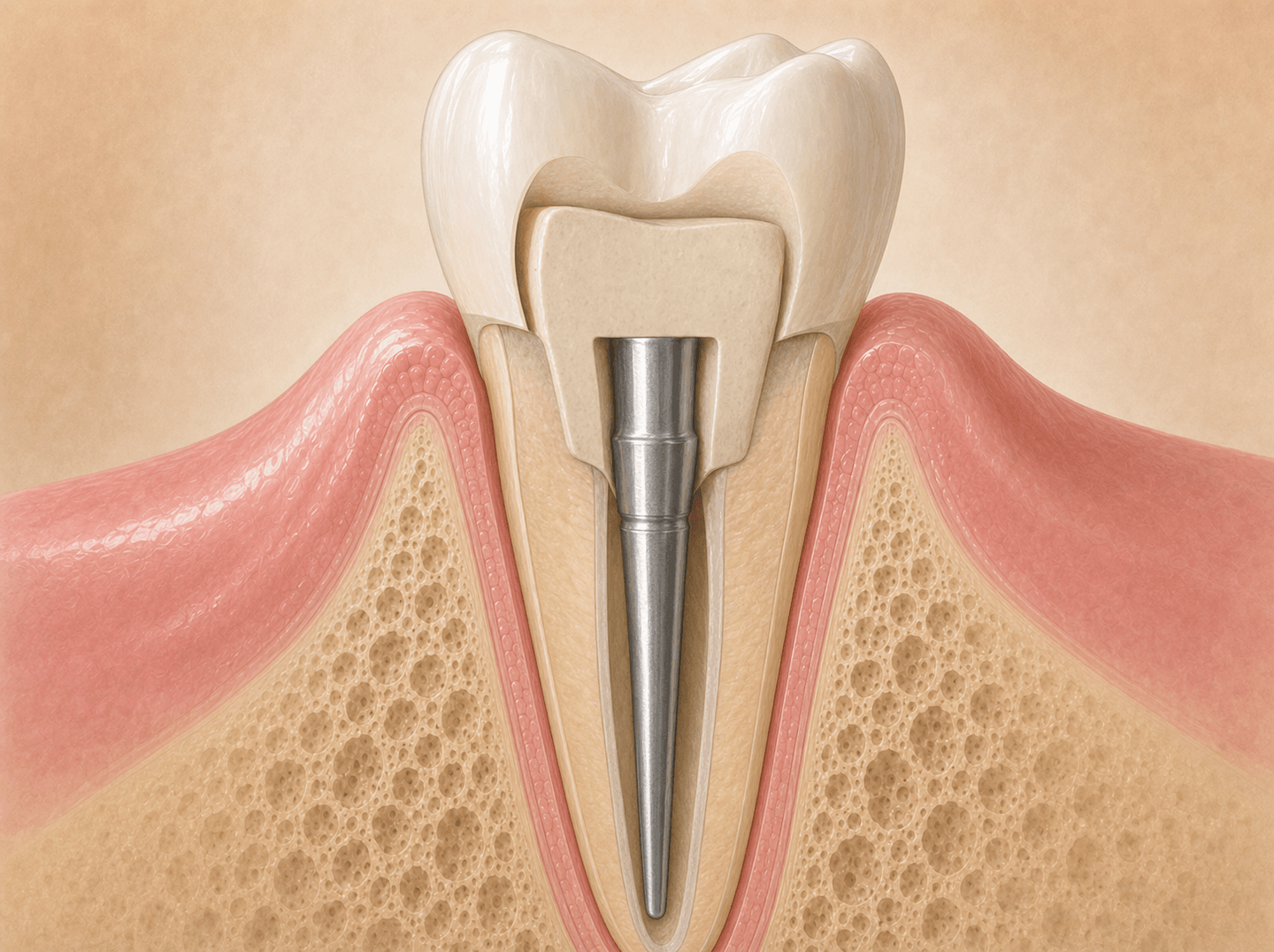
What D2954 covers
D2954 reports a prefabricated post and core placed in addition to a crown. The post is a stock, manufactured post that comes in standard sizes and shapes. The dentist selects one that fits the prepared canal, cements it, and builds core material around it so the crown has enough structure to seat on. The code covers both the post and the core.
The clinical setting is a tooth that has had a root canal and has lost enough coronal structure that a crown can’t be retained on the remaining tooth alone. The post extends retention into the canal space the endodontic treatment created. The core rebuilds the part of the tooth missing above the gumline.
Bill D2954 when:
- The tooth has been endodontically treated.
- There isn’t enough coronal structure left to retain the crown on the tooth alone.
- A prefabricated (stock) post is cemented into the canal.
- Core material is built up around the post to support the crown.
Do not bill D2954 for:
- A buildup with no post, on a vital or root-canal-treated tooth. That’s D2950.
- A custom lab-fabricated post and core. That’s D2952.
- A second post on the same tooth. That is D2957, not another first-post code.
- The crown itself. The crown is its own code (D2740, D2750, and so on), and D2954 goes on its own line in addition to it.
D2954 vs D2952: the prefab-vs-cast axis
The two are confused most often, and they pay differently.
- D2954 is a prefabricated post and core. The post is a stock item placed chairside, with no lab fabrication.
- D2952 is an indirectly fabricated post and core. The post is custom-made, usually by the lab, when a stock post won’t fit or hold. An impression or scan goes out, a custom post comes back, and a second appointment seats it.
The axis is how the post is made, not the material and not whether the tooth is anterior or posterior. A metal post and a fiber post can both be prefabricated and both billed under D2954.
D2954 vs D2950: post-and-core vs buildup
D2950 is a core buildup with no post. It rebuilds a tooth that has lost structure, either a vital tooth or a root-canal-treated tooth with enough remaining structure that no post is needed, so a crown has something to grip.
D2954 is a post and core. It only applies to an endodontically treated tooth, because the post seats in the canal space the root canal created.
The question that decides it: is a post going into the canal? If yes, it’s a post and core (D2954 prefabricated, or D2952 cast). If not, it’s a buildup (D2950), even on a root-canal-treated tooth.
Additional posts on the same tooth
A tooth occasionally needs more than one post, most often a multi-rooted tooth with posts in more than one canal.
- D2957 reports each additional prefabricated post on the same tooth, billed alongside D2954 for the first post and core.
- D2953 reports each additional indirectly fabricated (cast) post on the same tooth. It pairs with D2952.
Match the additional-post code to the primary post. A D2954 first post with a D2953 additional post is mismatched and will draw a question.
Coverage reality: bundling and necessity
How a post and core is paid varies more by plan than most restorative codes. Two patterns recur.
Bundling. Some plans treat the post and core as part of the crown and won’t reimburse it separately. The EOB reads as inclusive or bundled into the crown fee. That is the plan’s stated policy, not a coding error, so it is not appealable as a mistake. Confirm whether the plan bundles before you quote the patient.
Necessity documentation. Plans that pay the post and core separately usually want proof the tooth was endodontically treated and that the remaining structure couldn’t hold the crown. Pre-operative and post-operative radiographs are the standard ask, sometimes with a one-line narrative. Without them, the claim pends or denies.
One carrier paying D2954 at a clean allowable tells you nothing about the next plan. Verify before fabrication, not after the EOB.
Documentation that supports the claim
The chart note and claim should show that the tooth needed a post and core and that the post was the type you billed.
- Tooth number and endodontic history. Note that the tooth was root-canaled, and when if recent.
- Why a post was needed. The amount of remaining coronal structure and why the crown couldn’t be retained without a post. “Insufficient coronal structure to retain the crown” is the standard framing carriers look for.
- Post type. Prefabricated (stock) for D2954. A custom lab-fabricated post is D2952, supported by the lab invoice. This line defends the code against a downgrade.
- Radiographs. A pre-operative film showing the compromised tooth and a post-operative film showing the post seated. These are the most-requested attachments on these claims. Many systems store images at the patient level by default, so link them to the D2954 line on the claim.
Put D2954 on its own line in addition to the crown. If the carrier accepts a narrative, one sentence naming the tooth, the endodontic treatment, and the insufficient remaining structure is usually enough.
FAQs
- What is the difference between D2954 and D2952?
- How the post is made. Both report a post and core placed in addition to a crown on an endodontically treated tooth. D2954 is a stock, off-the-shelf post in standard sizes, cemented chairside. D2952 is an indirectly fabricated post and core, custom-made by the lab (or in-office) when a stock post won't fit or hold. D2952 usually carries a higher allowable, so if the chart shows a stock post but the claim says D2952, expect a downgrade to D2954 or a request for the lab invoice.
- Does D2954 include the core, or do I bill a buildup separately?
- D2954 includes the core. The descriptor is a post and core, so do not bill a core buildup (D2950) on the same tooth on top of it. D2950 is a separate code for a tooth that needs a buildup with no post, whether vital or root-canal treated. One tooth gets the post-and-core code or the buildup code, not both.
- Can I bill D2954 on a tooth that hasn't had a root canal?
- No. A post goes into a root canal space, so D2954 only applies to an endodontically treated tooth. A vital tooth that needs structure rebuilt to hold a crown takes a core buildup (D2950). Billing D2954 on a non-endo tooth is a coding error a carrier will catch.
- What code do I use for a second post on the same tooth?
- D2957, each additional prefabricated post on the same tooth, billed alongside D2954 for the first post and core. The cast equivalent is D2953, which pairs with D2952. Match the additional-post code to the type of primary post; don't pair a D2954 first post with a D2953 additional post.
- Why did the carrier deny or bundle my D2954 claim?
- Usually bundling or necessity. Some plans treat the post and core as included in the crown fee. Others cover it only with documentation that the tooth was endodontically treated and lacks enough coronal structure to retain the crown without a post, which most carriers want shown with pre-op and post-op radiographs and a short narrative. This is plan-dependent, so verify the plan before you set the patient's estimate.
Related codes
Need help billing this code?
We handle D2954 claims daily.
If your team is spending time on denials, narratives, or carrier follow-up for this code, our outsourced dental insurance billing service can take it off your plate. We submit the claims, post what comes back, and follow up on anything unpaid.
“Claims, posting, denials, all of it gets handled, and it costs far less than hiring another employee. My front desk got hours of their week back, and honestly I just don't think about billing anymore.”
CDT codes are maintained by the American Dental Association. This page is an editorial billing guide, not the official ADA code descriptor. Verify current coverage policies with each carrier before submitting claims.