D3910 is the CDT code for surgery to isolate a tooth with a rubber dam, usually because too little crown is left for a clamp.
- When to use: Too little crown is left to hold a clamp, so tissue must be surgically reflected or removed before the dam can go on.
- When not to use: Routine dam placement is part of the procedure, gum trimming for restorative access is D4212, and bone removal to lengthen the crown is D4249.
- Billing note: Many plans bundle D3910 into the related procedure, so expect no payment and send x-rays or photos showing the missing crown structure.
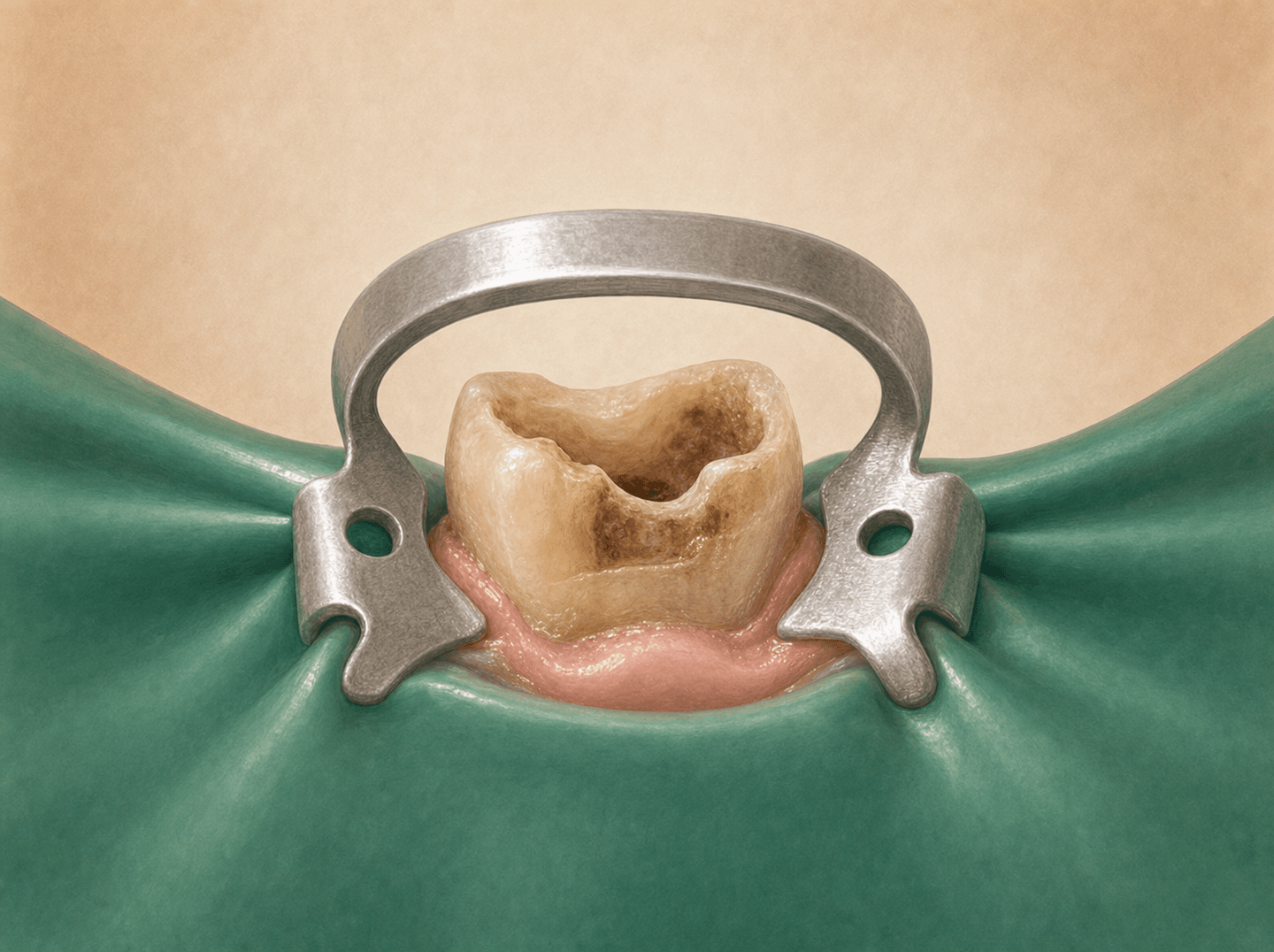
Routine dam placement is not D3910
A rubber dam is standard isolation for endodontic treatment, and its placement is part of the procedure. The AAE’s 2026 coding guide shows this in its own clinical scenarios: multi-visit endodontic cases describe the anesthetic, the rubber dam, and the access opening in the narrative, and none of the codes reported for them is D3910.
The code’s name says what it is for: a surgical procedure to make isolation possible. The surgery is the service, not the dam. CDT adds no descriptor beyond that name, so it sets no documentation standard, flap requirement, or list of qualifying situations. Those come from payer policies.
What makes a case qualify
D3910 typically fits a tooth that cannot hold a clamp as it stands. Common situations:
- A tooth fractured or decayed to the gumline before root canal treatment, where gum tissue covers the margin a clamp would grip.
- Tissue overgrowth over a broken-down tooth that blocks a clamp from seating.
Payers that publish criteria ask for documented need. Premera’s 2026 code list for employer groups asks for a narrative and a pre-op x-ray showing the lack of tooth structure. California Dental Network’s clinical guidelines (2017, carried into its 2019 edition) let members be charged for D3910 only with radiographic, photographic, or detailed narrative evidence of too little crown left to place a dam, and required the procedure to include a gingival flap, with or without bone removal. Laser or electrosurgical tissue removal that looked like hemostasis or operator convenience did not qualify without that evidence.
The flap requirement is one network’s older rule, not part of the code, and other payers may set different criteria. The shared thread is evidence of missing crown structure: a short note saying “dam placed with difficulty” is unlikely to support the line on any plan.
D3910, D4212, or D4249
All three remove or move tissue around a single tooth. The reason for the surgery decides the code.
- D3910 is surgery done so the tooth can be isolated with a dam, usually ahead of endodontic treatment.
- D4212 is gingivectomy or gingivoplasty on one tooth to give access for a restorative procedure, such as exposing a subgingival margin for a filling or crown.
- D4249 is clinical crown lengthening that removes bone to expose sound tooth structure for a restoration.
When the same tissue removal serves both the dam and the later restoration, bill it once, under the code the note supports. Two codes for one surgical step is unbundling.
What payers do with it
Payment is rare. PEHP’s 2026 CDT code guide lists D3910 as not covered, with payment bundled into the related procedure. Medi-Cal Dental’s fee schedule marks it global, its term for treatment done with another procedure and not paid separately. UnitedHealthcare lists D3910 among the applicable codes in its surgical endodontics clinical policy (DCP010.15, effective May 2026), which means a claim may be reviewed against that policy.
A bundled service is often not chargeable to the patient by a contracted provider. Before the visit, ask how the plan treats D3910 and whether a disallowed amount can be collected.
A denial scenario
A premolar, #13, is fractured to the gumline and needs root canal treatment. The dentist uses a laser to trim tissue around the margin, places the clamp, and completes D3320. The claim adds D3910 with the note “laser troughing for dam placement” and no photo.
The D3910 line comes back as included in the root canal fee. With nothing showing the lost crown structure, there is little to appeal with; the chart reads like routine soft-tissue management. Had the office attached the pre-op radiograph showing the fracture at the tissue line and a photo of the clamp failing to seat, the line would still face the plan’s bundling rule, but the record would support it on plans that pay. The same applies on anterior and molar cases billed with D3310 or D3330.
Sealing the canal openings afterward is a different line. That is the D3911 intraorifice barrier, which many plans also bundle.
FAQs
- Is there a CDT code for placing a rubber dam?
- No, not for routine placement. Isolating a tooth with a rubber dam is part of the root canal, filling, or other procedure it supports. D3910 exists for the surgical step needed when the tooth cannot be isolated without it, such as reflecting gum tissue on a tooth broken down to the gumline.
- Does insurance pay for D3910?
- Usually not as a separate line. PEHP's 2026 code guide lists D3910 as not covered with payment bundled into the related procedure, and Medi-Cal Dental marks it global. Some commercial plans list it, often with documentation conditions. Check the plan, and check whether your contract lets you bill the patient for a bundled service.
- What documentation supports D3910?
- Evidence that the remaining crown could not hold a clamp. A pre-op radiograph or intraoral photo showing the tooth broken at or near the gumline carries most of the weight, backed by a note describing the surgical step. A narrative alone is weak when the chart shows only a laser or cautery trough.
- Can D3910 be billed with D4212 on the same tooth?
- Not for the same tissue work. If gum tissue was removed to give access for the restoration, that is D4212, and billing D3910 for the same step reports it twice. Pick the code that describes why the surgery was done: isolation for the dam, or restorative access.
Related codes
Need help billing this code?
We handle D3910 claims daily.
If your team is spending time on denials, narratives, or carrier follow-up for this code, our outsourced dental insurance billing service can take it off your plate. We submit the claims, post what comes back, and follow up on anything unpaid. Already sitting on older claims that never paid? Our AR cleanup project works the backlog.
“Claims, posting, denials, all of it gets handled, and it costs far less than hiring another employee. My front desk got hours of their week back, and honestly I just don't think about billing anymore.”
CDT codes are maintained by the American Dental Association. This page is an editorial billing guide, not the official ADA code descriptor. Verify current coverage policies with each carrier before submitting claims.