D3320 is the CDT code for a completed root canal on a permanent premolar, covering the access, cleaning, shaping, and filling of the canals, with the crown or filling that rebuilds the tooth billed separately. The tooth type sets the code, not the actual canal count.
Premolars sit in the middle of the endo fee schedule between D3310 (anterior) and D3330 (molar), and the billing is mostly the same. The wrinkle is canal anatomy: upper first premolars frequently have two canals, and carriers sometimes question whether the case was really a D3320 and not a D3310.
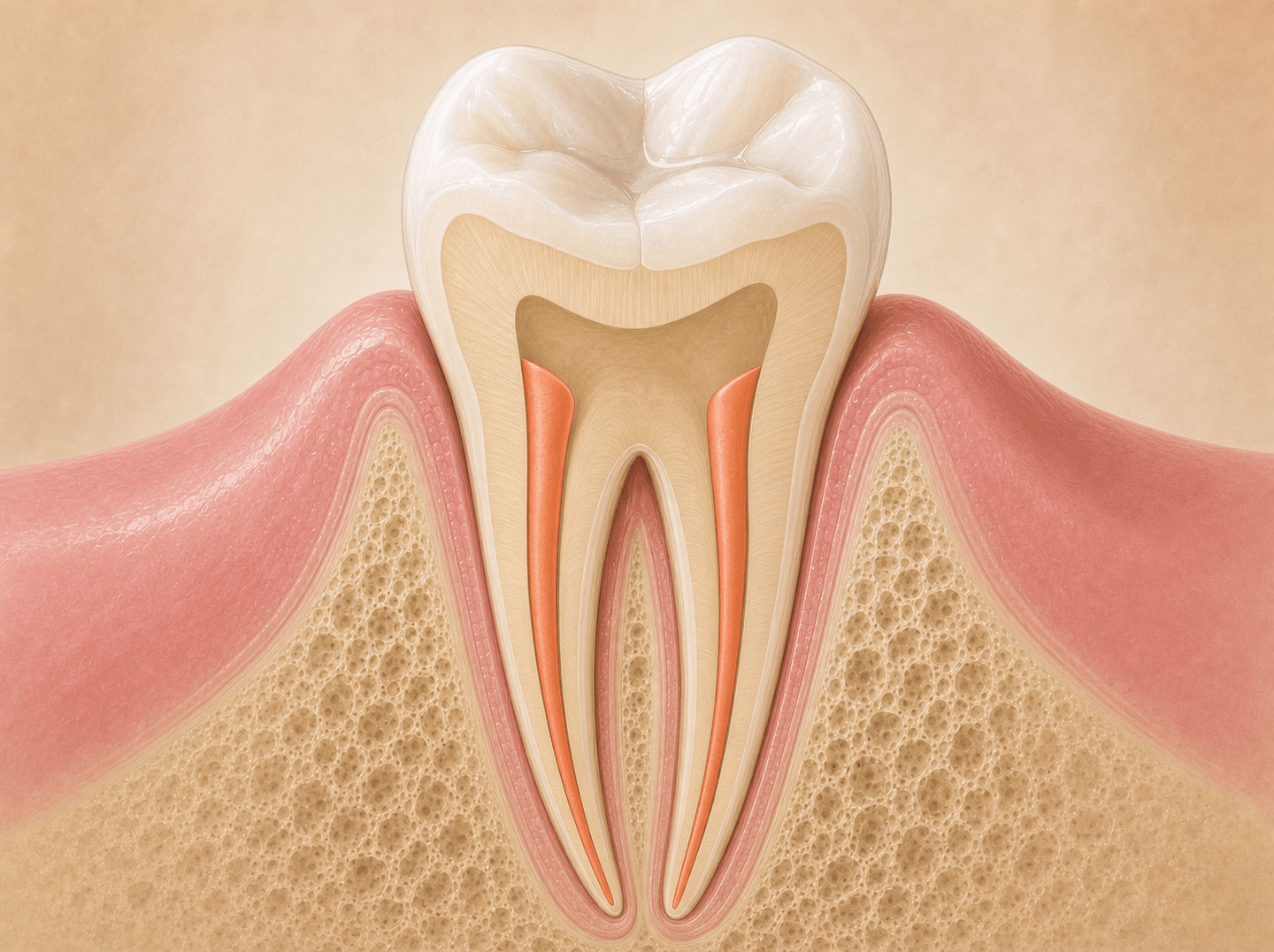
What D3320 covers
D3320 reports complete endodontic therapy on a permanent premolar, still called a bicuspid in a lot of offices. That includes the first and second premolars in both arches (typically teeth #4, #5, #12, #13, #20, #21, #28, #29). The procedure covers opening the tooth, debriding the pulp chamber and canals, shaping and cleaning, and obturating with a permanent root canal filling material. Routine intraoperative radiographs and the temporary restoration placed at the completion appointment are included.
It does not cover:
- Anterior root canal therapy. Use D3310.
- Molar root canal therapy. Use D3330.
- Retreatment of a previously root-canaled premolar. Use D3347.
- Pulpotomy or interim pulpal treatment. Use D3220 or D3221.
- Apicoectomy on a premolar. Use D3421.
- The final restoration (buildup, crown, or direct restoration). Those are separately billable.
When to bill D3320
Bill D3320 when:
- A premolar tooth has been diagnosed with pulpal pathology and root canal therapy has been completed.
- The obturation is complete with a permanent root canal filling material.
- The tooth has been temporized for the patient to return for final restoration.
Do not bill D3320 for:
- Incomplete treatment. The obturation must be finished.
- Anterior or molar teeth, regardless of how many canals are present.
- A retreatment of a previously root-canaled premolar. Use D3347.
- The final restoration.
The billing date is the date of obturation, not the date treatment started. Multi-visit endo cases are billed on the completion visit.
D3320 versus D3310 and D3330
The three endodontic therapy codes are divided by tooth type:
- D3310: Anterior teeth (incisors and canines). Typically one canal.
- D3320: Premolars. Typically one to two canals.
- D3330: Molars. Typically three or more canals.
The code follows the tooth, not the canal count. An upper first premolar with two canals is D3320. A lower second premolar with a single canal is also D3320. A mandibular incisor with two canals (anatomically possible) is still D3310.
This matters because carriers price the three codes at different allowables. D3310 has the lowest allowable, D3320 sits in the middle, and D3330 has the highest. The fee difference reflects the average complexity of each tooth category. You don’t get to code a two-canal premolar as D3330 because “it had molar-level complexity.” The tooth type is the deciding factor.
Top reasons D3320 gets denied
Five patterns account for most D3320 denials and pends:
- Missing radiographs. Pre-op and post-op periapicals are required by virtually every carrier. The pre-op shows the diagnosis (periapical pathology, caries into the pulp, fracture). The post-op shows complete obturation. Missing either one pends the claim.
- Retreatment coded as initial therapy. D3320 was billed on a premolar that already had endo. The carrier sees the existing fill on the pre-op film and denies. Retreatment of a premolar is D3347.
- Waiting period not yet satisfied. Endodontic therapy is classified as a major service on many plans. New patients with recently effective coverage often hit 6-to-12-month waiting periods for major services. The claim will process and deny on the benefit limitation. Verify waiting-period status before starting treatment when possible.
- Frequency limitation (lifetime per tooth). One root canal per tooth, lifetime. If the carrier’s records show a previous D3320 on the same tooth (even from another provider), the claim denies. This is different from retreatment. A true re-do uses D3347 and has its own frequency rules.
- Same-day sequencing issues. Billing D3320 with D2950 (core buildup) and D2740 or D2750 (crown) on the same date triggers review at some carriers. The question is whether the buildup and crown were placed the same day as the RCT or at a subsequent visit. Some carriers deny the buildup or crown when billed same-day with the RCT, requiring a separate date of service.
Documentation that supports the claim
The claim needs:
- Pre-op periapical radiograph showing the tooth and the diagnostic indication.
- Post-op periapical radiograph showing complete obturation of all canals.
- Date of service (the obturation completion date).
- Correct tooth number.
- Narrative for unusual cases (post-trauma, previously treated tooth being retreated under D3347, unusual canal anatomy).
For the patient record, document:
- Diagnosis (irreversible pulpitis, pulpal necrosis, apical periodontitis).
- Pulp testing results (cold, electric, percussion, palpation).
- Number of canals located and treated.
- Working length for each canal.
- Obturation material.
- Planned final restoration (direct restoration, buildup plus crown, or crown alone).
- Patient instructions.
For upper first premolars with two canals, the post-op film showing both canals obturated is the strongest documentation. A single-canal post-op on a tooth known to commonly have two canals can raise questions about completeness, even though the code itself doesn’t require a minimum canal count.
Example case
A 41-year-old patient presents with spontaneous pain on tooth #5 (upper right first premolar). Cold testing produces a lingering response. The pre-op periapical shows deep distal caries approaching the pulp chamber with a small periapical radiolucency.
Treatment sequence:
- Visit 1: access opened, single canal located and instrumented to working length, calcium hydroxide placed, temporary restoration.
- Visit 2 (one week later): obturation completed with gutta percha, post-op periapical confirms fill to the apex, temporary restoration placed.
Billing steps:
- Submit D3320 on the date of obturation (visit 2). Attach pre-op and post-op periapicals.
- No special narrative needed. The pre-op film clearly shows the caries and periapical pathology.
- Schedule the patient for a buildup (D2950) and crown (D2750) at a subsequent visit. Bill those on their own date of service.
- If the carrier denies for waiting period or frequency, verify the patient’s benefit effective date and prior claims history before appealing.
What to get right in your PMS
- Code by tooth type, not canal count. D3310 for anterior, D3320 for premolar, D3330 for molar. No exceptions.
- Post on the date of obturation, not the start date. Multi-visit endo cases are billed when the fill is complete.
- Attach pre-op and post-op films to the claim. The carrier only sees images attached at the claim level, not images stored at the patient level in your PMS.
- Check the pre-op film for prior endodontic treatment. If the tooth already has a fill, the code is D3347 (premolar retreatment), not D3320.
- Separate the RCT date from the buildup and crown date when possible. Billing D3320 on one date and D2950 plus crown on a subsequent date avoids the same-day sequencing denials that some carriers enforce.
- Verify waiting periods on new patients before scheduling endo. A plan with a 12-month waiting period on major services will deny D3320 regardless of clinical necessity. The patient needs to know the financial exposure up front.
FAQs
- What's the difference between D3310, D3320, and D3330?
- Tooth type, not canal count. D3310 is anterior teeth (incisors and canines). D3320 is premolars. D3330 is molars. The code follows the tooth, even if the actual number of canals is unusual for that tooth type.
- Can I bill D3320 again if the premolar root canal fails?
- No. Retreatment of a previously root-canaled premolar uses D3347, not D3320. If you rebill D3320 on a tooth that already has endo, the carrier will see the existing fill on the pre-op film and deny or audit the claim.
- Does a premolar always need a crown after root canal?
- Usually, but not always. Premolars with heavy structural loss, large existing restorations, or cusp fractures almost always need crowns (D2740 or D2750). A premolar with a conservative access and minimal prior restoration can sometimes be restored with a direct restoration, though this is less common than on anterior teeth.
- Do I need to document the number of canals for D3320?
- Yes. The code doesn't require a specific canal count, but the post-op radiograph should clearly show all treated canals. For upper first premolars with two canals, a clear post-op film showing both canals obturated prevents questions about completeness of treatment.
- Why is the D3320 allowable higher than D3310 if the procedure is similar?
- Premolars are anatomically more variable than anterior teeth. Upper first premolars commonly have two canals and bifurcated root anatomy that adds treatment time and complexity. The fee differential reflects the average case complexity across the tooth category, not any individual procedure.
Related codes
Need help billing this code?
We handle D3320 claims daily.
If your team is spending time on denials, narratives, or carrier follow-up for this code, our outsourced dental insurance billing service can take it off your plate. We work inside your PMS and post payments the same week.
CDT codes are maintained by the American Dental Association. This page is an editorial billing guide, not the official ADA code descriptor. Verify current coverage policies with each carrier before submitting claims.