D4341 is the CDT code for scaling and root planing, the deep cleaning below the gumline, in a quadrant with four or more qualifying teeth.
- When to use: Scaling and root planing in a quadrant with four or more teeth affected by periodontitis.
- When not to use: One to three teeth is D4342, gingivitis without bone loss is D4346, and cleanings after SRP are D4910.
- Billing note: Most carriers want 4mm or deeper pockets with bleeding, so attach a six-point perio chart and dated x-rays showing bone loss.
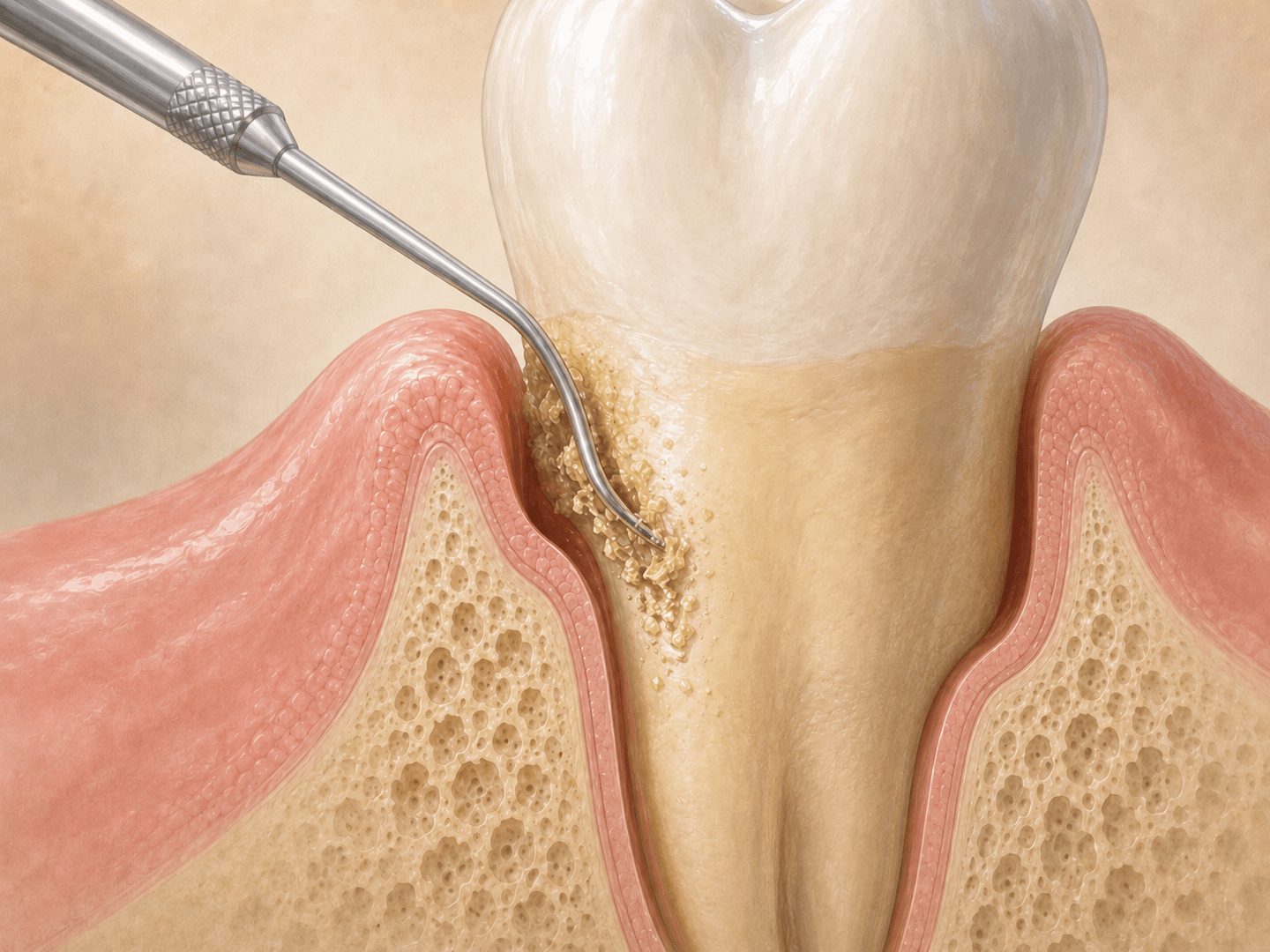
What D4341 covers
D4341 reports scaling and root planing in a quadrant with four or more teeth involved. The procedure removes plaque, calculus, and bacterial toxins from the root surfaces below the gumline. It is active periodontal therapy, distinct from a prophylaxis (D1110) and from periodontal maintenance (D4910).
Most carriers define a qualifying tooth as one with pocket depths of 4mm or greater, bleeding on probing, and radiographic evidence of bone loss. The clinical record should support a periodontitis diagnosis, not just gingivitis.
When to bill D4341
Bill D4341 when a quadrant has four or more teeth with pockets of 4mm or greater, those teeth bleed on probing, radiographs show bone loss consistent with periodontitis, and the diagnosis is periodontitis, not gingivitis.
Do not bill D4341 for:
- A quadrant with one to three qualifying teeth. Use D4342.
- Full-mouth gingivitis with no bone loss, or isolated 4mm pockets with no other perio signs. That is generally D4346 or a prophy.
- Recall visits after the patient has completed active SRP. Use D4910.
- Full-mouth debridement for a patient who can’t be evaluated until calculus is removed. Use D4355.
Top reasons D4341 gets denied
- Perio chart gaps. The submitted chart doesn’t show pocket depths, bleeding on probing, or both. Selective charting is the most common reason carriers ask for “additional information.”
- No radiographic bone loss. The films don’t support periodontitis. The case might be gingivitis (D4346) but was coded as SRP.
- Frequency exceeded. The quadrant had SRP within the carrier’s lookback window, often 24 months.
- Quadrant designation wrong. The teeth charted as the upper-right quadrant don’t match the quadrant billed on the claim. A common bookkeeping error.
- Pre-determination required. Some plans require predetermination on perio claims, and a claim submitted without it pends or denies. Submit the predet before treatment starts.
- Diagnosis-procedure mismatch. The chart shows gingivitis, the claim shows SRP. The carrier corrects to D4346 or denies.
What goes in an audit-proof perio chart
Most D4341 denials are documentation problems, not clinical problems. For the affected quadrant, the chart that survives an audit shows:
- Probing depths at six sites per tooth (mesio-buccal, buccal, disto-buccal, mesio-lingual, lingual, disto-lingual). A chart that records only the worst pocket per tooth is not enough.
- Bleeding on probing marked at each site where it occurred.
- Recession measured if present.
- Mobility charted if present.
- Furcation involvement charted if present.
- Radiographic bone loss visible on the films, with the date the films were taken.
- Periodontal diagnosis documented in the chart note (generalized chronic periodontitis, localized aggressive periodontitis, etc.).
Attach the perio chart and radiographs to the SRP claim, with a quadrant designation that matches the charted teeth. If the carrier asks for more information, it almost always asks for these items, so sending them with the first submission keeps the claim out of the pending queue.
Frequency and the four-quadrant cycle
Carriers typically pay SRP once per quadrant every 24 months. A patient with full-mouth periodontitis can have all four quadrants done as separate visits, or in two appointments of two quadrants each, and each quadrant resets its own clock.
Some plans require a re-evaluation visit between quadrants. It is usually reported as D0180 (comprehensive periodontal evaluation) or another perio code, not a separate D4341 line.
After active therapy, the patient moves to D4910 maintenance, usually on a three-month recall. Scheduling recall as D1110 instead breaks the documentation trail and causes problems later.
D4341 versus D4342
The difference is the count of teeth in the quadrant that meet the SRP threshold:
- D4341: four or more teeth per quadrant.
- D4342: one to three teeth per quadrant.
A patient can have D4341 in one quadrant and D4342 in another at the same visit. Each quadrant is its own claim line with its own frequency clock.
Coding all four quadrants as D4341 when one really qualified as D4342 is a common overstatement. Carriers cross-reference the perio chart and correct on audit.
Example case
A 47-year-old established patient presents for a comprehensive periodontal evaluation. The perio chart records 12 sites with 5mm or 6mm pockets across the upper-right and lower-left quadrants, with bleeding on probing at most of them. Bitewings and a panoramic show generalized horizontal bone loss of 2-3mm. The diagnosis is generalized chronic periodontitis, stage II.
Billing steps:
- Document the six-point probing chart, bleeding on probing, and bone loss in the patient record.
- Submit D0180 for the comprehensive perio evaluation.
- Schedule the SRP as two appointments (one per quadrant pair) or four (one per quadrant), depending on practice protocol.
- If the plan requires pre-determination, submit it before treatment starts.
- Submit D4341 for each qualifying quadrant with the perio chart and films attached.
- Move the patient to D4910 maintenance once active therapy is complete.
FAQs
- How do I decide between D4341 and D4342?
- Count the teeth in the quadrant that meet the SRP threshold, typically pocket depth of 4mm or greater with bleeding on probing and radiographic bone loss. Four or more such teeth is D4341; one to three is D4342. The count is per quadrant, not full mouth, and only qualifying teeth count.
- Why do carriers require radiographs for SRP claims?
- To confirm radiographic bone loss, which justifies SRP over a deep prophy or gingivitis treatment. A perio chart alone is not enough for most carriers. The films do not have to show severe bone loss, but they must support a periodontitis diagnosis, not just gingivitis.
- How often will a plan pay for D4341?
- Most plans pay D4341 once per quadrant every 24 months, and some go as long as 36 months. Because the limit runs per quadrant, a patient can complete all four quadrants in one course of therapy without hitting a frequency wall until each quadrant comes due again.
- Can I bill D4341 and a prophy on the same day?
- Generally no. D4341 is the active therapy for that quadrant, so a same-day prophy on the same teeth is duplicative. Some plans allow a prophy on the unaffected quadrants the same day, but most prefer the SRP visit to be its own appointment. Check the specific plan before billing both.
- What if the patient has 4mm pockets but no bleeding?
- Most carriers want both. A 4mm pocket without bleeding can be a recovering site or a stable pocket, and without bleeding on probing or radiographic bone loss the carrier may deny D4341 and require a correction to D4346 (gingivitis, full mouth) or D1110 (prophy).
Related codes
Need help billing this code?
We handle D4341 claims daily.
If your team is spending time on denials, narratives, or carrier follow-up for this code, our outsourced dental insurance billing service can take it off your plate. We submit the claims, post what comes back, and follow up on anything unpaid. Already sitting on older claims that never paid? Our AR cleanup project works the backlog.
“Claims, posting, denials, all of it gets handled, and it costs far less than hiring another employee. My front desk got hours of their week back, and honestly I just don't think about billing anymore.”
CDT codes are maintained by the American Dental Association. This page is an editorial billing guide, not the official ADA code descriptor. Verify current coverage policies with each carrier before submitting claims.