D4342 is the CDT code for scaling and root planing in a quadrant where one to three teeth meet the periodontitis threshold.
- When to use: One to three teeth in the quadrant have 4 mm or deeper pockets, bleeding on probing, and bone loss, however many healthy teeth surround them.
- When not to use: Four or more qualifying teeth is D4341, generalized gingivitis with no bone loss is D4346, and recall after active therapy is D4910.
- Billing note: Carriers deny or downgrade it when the claim lacks a six-point chart with bleeding marked and radiographs showing bone loss, so attach both.
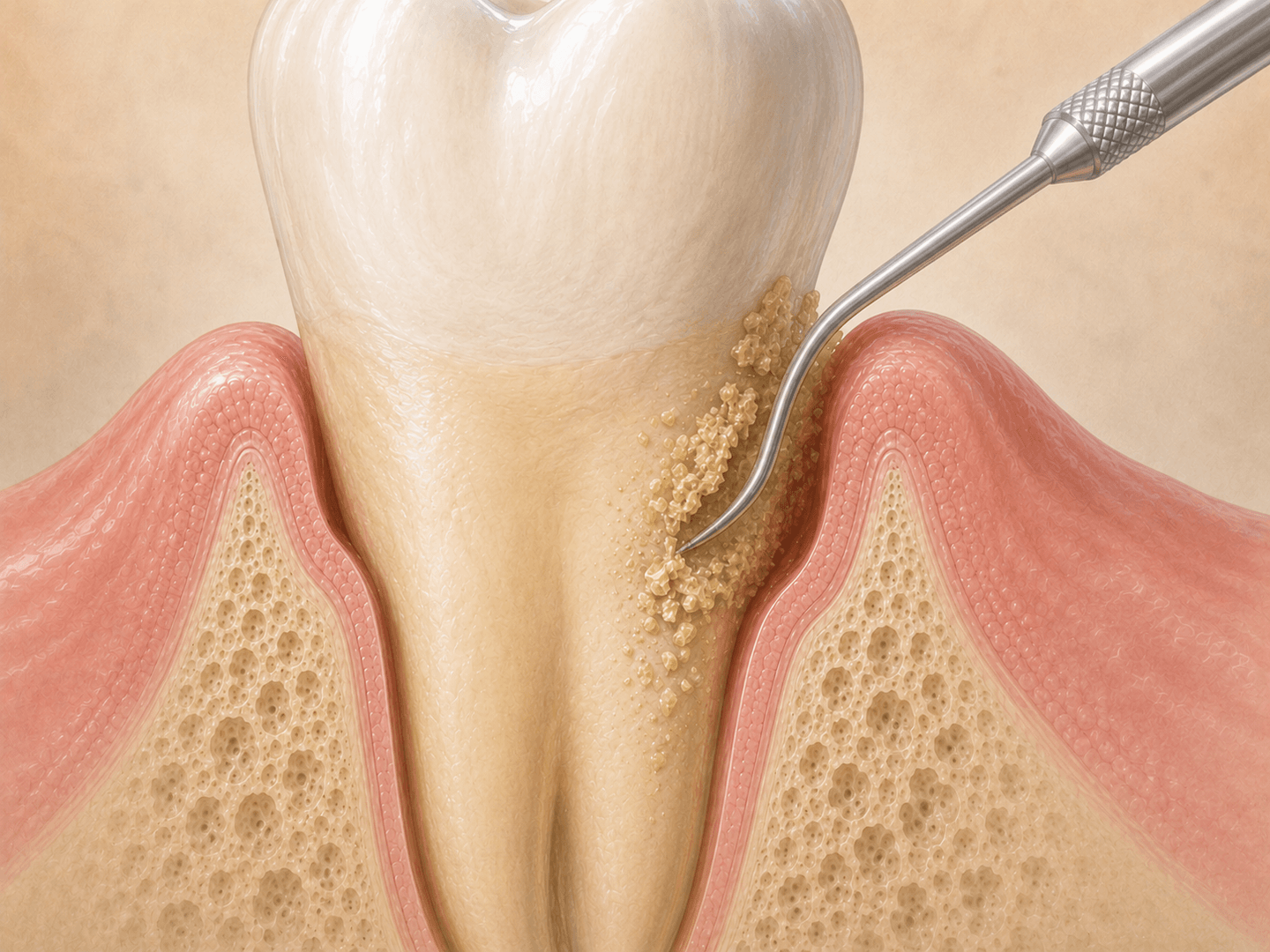
What D4342 covers
D4342 reports scaling and root planing on one, two, or three teeth in a quadrant: removal of plaque, calculus, and bacterial toxins from root surfaces below the gumline. The procedure and clinical threshold are the same as D4341; only the number of qualifying teeth differs.
Each qualifying tooth needs pocket depths of 4mm or greater, bleeding on probing, and radiographic bone loss. That is a periodontitis diagnosis, not gingivitis.
It does not cover:
- Four or more qualifying teeth in a quadrant. Use D4341.
- Generalized gingivitis with no bone loss. Use D4346.
- Maintenance recall after active therapy. Use D4910.
- Routine prophy on a periodontally healthy patient. Use D1110.
When to bill D4342
Bill D4342 when one, two, or three teeth in a quadrant have 4mm or deeper pockets, bleeding on probing at those sites, and radiographic bone loss at those teeth.
Isolated 4mm pockets with no bleeding and no radiographic bone loss do not qualify. That case is probably a prophy or gingivitis, not SRP.
D4342 versus D4341: count by qualifying teeth
The line between D4341 and D4342 is the number of teeth in the quadrant that meet the SRP threshold, not the number of teeth in the quadrant.
Examples:
- A quadrant has eight teeth. Three have 5mm pockets with bleeding; the other five are healthy. Bill D4342.
- A quadrant has six teeth. Four have 4mm-6mm pockets with bleeding; the other two are healthy. Bill D4341.
- A quadrant has seven teeth. Two have 4mm pockets with bleeding; the other five are at 3mm with no bleeding. Bill D4342.
Billing D4341 when only two or three teeth qualify overstates the case. The fee difference is significant, carriers cross-check against the perio chart, and the audit history hurts future claims for the same patient.
Top reasons D4342 gets denied
- Documentation gaps. The perio chart doesn’t show pocket depths or bleeding on probing at the affected teeth, and the carrier denies for “insufficient information.”
- Should have been D4341. The quadrant actually had four or more qualifying teeth. The carrier may correct upward (uncommon) or deny pending the right code.
- Should have been D4346 or D1110. The chart didn’t support a periodontitis diagnosis, so the carrier downgrades.
- Frequency exceeded. The same quadrant had SRP within the lookback window.
- Quadrant mismatch. The teeth charted don’t match the quadrant billed.
Documentation that supports the claim
The documentation standard is the same as for D4341, applied to fewer teeth. The claim needs:
- A six-point probing chart showing pocket depths at the affected teeth.
- Bleeding on probing marked at those sites.
- Recent radiographs showing bone loss at the affected teeth.
- A periodontitis diagnosis in the chart note.
- A quadrant designation that matches the charted teeth.
Example case
A 36-year-old patient presents for a comprehensive perio evaluation. Probing shows 4mm-5mm pockets with bleeding at teeth #18 and #19 in the lower left. The other teeth in the quadrant are healthy. Radiographs show localized bone loss at #18 and #19 only.
Billing steps:
- Chart six-point probing for the quadrant, with bleeding marked at the affected sites.
- Submit D0180 for the comprehensive perio evaluation.
- Submit D4342 for the lower-left quadrant with the perio chart and films attached.
- Schedule a periodontal re-evaluation about four to six weeks after SRP. Once active therapy is complete, move the patient to D4910 maintenance, commonly on a three-month interval. Returning a perio patient to D1110 prophy breaks the documentation trail.
FAQs
- When do I bill D4342 instead of D4341?
- When one to three teeth in the quadrant meet the SRP threshold (pocket depth of 4mm or greater, bleeding on probing, radiographic bone loss). Four or more is D4341. Only the count of qualifying teeth matters, not the total number of teeth in the quadrant.
- Can I bill D4342 if only one tooth needs SRP?
- Yes. A single tooth that meets the threshold qualifies for D4342, with the same documentation standard as a multi-tooth case.
- Why did the carrier downgrade my D4342 to a prophy?
- The documentation didn't support a periodontitis diagnosis. A single 4mm pocket without bleeding or bone loss reads as borderline gingivitis to most reviewers. If the chart shows isolated perio with clear documentation, appeal with the perio chart and radiographs.
- How often will a plan pay for D4342?
- Most plans pay D4342 once per quadrant every 24 months, the same as D4341, and some extend the lookback to 36 months. The clock runs per quadrant, so a patient who had D4342 in the upper right two years ago can have SRP in a different quadrant without hitting the cap. Verify the plan before treatment.
- Can D4341 and D4342 appear on the same claim for different quadrants?
- Yes. The codes are per quadrant, not per visit. A patient might have four qualifying teeth in two quadrants (D4341 on each) and two in another (D4342). All three lines can go on one claim with the perio chart and films attached, and each line carries its own frequency clock.
Related codes
Need help billing this code?
We handle D4342 claims daily.
If your team is spending time on denials, narratives, or carrier follow-up for this code, our outsourced dental insurance billing service can take it off your plate. We submit the claims, post what comes back, and follow up on anything unpaid. Already sitting on older claims that never paid? Our AR cleanup project works the backlog.
“Claims, posting, denials, all of it gets handled, and it costs far less than hiring another employee. My front desk got hours of their week back, and honestly I just don't think about billing anymore.”
CDT codes are maintained by the American Dental Association. This page is an editorial billing guide, not the official ADA code descriptor. Verify current coverage policies with each carrier before submitting claims.