D1110 is the CDT code for an adult prophy, the routine cleaning that removes plaque, calculus, and stains when the gums are healthy.
- When to use: A routine cleaning for a patient with healthy gums, chosen by the patient's teeth, not age.
- When not to use: Past SRP or perio surgery is D4910, full-mouth gingivitis is D4346, and a child with primary teeth is D1120.
- Billing note: Most plans pay two cleanings a year, and many apply an age-14 cutoff between D1110 and D1120.
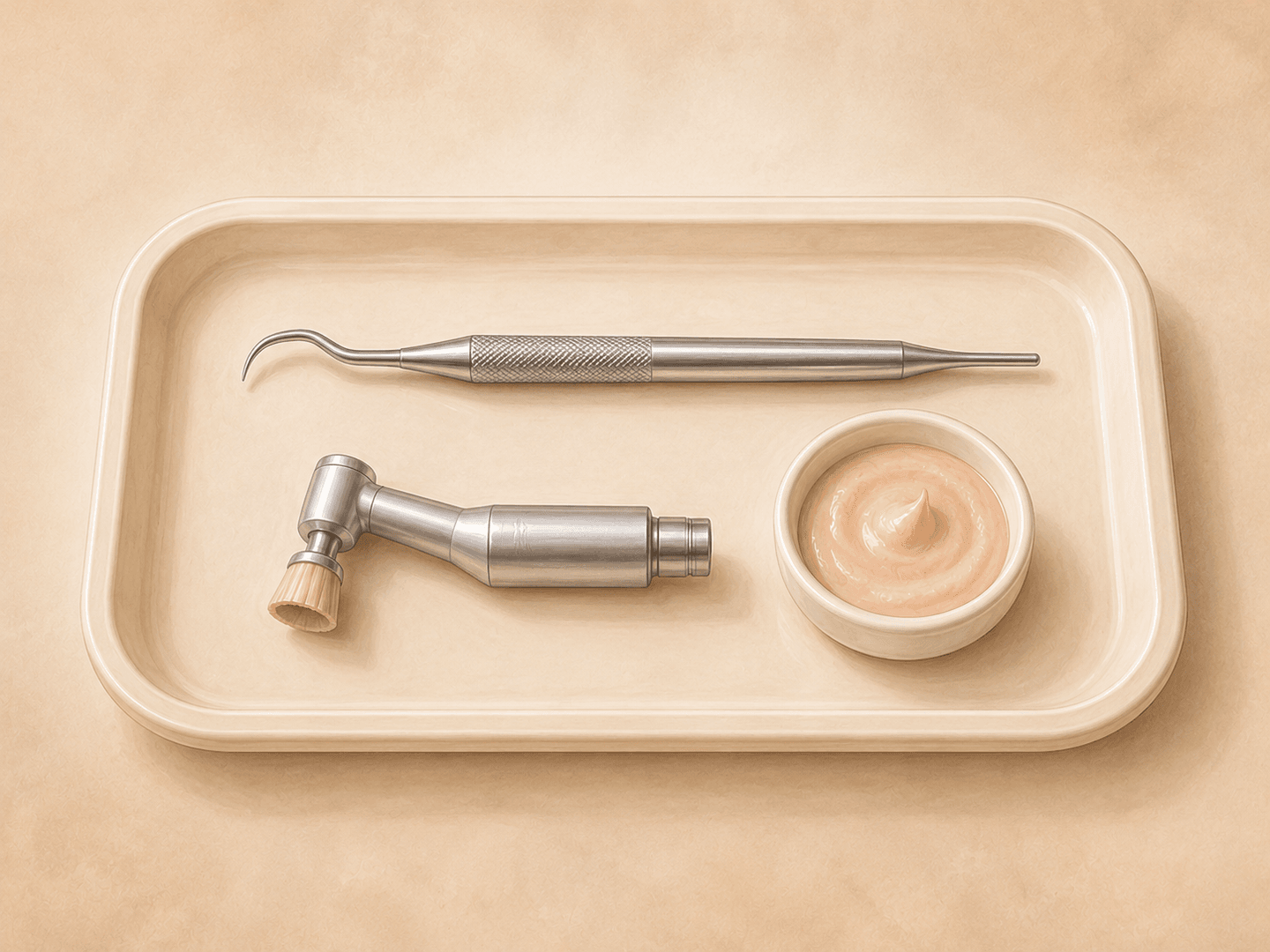
What D1110 covers
D1110 reports a prophylaxis in the permanent or transitional (mixed) dentition. The procedure includes removal of plaque, calculus, and stains from the supragingival and sub-gingival tooth surfaces (the parts of the tooth above and just below the gumline) where periodontal pockets are within healthy limits. Per the ADA, dentition (not the patient’s age) is the criterion that separates D1110 from the child prophy (D1120). The visit usually pairs with a periodic evaluation and may include polishing.
It does not cover:
- A patient still in primary dentition. Use D1120 (child prophylaxis). Transitional (mixed) dentition fits either code, so the plan’s age rule usually decides. The distinction is dentition, not age.
- A patient with active periodontal disease or post-SRP maintenance. Use D4910.
- Scaling on a patient with full-mouth gingivitis. Use D4346.
- Scaling and root planing for periodontal pockets. Use D4341 or D4342.
D1110 assumes a periodontally healthy patient. If the chart shows perio diagnosis, the code is generally wrong.
When to bill D1110
Bill D1110 when:
- The patient has permanent (or predominantly permanent) dentition. Per the ADA, dentition (not age) is the coding criterion, though most carriers use age 14 as a benefit proxy.
- The chart shows a periodontally healthy patient with no active perio diagnosis.
- The visit is a routine prophy, not a maintenance visit following SRP.
Do not bill D1110 for:
- Patients still in primary dentition. Use D1120. (A child with full permanent dentition is correctly D1110 regardless of age; the age cutoff some plans apply is a benefit rule, not the coding definition.)
- Patients with history of D4341, D4342, or perio surgery on the same dentition. Use D4910.
- Patients with full-mouth moderate to severe gingivitis. Use D4346.
- Periodontal recall after active perio therapy. Use D4910.
Top reasons D1110 gets denied
- Frequency. Most plans pay two prophy benefits per benefit year, often on a six-month interval. A patient seen at five months hits the cap.
- Perio history in carrier records. The carrier knows the patient had D4341 or D4342 in the past. Billing D1110 after that draws an automatic denial in favor of D4910.
- Plan age proxy. D1110 vs D1120 is selected by dentition, not age, so a 12-year-old with permanent dentition is correctly D1110, but many plans apply an age proxy (often 14) and will downcode or deny D1110 for a younger patient. When the dentition supports D1110, bill it and dispute an age-based downcode rather than recoding to D1120.
- Same-day eval bundling. The eval and prophy were billed together, and the plan bundles them under a single benefit. The prophy still pays. The eval line may zero out.
- Gingivitis case. A patient with full-mouth gingivitis should have been coded D4346. Carriers occasionally deny D1110 and require correction to D4346 when the clinical picture suggests it.
Documentation that supports the claim
The claim needs:
- Date of service.
- The patient’s dentition (and date of birth, which carriers use for their age-proxy benefit rules).
- A periodontally healthy status reflected in the chart.
For the patient record, document:
- Probing depths consistent with health (generally 3mm or less, no significant bleeding).
- Calculus removal performed.
- Polishing performed if it was part of the visit.
- Hygienist notes.
If the chart shows perio pocketing or bleeding on probing, D1110 is the wrong code for that visit, and the carrier may eventually catch it on audit.
D1110 versus the perio recall codes
The line between prophy and perio recall is one of the most frequent sources of confusion:
- D1110 assumes a healthy patient with no active perio diagnosis.
- D4910 assumes the patient has completed active periodontal therapy (typically D4341 or D4342, sometimes surgery) and is on a maintenance interval, usually every three months.
A patient who had SRP three years ago and has been seen for “prophy” every six months since may still belong on a D4910 protocol clinically. Some practices alternate D1110 and D4910 across the year. The plan’s benefit design and the patient’s chart drive which code is correct on a given visit.
Example case
A 38-year-old established patient comes in for a six-month recall. Probing depths are all 3mm or less. No bleeding on probing. No history of SRP or perio surgery. The hygienist completes a routine prophy. The dentist performs the recall exam.
Billing steps:
- Verify the patient has prophy benefits remaining for the benefit year.
- Code D1110 for the prophy and D0120 for the eval, same claim.
- Watch for either both lines paying, or one bundled into the other under the plan’s preventive benefit.
- If the prophy denies for perio history flag, pull the patient’s history. If perio therapy was actually performed at the practice in the past, switch to D4910 and resubmit.
What to get right in your PMS
- Code by dentition, then check the carrier’s age rule. D1110 vs D1120 is selected on the patient’s dentition (permanent/transitional vs primary/transitional), not age, but most plans enforce an age proxy (commonly 14) and may downcode based on age at the date of service. Confirm both before submission.
- Check the patient’s perio history in your own chart before submission. If the chart shows prior D4341 or D4342, the recall is probably D4910, not D1110.
- Submit prophy and eval together when both happen at the same visit. Splitting them across claims complicates posting.
- Confirm the carrier’s frequency cap counts benefit years, not calendar years. Some plans run benefit years on the patient’s enrollment anniversary.
- Use D4910 when the patient was previously treated for periodontal disease at the practice, even if it was years ago. Switching back to D1110 long-term is a common cause of audit issues.
FAQs
- When do I use D1110 versus D1120?
- The choice is based on dentition, not age. D1110 (adult prophy) is for the permanent or transitional (mixed) dentition; D1120 (child prophy) is for the primary or transitional dentition. The ADA's rule is explicit: dentition, not age, is the criterion. A child with full permanent dentition is correctly D1110 regardless of age. Many plans apply an age proxy (commonly 14) as a benefit rule and may downgrade D1110 to D1120 on that basis; that's a coverage convention to verify and appeal, not the coding definition.
- When should I use D4910 instead of D1110?
- Use D4910 when the patient has a documented history of periodontal therapy, typically prior D4341 or D4342 scaling and root planing, or periodontal surgery. Once a patient is on perio maintenance, the recall is D4910, not D1110. Some plans pay both alternately across the year, but the clinical record drives the code.
- Can I bill D1110 the same day as D0120?
- Yes, and this is the standard recall pattern. Both codes report on the same claim. Some plans bundle them under a single preventive benefit, but the codes still appear individually. The plan's benefit design decides how each line pays.
- Why did the carrier downgrade D1110 to a lower payment?
- Plans don't usually downgrade prophy by fee, but they sometimes apply a different benefit category. If the patient has perio history on file with the carrier, some plans will deny the D1110 entirely and only pay if the claim is corrected to D4910. The reverse also happens when D4910 is billed without documented perio history.
Related codes
Need help billing this code?
We handle D1110 claims daily.
If your team is spending time on denials, narratives, or carrier follow-up for this code, our dental insurance verification service can take it off your plate. We submit the claims, post what comes back, and follow up on anything unpaid.
“Claims, posting, denials, all of it gets handled, and it costs far less than hiring another employee. My front desk got hours of their week back, and honestly I just don't think about billing anymore.”
CDT codes are maintained by the American Dental Association. This page is an editorial billing guide, not the official ADA code descriptor. Verify current coverage policies with each carrier before submitting claims.